Ros and Ray are old hippies made good. She’s a hard-bitten, hard-working teacher in an inner-city Pennsylvania school where her pupils rob 7-Elevens on Fridays and the staff have a betting pool on how many times she gets called "white bitch". He’s a member of the one percent, a corporate heavyweight who’s always trying to see “the bigger picture” but who drives a Merc and – by his own admission – pulled himself out of poverty to become a wealthy financier.
Even on the cusp of retirement they’re still besotted with each other, their love conversely made stronger by the frank acknowledgement that each needs the other: she needs his stability, while he needs her practical idealism. They balance each other out, consciously. Whatever they are, they’re clear-sighted – they’re not hypocrites.
 Of the other characters, Christopher was the child of their next-door neighbours. He’s a waif, semi-abandoned by his globe-trotting parents and in thrall to Ros and Ray’s life which combines mean edges with distinct comfort. He’s engaged to Molly and writing a PhD proposal on the representation of black men in advertising. Molly, before she gets pregnant, rankles Ros no end with a peculiar combination of naïvety, moralising politics and practical laziness. Shatique is the woman whom Ray sits next to on the bus that every Saturday takes him to an out-of-town prison and back. They spend hours talking, though their lives are separated by vast and totally impassable gulfs, and it is out of these conversations that the friction of the play comes to the fore.
White Guy on the Bus is not a play about skin colour only. It's a particularly American play about the intersection of power and the intersectionality of vulnerabilities. If you’re poor, if you're black, if you're rich, if you're white, if you’re clever, if you’re not, if you’ve got opportunities, if you haven’t. Whatever you are, at the bottom of the pile you’re going to be taken advantage of: the ways characters deal with hitting rock bottom says more about them than any matrix of demographic data.
For this, it’s also a deeply moral play. Ray grew up poor but he’s forgotten the raw sensitivity that comes with being socially and financially precarious. Cynical and alcoholic though she is, Ros lives by her moral compass. Shatique is smart but desperate – which explains her relationship with her brother. She is willing herself out of a slurry of crime and poverty, entrenched perceptions and terrible prospects in order to better the life of her son. That comes with accepted compromises such as the hours she works, her pittance wage and constant fatigue, but when Ray gets on the bus things shift and she’s faced with compromises that are much more terrible and inconceivable because she’s not in control of her options.
People are judged by what they do and what they rely on to bulwark their choices, but in the second half Molly's pregnancy shifts the dynamic between her and Christopher, and the world bends for their circumstances. At this point, things happen to them because of who they are in the same way that things happen to Shatique because of who she is rather than what she makes of herself. As Shatique says bitterly, even if she was a top flight student at Harvard, if she walked down Ray’s street the neighbours would think she had just cleaned his house.
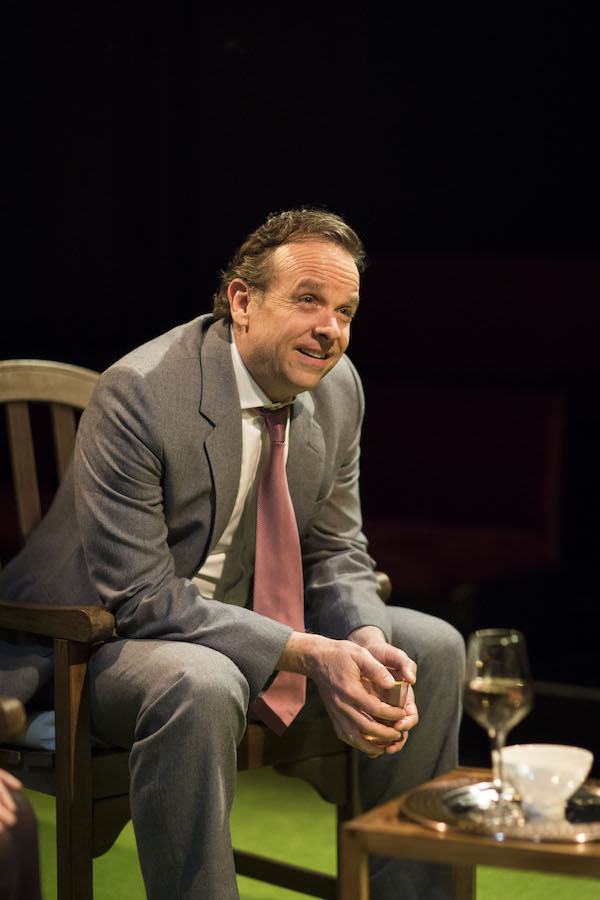
Samantha Coughlan as Ros is affectingly intense, and bounces off Donald Sage Mackay’s genial and somehow slightly lost Ray (pictured top). Performances by Joanna McGibbon, Marina Bye and Carl Stone as Shatique, Molly and Christopher are less assured. Direction by Jelena Budimir makes urbane use of space and time to overlap lives and periods, elegantly setting up contrasts as the tensions ramp up.
There are some easy targets in the play, not to mention some plot holes, but for a thriller set in modern America for the most part it doesn’t pull its punches.
- White Guy on the Bus at the Finborough Theatre to 21 April
- Read more theatre reviews on theartsdesk