In June 2014, I was invited to the late Sir John Tavener’s Memorial Service in Westminster Abbey. It was a poignant occasion, marked by a number of special tributes and performances. My childhood idol Steven Isserlis performed Threnos during the service and as I made my way up to thank him for his moving performance, I was aware he was clutching a big blue score, and talking with Meurig Bowen, the Artistic Director of the Cheltenham Festival.
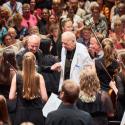
Just as I approached them, I heard Meurig ask Steven whom he would recommend to perform the premiere of the recently completed cello concerto by Herbert Howells? Steven saw me, thrust the score into my hands and said, “Guy!” (Guy Johnston with Steven Isserlis in Westminster Abbey, pictured below right). It was a wonderful, serendipitous moment. I sang a lot of Howells when I was a chorister at King's College, Cambridge, but a cello concerto... How did this come into being, and how had I only just heard about it?
It is rhapsodic, full of colour, with long lines and melancholic lyricism
Howells revisited the concerto throughout his life. Personal circumstances surrounding the work undoubtedly played a part in his complex relationship with it. Sketches for the first movement began in 1933 and, three years later, Howells returned to the work following the tragic death of his son from polio. It was through composing that Howells was able to confront his grief and, in turn, try to come to terms with the death of his son. There are three movements: the original opening “Fantasia”, which has remained unchanged, is followed by a “Threnody” and “Finale”, completed more recently by Christopher Palmer and Jonathan Clinch respectively.
Howells saw the cello as an extension of the male voice, and this can be heard from the moment the cello enters with its first sighing gesture in the Fantasia. It is the most expansive movement of the concerto and was submitted as part of his DMus at Queen’s College, Oxford. It certainly gives us an insight into Howells’ enigmatic and unique emotional sound world, whilst also being steeped in the English musical Renaissance traditions of Byrd and Tallis. Howells felt a close affinity with the Tudor period all his life, and you can hear this influence in the Fantasia through modal harmony, chromatic alterations, false relations and the shifting of major and minor sonorities. It is rhapsodic, full of colour, with long lines and melancholic lyricism.
The second movement, Threnody, was completed in short score in the summer of 1936 and sketches were also made for the Finale. Letters and diary entries suggest that Howells returned to the concerto intermittently around the anniversary of his son’s death. As time went on, it became increasingly more difficult for Howells to complete the work because of these personal circumstances. In fact, the concerto was never finished, despite Howells considering the inner movement, Threnody, to be one of his finest works.
 Fittingly, this second movement was unearthed and orchestrated by Christopher Palmer in 1992 in time for a centenary concert in Howells’ honour at Westminster Abbey, where his ashes are interred. I think this is the heart of the work. Hauntingly searching and nostalgic, it is a story told from the heart. There is evidence to suggest at one point that this movement was being considered for two solo instruments, including a viola. I imagine this could have been to emphasise the relationship and dialogue between father and son.
I’ve recently had the pleasure of communicating with Jonathan Clinch, a Howells enthusiast and musicologist. In 2010, Jonathan continued the tradition and decided to study the sketches of the Finale at the Royal College of Music. After extensive research and consideration, he ordered the material into what could have been Howells’ intention, filling in gaps and orchestrating a final version. It has a kind of nervous, almost angry, side to it, but there are moments where the music dances in 7/8 time, and in the end the work seems to release with a surprisingly joyful resolve.
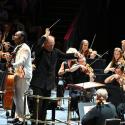
It has been a fascinating process getting to know this hidden gem. We are premiering it this Saturday in Gloucester Cathedral as part of the Cheltenham Festival with the Royal College of Music Symphony Orchestra conducted by Martin André. It's extraordinary to think of the connections surrounding this concert. Howells received his first composition lessons from Sir Herbert Brewer at Gloucester Cathedral, which prepared him for his RCM scholarship audition. His son, Michael, is buried just a couple of miles away from the Cathedral.
I wonder what Howells would have thought about the final version and resurrection of his cello concerto. Who knows? Herbert and Michael may well be with us in spirit on this occasion.