Even for a dancer of Akram Khan’s sublime gifts, “Now” is an evasive concept to convey. During last night’s Sadler’s Wells extravaganza of Azerbaijani jazz and contemporary dance, “The Pursuit of Now”, Khan and his co-performer, the German-Korean dancer Honji Wang, mesmerised in a series of vignettes, gorgeously choreographed and lit. Azeri pianist Shahin Novrasli, whose ensembles’ charismatic folk-jazz comprised far more of the programme than the dance, offered a compelling snapshot of the Azeri music scene, beautifully positioned between Eastern and Western traditions. In the end, though, these parts didn’t quite cohere into an artistic whole.
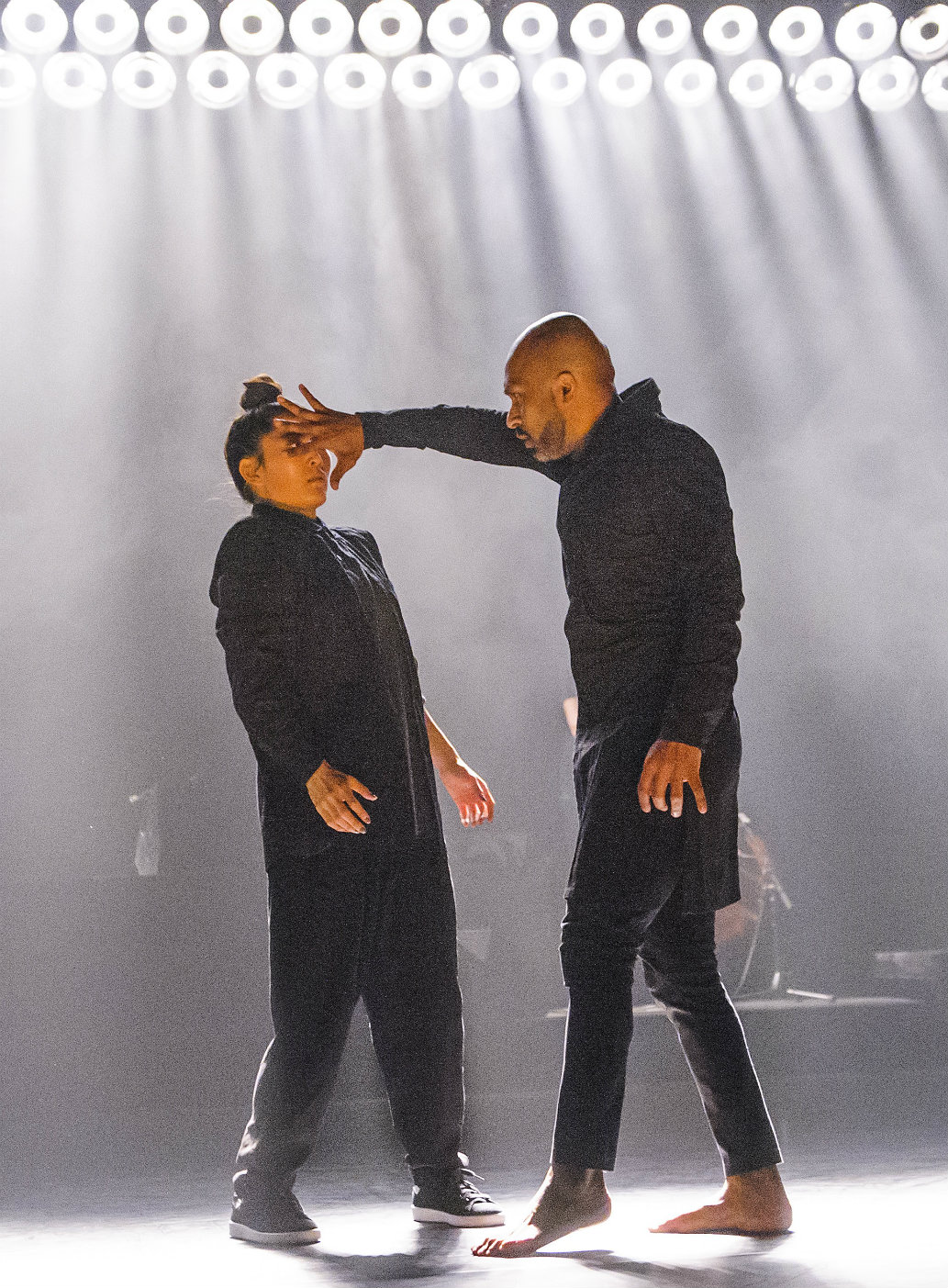
The opening scene, a kind of dream sequence featuring Khan and Wang (pictured below) that combined brutality and tenderness, was the standout moment of the show, and appeared to be a planned showpiece. Accompanied by Novrasli playing classical themes and variations, Khan and Wang enacted a kind of ritual that seemed part menace, part seduction, the mood flickering between the two poles with every flick of a limb. Like puppets connected by rubber strings, their movement was elastic, intimate, and instantly responsive, the athleticism and human drama perfectly matched. A whole evening of these two would have been highly memorable. Once Khan had left, Wang had several solo dance scenes to herself during which she improvised with exquisite and seemingly effortless fluidity to Novrasli’s ensembles.
 Azerbaijan, or “Jazzerbaijan”, as earlier musical events in this BUTA Festival of Azerbaijani Arts had it, has a long and distinguished history of jazz culture stretching back to the birth of the music. The piano trio, with bass and drums, is one of the staples of the Western form, and part of Novrasli’s performance, with his trio of Nathan Beck on double bass and Ari Hoenig on drums, comprised the kind of energetic, straight-ahead playing to be found in clubs across London and New York; another part, with his brothers Arslan on tar and the khanende (traditional mugham vocalist) and kamancheh-player Nurlan, was a kind of fusion of jazz and traditional folk.
Particularly striking for a Western audience was the entwining, plaintive tones of vocals and the kamancheh (a kind of Persian viol), which created sinuous lines of melody that filled the hall, and were a perfect balance for the percussive effects of drums and piano. Musically, the most adventurous passages occurred when all five played simultaneously, creating a kind of East-West fusion sound that was for the most part both fresh and enjoyably melodic, though the ensemble also ventured into more angular, freely improvised repertoire. The Sadler’s Wells acoustic was very responsive for a small ensemble, but for these long sections of music a specifically musical venue may have worked better.
The lighting, by Fabiana Piccioli, was at times naturalistic, evoking the roseate and bronze of the Azeri landscape, and at others, especially during Wang’s solo improvisations, more abstract, with geometric patterns of black, red and white slashed across the stage. Some of Wang’s most extraordinary sequences occurred when she appeared to respond simultaneously to the rhythm of both the music and the swirling patchwork of lights before her. Though always striking, the lighting never overwhelmed the music or movement, and was in many ways the most coherent and integrated part of the show.
Yet for all the brilliance of the lighting, “The Pursuit of Now” is not an illuminating title. It was difficult to avoid the conclusion that this was a line-up and a project in search of a concept. I wondered at one point if there was a theme of time and immediacy permeating both the improvised dance and music. Perhaps. As a series of individual short pieces, this was a compelling show, but the lack of a convincing unifying theme left it feeling slightly aimless. Akram Khan, despite the potent fluidity of his masque-like narrative with Honji Wang, was a cherry, albeit a very beautiful one, on a largely musical cake, and “Now” escaped at the end of the evening, uncaptured.
- The Pursuit of Now continues tonight at Sadler’s Wells