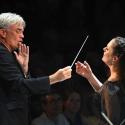
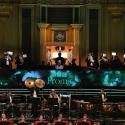
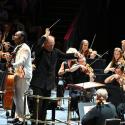
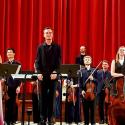
Is there an ideal way to programme Metamorphosen? Richard Strauss’s elegiac masterpiece requires 23 solo strings. That’s more than most chamber orchestras can muster, but with a full size symphony orchestra the piece leaves most of the players with nothing to do. In this Usher Hall concert the Royal Scottish National Orchestra chose to let Metamorphosen stand in glorious isolation before the interval. Those players that could opted to stand – not an option for the lower strings – in a tight semicircle round principal guest conductor Thomas Søndergård, with the rest of the orchestra’s clutter shoved discreetly to the back of the stage out of the limelight.
Those seeking to laud aspects of the RSNO tend to highlight the crisp brass, tight percussion, and some very fine woodwind players. The strings seldom receive such praise, lacking the depth and velvety textures of the great central European orchestras. But at the outset this performance suggested otherwise: lower strings brought a luminous, questioning air to the opening theme, the upper parts added a few moments later with infinite delicacy.
In other movements clarinet and piccolo solos lost prominence in the heavily upholstered surroundings
But as the piece got into its stride so it seemed to loose focus. Rather than demonstrating lofty detachment, leader Maya Iwabuchi seemed to be rather manic. Søndergård has a fine command of grand moments but in the faster passages his breast-stroke style of conducting is less effective, and we were rather more conscious than we should have been of the intricacy of the writing. But there were excellent moments too: the insistent repeated notes that lead into the final section were dramatic and moving, and the final winding down to silence beautifully choreographed.
The concert could have ended there – Metamorphosen is a difficult piece to follow. In the Edinburgh Festival it could have stood alone as a single plat du soir in one of the fabled late night concerts pioneered by Brian McMaster, but in the Usher Hall on a Friday night a traditional audience demands starters and pudding. In the event, after the interval, we had Beethoven’s Fidelio overture and Bartók’s Concerto for Orchestra. This was not the order of play originally planned, which was Beethoven-Strauss-Bartók. Evidently someone thought that resetting the stage after Fidelio would be a nuisance, but it was strange to come back after the interval to see a vast orchestra assembled to play a classical overture when 20 minutes earlier a tiny orchestra had been playing Strauss.
Maybe there was no way to make it work, apart from ditching Fidelio, which would have resulted in a very short concert and would doubtless have upset those who had come to hear it. The real culprit is the traditional overture-concerto-symphony format for classical concerts which for promoters and audience alike seems resistant to innovation. For this concert, it is worth noting, the entire upper circle had been closed, presumably as tickets sales were poor.
Bartók’s wonderful orchestral showpiece was well received. Violas rose to their occasion in the third-movement ' Elegia'. The Shostakovich parody from the "Leningrad" Symphony was delivered with caustic aplomb. Yet here, as in the Strauss, I felt that Søndergård’s best moments came in the big tunes, sweeping all before them, whereas he left the woodwind chit-chat of the "Giuoco delle coppie" ("Games of the Couples") second movement to fend for itself. In other movements clarinet and piccolo solos lost prominence in the heavily upholstered surroundings. Søndergård allowed all the sections of the orchestra a curtain call at the end but it would have been nice if he had given them more help during the piece itself.