Usually, to describe a play as "of its time" is a criticism. It is suggestive of drama that hasn't aged well, that doesn't work quite as well for today's audience as it did for the original crowd. First performed in 1847, Dion Boucicault's The School for Scheming seems at first glance to fall into this category, with its mannered language, twisting plot and moral overtones.
But, as this revival demonstrates, pre-emptive assumptions of staleness can be confounded by a production that is all witty observations, sly mimicry and sarcastic asides. As the title would suggest, the action revolves around an educational establishment - a finishing school, at which the unscrupulous Mrs Fox-French instructs her charges in how to secure noble husbands. The young ladies attract a bevy of bizarre suitors, and as one particular family - the Plantagenets - seek an advantageous marriage to fix their debt problems, an intricately-woven plot emerges in which it seems that everyone is either engaged to someone they don't love or else owes them a vast amount of money.
We long for some of that Wildean sparkleDion Boucicault was a prolific, prosperous impressario of the nineteenth century theatrical world. He toured all over, writing, adapting and performing in numerous plays, and like many of the characters he created, making fortunes only to lose them again.
London Assurance, which opened in 1841, was his first big hit. It's also the work for which he is probably best known to today's theatregoers, thanks to a widely-praised production at the National Theatre in 2010 which starred Simon Russell Beale as foppish dandy Sir Harcourt Courtly and Fiona Shaw as the excellently-named Lady Gay Spanker. In an article written for the programme of London Assurance, Boucicault's biographer Richard Fawkes contends that the playwright "bridged the gap" between the work of Congreve, Sheridan and Goldsmith and that of Wilde and Shaw. It's a useful way to think of it - if you imagine something halfway between Mrs Malaprop and Lady Bracknell, you come close to the kind of character at which Boucicault excelled.
In this production of The School for Scheming, director Auriol Smith has made the very sensible decision to keep things firmly rooted in the original text. There has been no attempt to introduce knowing parallels with today's topical issues, and the production is the better for it. The lines about the ephemeral, swindling nature of capitalism are all the more hilarious when the audience is allowed to make the connection to today's City-dwellers for themselves.
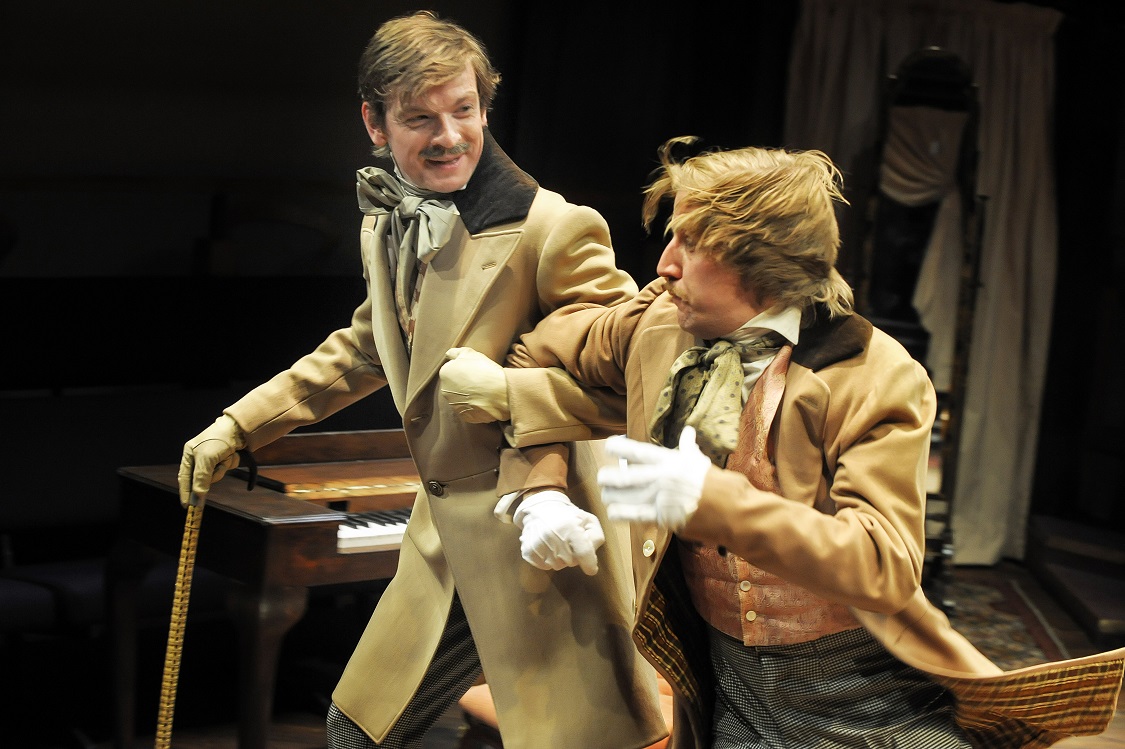 Dominic Hecht (pictured right with Oliver Gomm as Lord Fipley), playing a "speculator" known as The MacDunnum, manages to be funny, despicable and pathetic all at the same time as his machinations take him from impoverished gentility to vast wealth to extreme poverty. In an accomplished cast, Hecht stands out, as does Imogen Sage as heroine Helen Plantaganet. Sage, who is still at drama school, does great things with a difficult role, since Helen has to be as conniving as the rest while still retaining a discernible capacity for redemption.
The only aspect of this play that does feel like it has gone sour with age is the denouement, in which Victorian moralising about the transformative nature of poverty triumphs over witty speculation. It is here that we long for something of that Wildean sparkle. As Boucicault winds up all his loose ends, we want a sly wink that conveys a sense of mischief managed, that tells us not to take the high-falutin stuff too seriously. As The MacDunnum has it, this play is the product of "an electroplated age - there are figures on top, but it's all humbug beneath".