“Let a woman in your life," roars Professor Henry Higgins, “and your serenity is through. She'll redecorate your home, from the cellar to the dome and then go on to the enthralling task of overhauling you.” It’s a scenario not unlike letting the winsome darling that is musical theatre loose among the club armchairs and smoking jackets of a classical music festival.
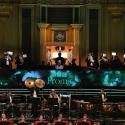
The dome of the Royal Albert Hall may have been safe from a substantial redesign, but last night the lights glowed hot pink and the stage teemed with more action than a whole cycle of Beethoven symphonies. John Wilson and his orchestra were back in the building and Eliza Doolittle wasn’t the only one who could have danced all night.
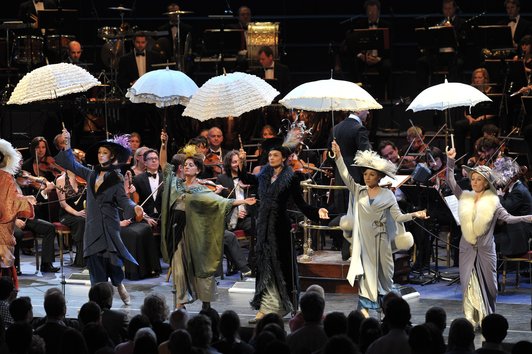 Now something of an annual fixture at the Proms, the visits of John Wilson and his orchestra have become a regular highlight – an evening of joyous nostalgia tucked amongst the symphonies and concertos of regular programming. In this Jubilee year however it seems only fitting that we should get a double-helping – Lerner and Loewe’s My Fair Lady performed in full, as well as the usual evening of cherry-picked highlights.
The technicolour shading of the John Wilson Orchestra (even in last night’s reduced forces) is vivid enough to render any scene unaided, but yesterday received unexpected support from costumes, chorus, dancers and a cartload of props. “Semi-staged” is an inadequate description for the work of director Shaun Kerrison and choreographer Josh Prince, who summoned a bustling Covent Garden market, an embassy ballroom and Ascot racecourse into the awkwardly-shaped space with the slickness of a long-running show rather than just a one-nighter.
They had plenty of help from a cast of big names. Annalene Beechey brought us West End polish without any brashness, singing sweetly through classics “I Could Have Danced All Night” and “Wouldn’t It Be Loverly?”, relishing the cockney flourishes of Act I particularly. She was supported by the magnificent Siân Phillips as long-suffering Mrs Higgins, and by the ardent foolishness of Julian Ovenden’s Freddy.
 Reprising his West End turn as Higgins himself was Anthony Andrews – always watchable, but generating nothing resembling heat (either of fury or passion) with his protégée, and proving himself something of a liability in the freer sections of Harrison-inspired sprechgesang. We never quite came off the rails, though his number lacked a musicality that even the vocally-challenged Rex Harrison achieved. James Fleet’s Pickering was gentle and affable enough, but its deliberate dramatic subtleties (and quite a few lines) were lost in the Royal Albert Hall.
It’s a challenging space for a musical about words, in which the text is both so essential and so entertaining, and the amplification didn’t always help the clarity. With or without its assistance however there was no stopping Alun Armstrong’s belligerent and canny Alfred P. Doolittle (pictured above), who reminded everyone just how good a musical theatre all-rounder he is.
The chorus sang and danced, and shifted seamlessly between roles and stage-pictures, joining with the orchestra in giving a performance that matched the Royal Albert Hall’s cavernous space for dramatic dynamics. My Fair Lady was never going to rival this season’s operas – Les Troyens, Peter Grimes – for intensity, but John Wilson and his team made an unassailable case for the show’s right to sit proudly alongside them in this greatest of classical music festivals.