"37 Plays. 37 Languages." This is the tagline for the Globe Theatre's Globe to Globe season, hosting theatre companies from every corner of the world. The season may be international in outlook, yet the language used to perform this version of Love's Labour's Lost is at once home-grown, yet very different from the words of Shakespeare.
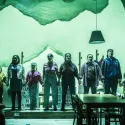
His comedy is performed here in sign language, with no spoken words at all, just musical backing from a live band on stage. The genius of Deafinitely Theatre's interpretation of this play (and something that marks it out from their past work) is that there is no attempt at providing a voiceover for the hearing audience. Instead, surtitles give a brief synopsis of each scene, then leave the audience to their own devices. Freed from hearing one language while watching another, they are compelled to try and see.
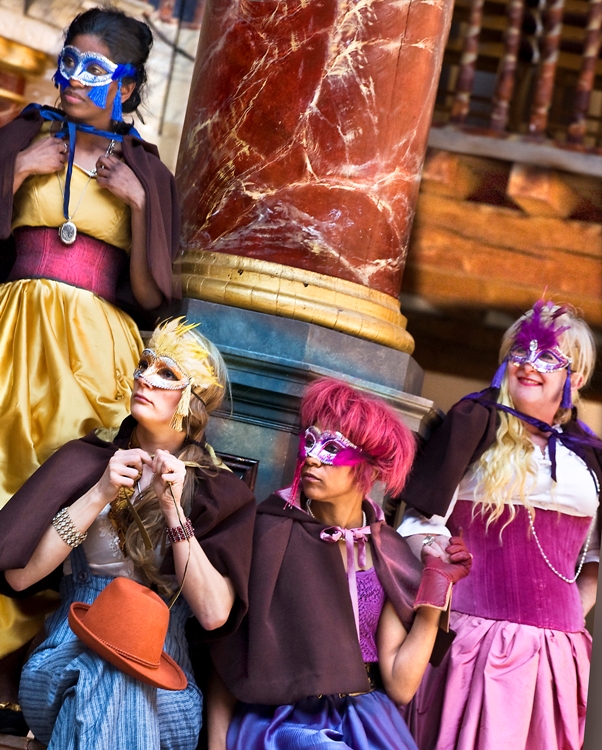 And see they do. In the expression and physicality of this young but seriously talented deaf cast, they absorb, visually, every bit of the humour and silliness that the Bard intended. Indeed they laugh aloud even at the dubious sideways glances of the King's Lords as they consider the terrifying reality of their oaths - to deny themselves the pleasures of the flesh, in favour of educating their minds.
There are moments when the full potential of sign language transcends any communication barrier. As Matthew Gurney, playing Lord Berowne, argues that the oath is too strict to adhere to, he uses a sign in a way that causes audible gasps in the audience. He signs "study" with his face pushed up so close to the imaginary book in his hands that he cannot see the world around him, and in that moment, the audience knows exactly what he is trying to say – that the men will study at the expense of real life. (Shakespeare's plot revolves around enforced abstinence in the presence of the Princess of France and her comely entourage.)
There is a real sense of liberation in seeing Deafinitely perform an established work. They are able to make one of Shakespeare's plays their own. Love's Labour's Lost is often thought of as one of his least accessible plays, but here it is made accessible, and most importantly, funny, for all. I hope this is not the last time Deafinitely Theatre tackle Shakespeare, because as the level of applause as the actors took their bows showed, this was a complete triumph.
This review was originally commissioned and published by Disability Arts Online
- Globe to Globe continues until 9 June
- Read theartsdesk's coverage of Globe to Globe
- See more photographs of Globe to Globe productions on theartsdesk's Facebook page