There has long been a conviction in Italian drama circles that there exists a “Special Relationship” between themselves and il Bardo di Stratford: something to do with the complexities of Elizabethan English syntax and the unusual amount of words of Italian that Shakespeare appropriated from the dominant European language(s) of theatre of his day.
Indeed, going to almost any contemporary production of Italian theatre (for anyone raised on the English language canon and its main schools of interpretation), is to hit a very hard wall of cultural dissonance. We go for grades of naturalism; our Italian cousins are still deeply wedded to the rhetorical, declamatory style that went out in the late 19th century. Indeed, to witness a standard produzione scecspiriana in Italy is often like being projected in a time capsule to a faraway distant land.
This banal exchange could be from an Italian daytime TV soap
But then there is also a widely observed “contemporary style” which emerged out of the late Sixties sexual and cultural revolution, which saw texts stripped down to the bare bones, and a very heightened psychological response (think wild, wide-eyed gestures, arms akimbo, hair pulled at).
The point of this was to shock the bourgeousie and to reboot the theatrical cannon in a new “democratic, no frills” manner, parallel to what was happening on the radical fringes of Italian cinema at the time. This worked brilliantly in the early 1970s. The problem is that 40 years on, the values and techniques of the Italian “revolutionary theatre” are still with us, and very tiresome they tend to be.
La Compagnia I Termini’s production of Julius Caesar for Globe to Globe was an excellent sampler of modern Italian theatre: ludicrous, bombastic and shorn of anything beyond surface meaning. Director Andrea Baracco and Vincenzo Manna have radically revised the text, which is contemporary Italian (fine in itself, but is rendered so inexpressive in the actor’s mouths as to appear a parody. “Venite a cena da me stasera?” “No, sono gia’ impegnato” This banal exchange could be from an Italian daytime TV soap. "Lend me your ears" became "Ascoltatemi" or "Listen to me".
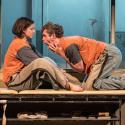
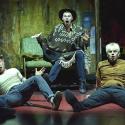
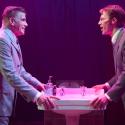
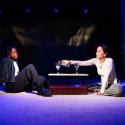
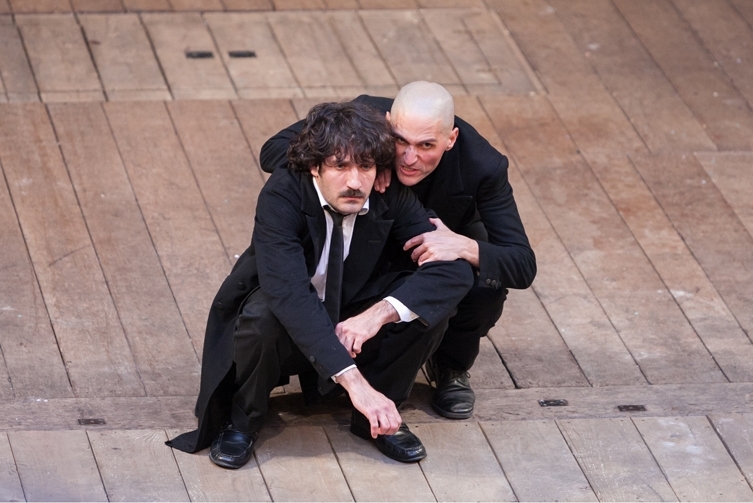 Caesar himself is always referred to but not seen. The three conspirators semaphore his murder by drawing striples in red chalk on an old leather chair. Again, fine in itself, but the remaining characters are marooned without his essential presence. Baracco’s direction has whittled the action down to a series of neurasthenic clashes between half a dozen lead characters. Their stage mannerisms are defiantly “radical”. There was unexplained writhing from Ersilia Lombardo’s barren Calpurnia and Liva Castiglioni’s Porzia, whose presence on stage can otherwise scarcely be justified. From the men there were jerky marionette steps. Roberto Manzio’s Cassio, a squeaky-voiced petulant psychopath from a Seventies cheapo horror film was particularly grating. Giandomenico Cupaiuolo’s Bruto (pictured above right with Manzio) was driven to maddening torment as if by numbers. Lucas Waldem Zanforlini’s Casca (and briefly, Ottaviano) and Gabriele Portoghese’s alcoholic Marc’Antonio looned around the stage as if an early Eighties pop video.
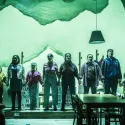
Arcangela Di Lorenza’s pared-down design featured three requisitioned old doors, two plastic dustbins, a smashed-up armchair and some lightbulbs planted in a pot. Despite the rhetorical, declamatory posing, Italian actors don't really “do” voice production; which along with the clumsily chosen background music (stray bits of Arvo Pärt, Morricone etc) made for a desultory sound experience.
The idea of a stripped-down, deconstructed Shakespeare tragedy sounds great, but not when the play’s gut’s have been replaced by an incessant overload of meaningless actions and clambering around the stage as if in a padded cells. Sound and fury, signifying… not a great deal? Afraid so. The largely Italian expat audience who filled the theatre just loved it.
- Globe to Globe continues until 9 June
- Read theartsdesk's coverage of Globe to Globe
- See more photographs of Globe to Globe productions on theartsdesk's Facebook page