Obsession and redemption, the twin themes of Wagner's ghostly earliest masterpiece, are two words that could just as pertinently be applied to Jonathan Kent's new production for English National Opera. Obsession is how many non-diehard Wagner opera-goers will view Kent's decision to stage this opera as a continuous pieceit' of drama with no interval. Sure, Wagner originally considered a single-act work, but he quickly dropped the idea. He never conducted or endorsed a staging without a break. So, the fashion for running all three acts together almost feels like obsession in its unwillingness to forgo, for once, the usual Wagnerian operatic leitmotif of having to sit still for a very long time.
However, thankfully, last night there was also redemption, because after 30 seconds of the overture it was clear that, despite the prospect of over two hours in our seats, this wasn't going to be a clock-watching endurance challenge of an evening. In fact, quite the opposite.
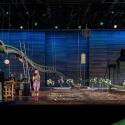
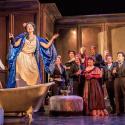
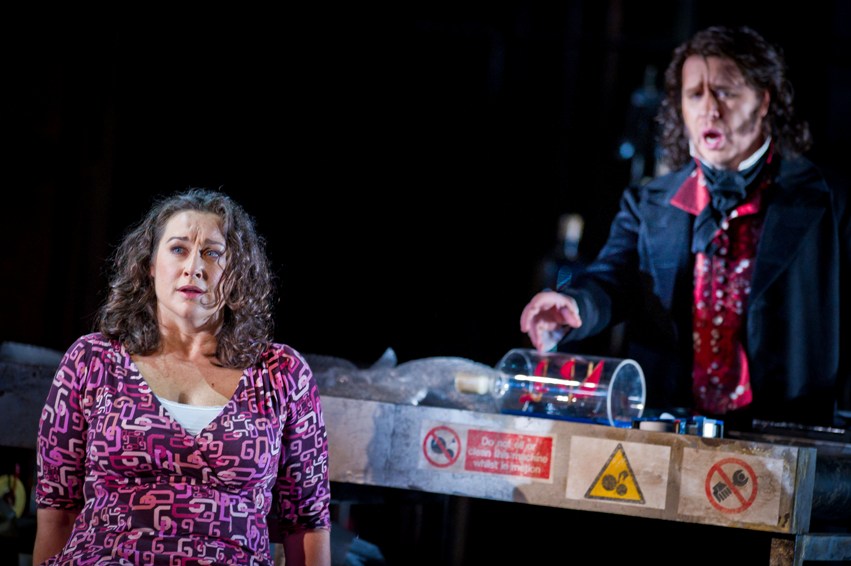 Kent's production sets the action in a loosely modern setting, Daland's ship a massive cargo vessel, all corrugated metal and rusting pipes. At the centre of this harsh adult sea environment is an Ikea-like bed bedecked with a childish pink duvet, in which Senta the child (Aoife Checkland), repeatedly fobbed off by her father, takes solace from her book of tales about the flying Dutchman, feeding the obsession that will eventually kill her. However, just as you've got your historical bearings, in crashes the Dutchman's tall-masted sailing ship, rigging and all, whilst American bass James Creswell's Dutchman rises up into Senta's (now empty) bed, complete with Victorian side-burns and tailcoats, and a good century and a half's worth of bitterness on his face. Suddenly, this feels like a serious ghost story.
Watch the trailer for the ENO's production of The Flying Dutchman
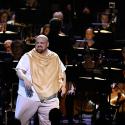
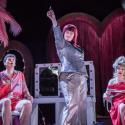
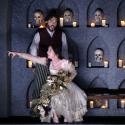
Meanwhile, the singers match superb vocal performances with such convincing acting that the production also feels like a proper drama, rather than like a bunch of opera singers walking through their stage directions. Cresswell, and Orla Boylan as Senta (pictured above), are an electric pairing, and individually captivating. The subdued power in Cresswell's tone as he utters his opening, “The time is up”, is spine-chilling, and its later full-throttled eruption fulfils all the initial promise.
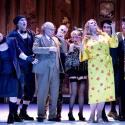
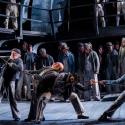
Orla Boylan sings a glorious, clear-voiced Senta, by turns ecstatically pure and almost gratingly piercing as the drama requires. She has absolute mastery over her taxing vocal lines and high notes. Her characterisation of this vulnerable, disconnected, bewitched woman come together in her tension-riven Ballade, its surface calm barely keeping at bay the schizophrenic jostle beneath between aggression and tenderness. Stuart Skelton lends dignity to the impotent Erik by the sheer poised beauty of his performance, Robert Murray's aria as the Steersman is true-voiced and tender, and the gentlemen of the ENO chorus (pictured below) have never sounded so good or lifted the roof so high.
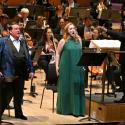
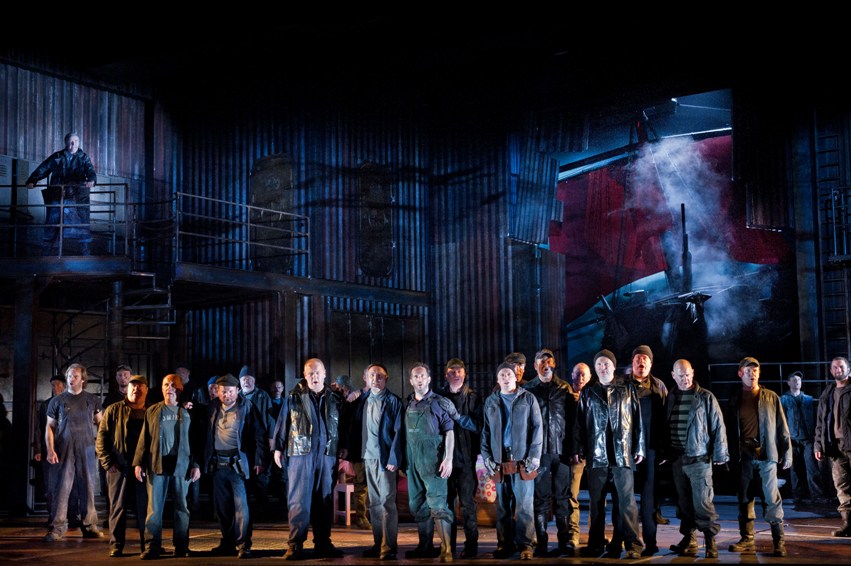 The real star of the night, though, was musical director Edward Gardner. This was his first Wagner opera as conductor, and he absolutely smashed it. An edge-of-the-seat orchestral adventure ride from the first note, with tempi on the faster side of the spectrum, Gardner's interpretation crackled and smouldered with devilish fire through the many gear-changes in mood and pace. Such was the orchestra's dramatic power that there was a sense of the instrumentalists in the pit being not just the accompaniment, but also narrator and Greek chorus all rolled into one.
It wasn't all perfect. Early on, there were a few balance issues between orchestra and soloists. Later, the Act Three trio between Erik, Senta and the Dutchman felt strangely static and awkward. Even more awkward was the segue between Acts Two and Three, which saw Senta engaged in a bizarre slow dance with a hitherto unintroduced member of the Dutchman's crew. Still, these are small gripes. This is one to grab a ticket for.
- The Flying Dutchman at the London Coliseum until 23 May