What's the Greek for "oy"? All the bouzouki dancing and retsina in the world wouldn't be enough to make a satisfying play out of Onassis, Martin Sherman's rewrite of his own Aristo, seen two years ago at Chichester with the same director (long-time Sherman collaborator Nancy Meckler) and absolutely invaluable leading man (Robert Lindsay). The star gives the piece his customary highly theatrical all, in the process making you think perhaps the material really is the stuff of genuine tragedy. But all the high-flown talk of "destiny" and whatnot can't shift what Onassis actually is - less a fully realised drama than a celebrity flow-chart on stage.
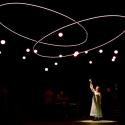
The show, to its credit, at one point acknowledges as much, illustrating one or another instance of reported copulation with a visual curlicue to indicate - you guessed it! - so much rumpy pumpy. But it's difficult to take seriously the script's invocation of the gods and subsequent galloping study in paranoia when the impulse behind it remains so crude. If you've ever wondered what Hello! might look like brought to the stage, well, the wait is over.
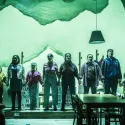
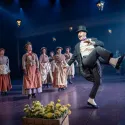
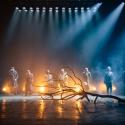
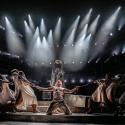
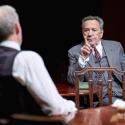
Marking a rare West End appearance in a new play (he's more frequently seen playing the likes of Fagin, Richard III, Archie Rice or Cyrano), a silver-haired Lindsay makes his entrance dressed entirely in white, snapping his fingers, grooving silently to a Greek vibe that includes an onstage rivulet courtesy the designer, Katrina Lindsay - no relation to the actor. Indeed, with lighting from Ben Ormerod redolent of the Mediterranean sun and Lorna Heavey's shimmering projections appearing to liquefy the stage as we watch, the physical production could well appeal to those staycationers keen to go to Greece without actually having to fly anywhere. Wait, didn't this season's revival of Shirley Valentine get there first?
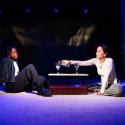
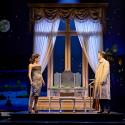
The play is adapted from the Peter Evans book, Nemesis, positing Onassis's involvement in a plot to assassinate Bobby Kennedy. Before we reach that point, though, we traipse through Onassis's sexual history, starting with the suggestion of an early initiation at the hands (well, not quite) of a Turkish soldier (!) and leading inevitably to Bobby's one-time sister-in-law, Jackie Kennedy (played by Lydia Leonard with the help of pearls, long gloves and a vocal purr). The American First Lady's eventual marriage to "Aristo" sits none too well with opera diva Maria Callas, who is herself played by Anna Francolini in cascading curls and an accent that traverses the globe even more diligently than did Onassis's fellow Smyrnan (Smyrnanite?), Homer. (Elizabeth McGovern and Diana Quick were the starrier inhabitants of these two female roles in Chichester.)
Throughout it all, Lindsay bobs and weaves and gets into the florid spirit of the occasion, sailing through some of the more daft dramaturgy - Winston Churchill, we're informed, was "the former British Prime Minister" - abetted skilfully by Gawn Grainger, who is actually quite charming as the de facto narrator and gossipy aide-de-camp. "What can I tell you?" Grainger's Costa asks the audience at the start of the show, prompting one to feel that if he doesn't know, we certainly don't. Sue Kelvin lends some cod-Greek vocals to the part of an onlooker, Dimitra, who sees portents in the sky, even as the emphasis on capital-A atmosphere makes one wonder if Nia Vardalos is going to pop by for a cameo.
If one considers the bigger picture, it is extraordinary that both Ari and Jackie lost sons in plane crashes, a coincidence the play doesn't in fact point up, and Sherman thankfully refuses to sentimentalise a title character who seems entirely happy in the knowledge that he is generally despised. It's possible, too, that as a TV mini-series or biopic the conceptual cheesiness would be less overt.
As it is, fairness impels me to report that the audience seemed considerably more held at a recent matinee of this play than they were the previous night at the new National Theatre Hamlet, where the capacity crowd came to resemble a bronchial ward. I don't know what Onassis, in his hubris, would have made of that, but as far as the play itself, the rest is silence.