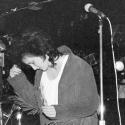
Is it a bird? Is it a plane? Is it an amphetamine-fuelled chicken on rollers? No, it’s the one-time guitarist for Dr Feelgood (during the only period that matters) still doing the moves that made him the main reason to see the band in the mid-1970s. Now bald-headed and bushy-browed but still delivering those electrically charged stares (which he learnt to do during a brief stint as a schoolteacher), he had the air of a benevolent dictator last night as he surveyed the Academy’s crowd for would-be assassins to mock-machine-gun with his trusty Stratocaster.
To an audience made up of approximately 98.5 per cent white blokes over 40 (a motley tribe I mournfully confess I belong to), Wilko Johnson and his regular Blockheads sidekicks, bassist Norman Watt-Roy and drummer Dylan Howe, made the kind of big life-affirming noise that one would expect from twice the number of musicians half their age. Hunched over his instrument, Watt-Roy played six notes where two would do, his head wobbling like a demented muppet, his body bending and swaying with the music. And Howe is just a reliable engine-room kind of drummer, keeping everything tight and rolling along.
And then there was the man himself. Let’s be honest here. No one goes to see Wilko for his voice which is, at best, merely adequate as it strains for notes perhaps best left well alone. The audience were there to see the moves (because either they’d just seen Julien Temple's excellent documentary Oil City Confidential or they have fond memories of seeing Dr Feelgood for real), and to hear the unique way he brutalises a Fender Stratocaster. It’s not the chords the man plays, it’s the way he plays them, the way he nonchalantly flicks at the strings with his right hand while stopping notes dead with his left.
Every riff is a complex mix of muting notes, frenetic crosshatching and strangled bursts of nervy lead which make him sound like at least two guitarists in fierce competition. But he’s no Hendrix. In fact in many ways he’s the anti-Hendrix: zero sustain, limited distortion, no interest whatsoever in hedonistically indulging in lengthy feedback-swamped digressions. Nearly everything last night was held back, so that when the man did unleash the briefest of searing, stuttering solos it was a delight because it was that rarest of things: a purely functional solo that was gone before you’d had time to admire its shape and force.
An accordionist called Slim (who needless to say was anything but) at one point joined the band for a couple of numbers including a driving cover of “Woolly Bully”. They also played a strikingly sparse and angular version of Leadbelly’s “The Western Plains” which reminded me of how often I’ve thought that Wilko has more in common with television-style art rock than he does with the stolid, predictable pub rock he’s generally unfairly associated with. Even his high sharp vocals aren’t dissimilar from Tom Verlaine's.
But despite several functionally effective covers taken from the 2005 album Red Hot Rocking Blues (perhaps the old schoolteacher in him made it impossible for him to go with the usual “rockin’”) it was the old Dr Feelgood tunes that got the best reception, and rightly so. Although it was hard not to miss Lee Brilleaux’s tense, vicious vocals and liquid slide guitar on “Back in the Night”, this and “She Does it Right” still had a timeless presence, and the latter boasted a riff Keef would have been proud of. A great Wilko riff motors along like a speeding truck over the roughest terrain, bouncing, flying, seemingly joyously independent of its creator.
Canvey Island’s most enduring eccentric is in a sense our very own Iggy: back in the pre-punk 1970s, many of those who watched and learned and admired him went on to form a band. And now at long last he is getting some long-overdue respect and acknowledgment, thanks mainly to Oil City Confidential. So I’ll leave you with this question: in a year’s time, what random, unlikely product or service will Wilko be advertising on TV and on billboards across the land? Good luck to him, though.