The UK premiere of Wynton Marsalis's Swing Symphony (Symphony No 3) last night was extraordinary on several counts. We heard, first and foremost, a real dialogue between jazz band and orchestra. Not one of those fist-bitingly cornball jazz arrangements where the jazz players get to stretch out and the orchestral players sit back and contribute the sustained, saccharine harmonies. This was a genuine coming together where all hands contributed equally to the rhythmic, harmonic and melodic detail of the work. And talking of melody, the one that Marsalis penned for the orchestral bass section – it doesn't happen as often as you'd think – in the penultimate movement was another of the work's many remarkable moments.
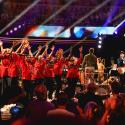
I can also never recall seeing members of the London Symphony Orchestra smiling throughout an entire performance before, nor see members of the audience react with such enthusiasm to a new work. A lady in the front row was so transported by certain sections of the symphony that she adopted a rather uncomfortable looking position that was halfway between sitting and standing: crouching, I suppose you'd to have to call it. This doesn't happen at symphonic concerts, does it?
Swing Symphony is Marsalis's third work for orchestra following All Rise (2002) and Blues Symphony (2009). An ambitious seven-movement work – it appears to have grown a couple of extra movements since its premiere in June 2010 – which traces the different eras of American music, at its heart beats the Holy Trinity of jazz: the blues, improv and swing.
Opening in typical Marsalis fashion with a vast, guttural gesture, the work takes you on a journey through ragtime (with echoes of Scott Joplin's "Maple Leaf Rag"), the celebratory snap of a New Orleans Parade March, Broadway-style razzmatazzz with Marsalis subtly flipping the Charleston dance rhythm, plus a blazing Basie Band call-and-response and shades of Ellington's Black, Brown and Beige.
Marsalis weaves in numerous tributes during the work's serpentine course
Marsalis weaves in numerous tributes during the work's serpentine course: Louis Prima's Big Band swing classic "Sing, Sing, Sing", tenor sax giant Coleman Hawkins's rightly famed performance of "Body and Soul" – a truly lovely dialogue here between saxes and cellos (Hawkins was also a noted cellist) – and the virtuosic New York City bebop of Dizzy Gillespie and Charlie Parker. Small wonder, then, that the work's final gesture was a collective exhalation.
Grounding the entire proceedings in the most fundamental way was the Jazz at Lincoln Center Orchestra's exceptional drummer, Ali Jackson. Whether delivering the crispest rimshots, the subtlest brushwork or the most perfectly syncopated hi-hat work, Jackson's pulse was impeccable. Marsalis built plenty of space for soloing into the fabric of the piece, and the contributions from Joe Temperley, Sherman Irby and the leader himself will live long in the memory. A quite stunning achievement, then, and a work that I would love to hear done at the Proms.
Conductor Simon Rattle, you feel, has always been something of a closet jazzer
Conductor Simon Rattle, you feel, has always been something of a closet jazzer. The first hint of this was his 1987 recording The Jazz Album – A Tribute to the Jazz Age, which featured Bernstein’s Prelude, Fugue and Riffs, Gershwin’s Rhapsody in Blue, Milhaud’s La création du monde and Stravinsky’s Ebony Concerto. OK, it's not exactly Ellington, but this collection of "classical meets jazz" works was clearly no one-off. Following his outstanding recording of Gershwin's operatic masterpiece Porgy and Bess came the absolute clincher - the 2000 album Classic Ellington, where Rattle and the City of Birmingham Symphony Orchestra really do get to grips with The Far East Suite ("Isfahan"), as well as Black, Brown and Beige, Take the "A" Train and more, in the company of bona fide jazz musicians including Joshua Redman, Clark Terry, Joe Lovano and Regina Carter. The evidence is stacking up. Certainly, his love for this score communicated itself in every bar.
In the first half of the concert we heard Rachmaninov's Symphonic Dances Op 45 (1940). For all its busy surface activity, in this context the three-movement work sounded rather less terpsichorean and rather more like a slightly arthritic older relative. You couldn't help thinking that the galvanising rhythms of Stravinsky's Petrushka, which coupled the Swing Symphony at its world premiere in Berlin (Rattle conducting the Berliner Philharmoniker), was a more ingenious piece of programming.
Watch a clip of Wynton Marsalis and Simon Rattle discussing the Swing Symphony: