

Judy Garland's Carnegie Hall comeback concert on Sunday, 23 April 1961 has often been lauded as "the greatest night in show business history", though that judgment surely depends on where Garland sits in one’s personal pantheon. Elvis’s made-for-television 68 Comeback Special, the king lean in leather, must be up there, and likely Sinatra at Madison Square Garden in 1974. Whatever, the sold-out performance featured some 25 standards, Garland backed by a 40-piece orchestra conducted by Mort Lindsey. Marilyn Monroe, Richard Burton, and Julie Andrews were in the audience. The album, Judy at Carnegie Hall, spent five weeks at number one and garnered five Grammys.
Some 400 concerts followed before Garland died, in London, in June 1969 – among them the notorious five-week Talk of the Town season during which she frequently kept audiences waiting an hour. Imagine the overtime bill! As it happens, my guest at Rufus Does Judy was my cousin, whose late father was the Chief Engineer at the legendary cabaret venue who had to hold it all together. He’d have had something to say about the sound balance at the RAH, Wainwright often lost in the mix.
But back to Rufus… His mother, Kate McGarrigle, would wake him at night to have the little boy sing “Somewhere Over the Rainbow” for guests. He was obsessed from an early age, and his performance is at once an hommage to Garland as a gay icon and to the Great American Songbook. He has used Garland as a way to confront his own personal demons and, like her (but more successfully), to navigate his way through substance abuse. For him, her music is a way to remember "all the great things that America can be and create and represent” and from her he learned to sing with unabashed emotion. He has said he sees himself as “the male Judy Garland”. Modesty never was his strong suit.
Their voices are quite different of course: Garland was a theatrical belter with a voice that came from the chest, and she had a wide but mostly well-controlled vibrato. Wainwright whines, a head voice that is melancholic, world-weary, sort of lazy-sounding. Where Garland’s voice sounded like it would crack under the weight of emotion, Wainwright somehow leverages his to sound vulnerable and exposed. And where Judy makes the great octave leap (pitch-perfect in her prime) in “Rainbow”, Rufus glides through the interval, a long slurry portamento, crescendo-ing as he goes. Singers wouldn’t do that at the Juilliard.
So here we are, 20 years on from Rufus Does Judy at Carnegie Hall at Carnegie Hall, and Wainwright is back with what he says will be the show’s final outing – and on Garland’s birthday. (She’s now been dead for longer than she lived.) The songs will remain in his repertoire, but he won’t repeat “the marathon”. London’s Royal Albert Hall was not quite at capacity, but the audience (some of whom had travelled from the US and Canada) was enthusiastic, more so as the evening wore on. The programme was, once more, the same as the Garland original, but the banter – Judy was chatty throughout – was replaced with his own camp anecdotage, inserted at the same points. Wainwright was backed by an orchestra, Stephen Oremus conducting and occasionally playing the piano, as he did two decades ago.
The songs are surely familiar to us all, Garland die-hards or not. After the overture, Rufus entered – in a too-tight grey suit and sparkling ruby slippers – and launched into “The Trolley Song”, segueing into “When You’re Smiling”. Then it was into the real classics: “Who Cares?”, “Puttin’ On the Ritz”, “How Long Has This Been Going on?”, “San Francisco”… Showstoppers all. Arthur Schwartz and Howard Dietz’ “Alone Together” was dedicated to his husband, Jörn Weisbrodt, as it was at Carnegie Hall when their love was new.
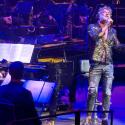
After an intermission, Rufus returned in a black sparkly top over black sparkly drainpipe jeans, topped by a bizarre-looking red cape. Feathers or furs, Liberace-style, would have looked better but they are both non-U these days. Where Garland had offered a monologue about a wardrobe malfunction, Wainwright actually wore one. The cape was soon discarded (leaving him looking like a glittery Max Wall) as he perched on a stool while Oremus played piano for three songs that were a quiet highlight of the evening: “You’re Nearer”, “A Foggy Day”, and “If Love Were All”, the latter by Noel Coward, who would doubtless have had an interesting take on the whole endeavour. “Rock-a-Bye Your Baby With a Dixie Melody” and “Swannee”, both of them made famous over a century ago by Al Jolson in blackface, are problematic today, and Wainwright rightly included some prefatory context. Then “Somewhere Over the Rainbow”, for which Rufus perched on the edge of the stage.
The evening’s surprise guests were Nicole Scherzinge and his sister Martha Wainwright, who offered a rather spectacular “Stormy Weather” and, as an encore, the Gershwins’ “Someone to Watch Over Me,” one of the most beautiful and tender love songs ever written. To close, Rufus slipped in a favourite of his own, “Every Time We Say Goodbye”, a classic by Cole Porter who was unrepresented on the original programme.
It’s a curio, to be sure, Rufus Does Judy, and one wonders what La Garland herself would make of what Wainwright has called "a communion" and a "postmodern happening". It was one of those evenings I was pleased to experience.






Add comment