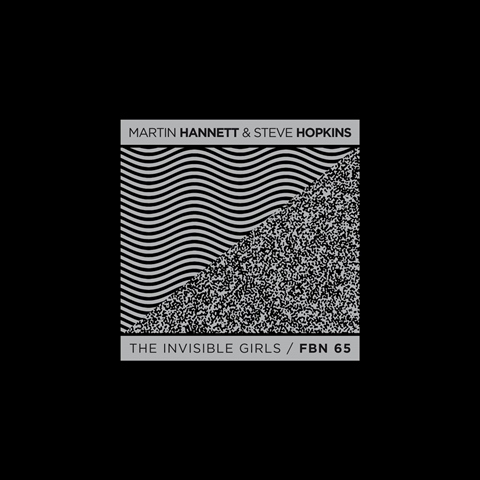
 Martin Hannett & Steve Hopkins: The Invisible Girls
While acclaimed for his glacial productions for Joy Division and New Order, Martin Hannett was also a musician in his own right. With bass guitar in hand and alongside composer-keyboard player Steve Hopkins, the duo recorded as The Invisible Girls. Under that name, they provided music for albums by John Cooper-Clarke, ex-Penetration singer Pauline Murray and provided a sonic bed for Nico. They also contributed to Hannett-produced records by Durutti Column and Jilted John.
The Invisible Girls celebrates a more under-the-radar side of Hannett, who died in 1991, and Hopkins by collecting tracks which weren’t intended for release or were issued under names other than The Invisible Girls – including the flexi-disc which came with Durutti Column’s debut album The Return of which was, whatever the credit at the time, by a solo Hannett.
Disentangling Hannett’s musical legacy is difficult as he was more than a producer. The imprint he left on the bands he worked with was significant – he actually added elements to what they had recorded. In the liner notes, Crispy Ambulance’s Alan Hempsall says of the recording of their album Live on a Hot August Night “we discovered that he wasn’t going to be doing a great deal in terms of production, he just sat at the back and let John Brierley do all the engineering. We were told in no uncertain terms that Martin didn’t like his bands being there at the mix, he’d rather just get on with it.” Hannett totally reconfigured some of the band's music with the help of an ARP 2600 synthesiser. The boundary between the produced and their producer was breached.
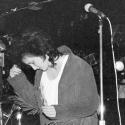
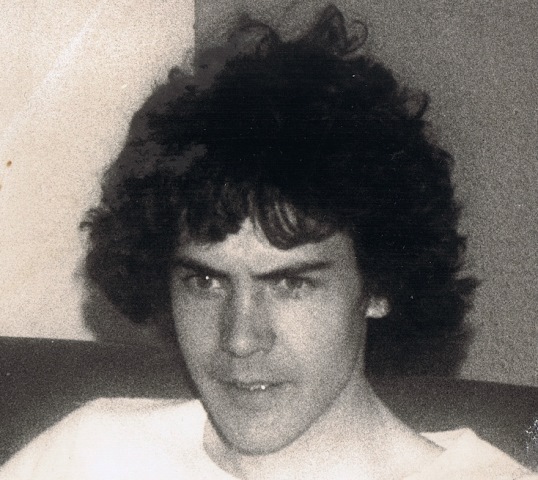 Although the bulk of The Invisible Girls is recordings by Hannett and Hopkins (pictured left, in 1978), Crispy Ambulance’s “Concorde Drone”, Nico’s “Procession” (no relation to the New Order song of the same name) and Section 25’s “Collective Project” are included as Hannett's presence is so robust. “Time is Slipping” is the original version of a track which ended up on the Pauline Murray album.
Although essential to the Hannett jig-saw, none of these are particularly surprising. The revealing aspects of this collection are a film soundtrack completed in 1976 and a group of tracks recorded from 1980 to 1987. Elements of funk, jazz and soul feature heavily, all of which are not usually associated with Hannett.
Hannett and Hopkins had first met at a Manchester gig by jazz-progsters Soft Machine in July 1976. The Sex Pistols had already played the city’s Lesser Free Trade Hall and inspired what would become the local punk scene. When the duo came to record the soundtrack to the cartoon All Sorts of Heroes later in the year, punk was not on the agenda. The music they came up with was jazzy. Hannett’s bass playing was slippery and sinuous. Parts of would the soundtrack not have sounded out of place punctuating a TV cop show like The Sweeney. At almost the same time, as Martin Zero, he was defining the future by producing Buzzcocks' debut, the Spiral Scratch EP.
The Eighties Invisible Girls instrumentals were recorded as probable backing tracks. Hopkins says “these were the beginnings of an Invisible Girls world domination plan. The idea was to assemble the roster of key instrumental players, and produce tracks to be fronted by different singers/stars, get some hits, and then take the Girls out on the road.” The plan was never realised. Again, there is a jazzy, funky feel and, despite its inappropriate title, it is not a stretch to imagine “Huddersfield Wastes” being reconfigured for chart funksters Shakatak or even Level 42. It also has the rhythmic lope of early Happy Mondays.
By revealing a fresh side of Hannett, The Invisible Girls is fascinating and valuable. It also, though, shows that Hannett was more than the producer with the characteristic otherworldly sound. He was a chameleon who turned his hand to much-less esoteric music. With Steve Hopkins, Martin Hannett wanted to court the mainstream.