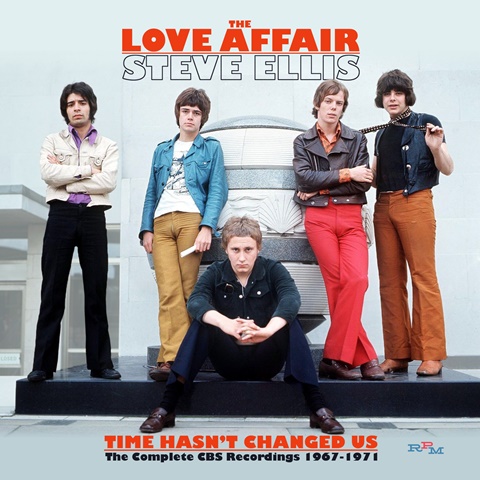
 The Love Affair/Steve Ellis: Time Hasn’t Changed us - The Complete CBS Recordings 1967-1971
The connection between Sex Pistols, the stars of last week’s Reissue CDs Weekly, and late-Sixties London soul-pop hit-makers The Love Affair is unlikely, but genuine. Shortly after they formed, when their repertoire of originals was thin, the instigators of UK punk rehearsed a version of The Love Affair’s 1968 Top Ten single “A Day Without Love”. Despite the supposed year-zero ethos of Brit-punk, Sex Pistols covered a fair amount of pre-hippy nuggets, including – as well as that Love Affair song – material by Dave Berry, The Creation, Small Faces and The Who.
The Love Affair weren’t an influence on punk though, but one of the ingredients which helped recalibrate pop towards the more straightforward after a few years of increasing convolution and remoteness. Nonetheless, the north London quintet which had formed as The Soul Survivors in 1966 did foment some controversy which would have been a snug fit for the punk era.
Following the name change to The Love Affair, an initial 1967 single on Decca flopped, but the quintet hit big on CBS in early 1968 with their classic version of Robert Knight’s soul stomper “Everlasting Love” (where Time Hasn’t Changed us picks up the story). The single hit number one. It was, and remains, a fantastic moment in British pop. Yet, at the time, their bassist Mick Jackson tarnished the success. On the Jonathan King show on national TV, he admitted that apart from singer Steve Ellis’s voice, no members of the band were heard on the record.
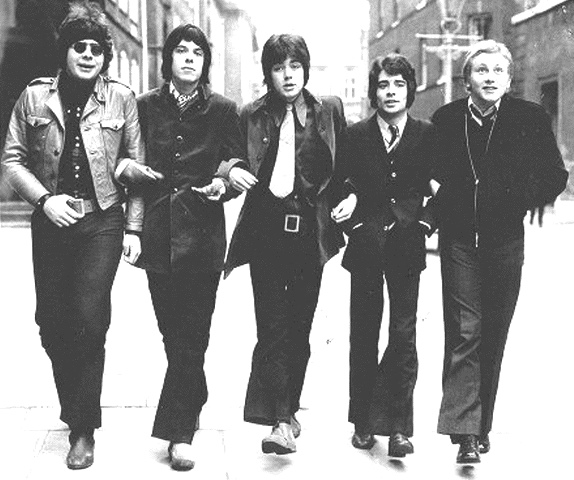 The Love Affair had recorded their own take of “Everlasting Love”, but producer Mike Smith decided it wasn't up to scratch and recorded a new version with session musicians which became what was released. Although not atypical in Sixties pop for session musicians to assume the role of band members in the studio, the loose-lipped Jackson had breached a code of silence in an era where the idea of authenticity was gaining ground. In America, The Monkees had already been stung by being outed as a manufactured band who did not play on their own records, so knuckled down to make Headquarters, their third album, themselves.
For The Love Affair – themselves a band assembled by millionaire handbag manufacturer Syd Bacon as a vehicle for his son Maurice, an aspiring drummer – the fallout was fevered coverage of the confession in both the music and national press. The band were forced to perform their next single, “Rainbow Valley”, before an invited press audience to prove they could play. Even so, the lesson was not learned and session players were still heard on their singles. After an album was issued late 1968 (the band played on its non-single tracks), singer Steve Ellis left in summer 1969. He then recorded solo and a reconfigured Love Affair limped on into 1970 as L.A. The ruckus begun by Jackson effectively stalled the band’s momentum. The fascinating story is told in full here.
Time Hasn’t Changed us - The Complete CBS Recordings 1967-1971 is a neat 3CD set with each card-sleeved disc sliding into a slipcase. The booklet tells the story of the band with the input of Ellis. As well as all his and the band’s released output for the period, there are previously unheard live BBC sessions (yes, they could actually play), foreign-language singles and a then-shelved solo album by Ellis.
What happened to The Love Affair was a shame. They were not innovators but a fine, mod-inclined pop group and, in Ellis, had a terrific white-soul frontman. Beyond the pop hits, they shifted between the styles of Small Faces and early Deep Purple. Ellis’s solo material is gritty, bluesy and soul-flavoured with a taste of The Faces. Get this and revel in a band who, at their best – with or without session musicians – were one of late-Sixties British pop’s best.