The veteran South African jazzers Adam Glasser and Pinise Saul transformed the gleamingly elegant Crazy Coqs cabaret den into a throbbing township jazz club last night, with an exhilarating programme of original South African jazz, seasoned with standards and township folk. Joining forces with the percussionist Marcina Arnold, a relative newcomer to their ensembles, they roughed up this venue’s urbanity with unfamiliar fires of passion and yearning.
As well as playing piano with a gallery of South African jazz greats, Glasser is noted for his work on the chromatic harmonica, and last night’s concert opened with a version of Abdullah Ibrahim’s “Blues for a Hip King”, in which the harmonica’s piercing, plaintive note stirred melancholy into the djembes’ faltering heartbeat. As with so much of this repertoire, pain and protest lies just beneath the exuberance, and politics puts its shoulder to the emotional wheel: Ibrahim wrote the piece for Sobhuza II, King of Swaziland, who offered him asylum during the apartheid regime.
Then the irresistibly charismatic singer Pinise Saul came to the stage. Her voice, best known for its blistering edge and explosive calls and vocalisation, can easily keep up with the full brass section of her usual bands, The Township Comets and The African Jazz Allstars, and she dominated the ensemble, but it was a benign, collaborative dominion - there are many reasons Saul is known as the Queen of African Jazz - roused to celebratory pitch by Arnold’s percussion, and glorified by Glasser’s elegant piano.
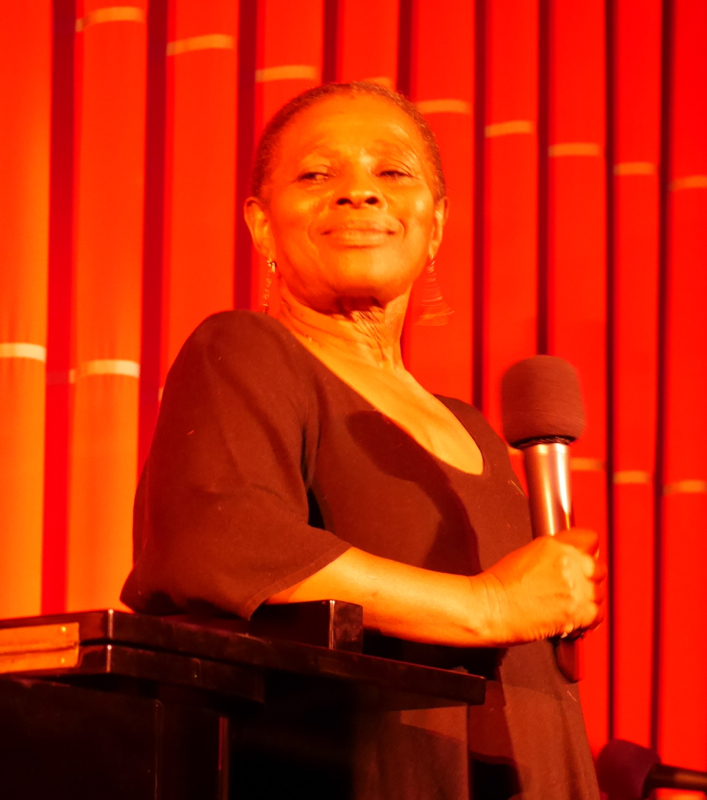 The admonitory, maternal aspect to her character was best expressed in the third song, “Pasop” (music by Glasser, lyrics by Saul), a warning to women about South Africa’s dangerous urban streets. Here, Saul’s whoops and cries could be heard at their sternest. But there was much tenderness, too, in the ballads “Ntyilo Ntyilo” and “Lakutshonilanga”, and the song “Mra Khali”, written in honour of a fellow musician. Glasser’s accompaniments offered delicately poignant contrast during the more strident passages of song, while at other times he drove and swang vigorously. And in short sections of close harmony duet with Saul, which glowed with sympathetic feeling, Arnold showed great vocal talent in addition to her steely control of the trio’s rhythm.
The Crazy Coqs is more reminiscent of Paris than Saul’s home town of Port Elizabeth, but its intimate size and acoustic was perfect for this ensemble. It’s unusual to have a whole concert of foreign-language jazz (last night was part of the monthly series London Jazz Translates), but it emphasises how vigorously alive the jazz song is in parts of the world an English audience rarely gets to hear.
Of all of the national varieties of jazz, South African is perhaps the most distinctive and intriguing. By re-importing the African rhythms and political protest from American jazz back to Africa, and reinvigorating them with Zulu rhythm (the rapid, snatching pattern of Arnold’s djembes is mainly a Zulu beat) and the righteous anger of the anti-apartheid movement, a compelling tradition, unmistakably jazz, and unmistakably South African, was created.
- This concert with Pinise Saul was part of the monthly LondonJazz TransLATES series at Crazy Coqs. The next dates in the series are an evening on Argentinian flag day on Friday June 20th with Guillermo Rozenthuler, and a celebration of Jamaica with Shireen Francis on July 18th.