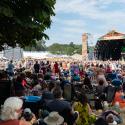
By the end of the first half an hour, the burly Egyptian journalist next to me was in tears. By the end of the show, the entire Barbican audience was on its feet. It was a memorable evening – even if the august Barbican Hall was nothing like the teeming masses of the Tahrir Square at the height of the protests against Mubarak. One thing was clear though – those who think popular music has lost the power to change things and mutated into mere consumerist spectacle will have to eat their words. Especially if they understand Arabic.
Which was a slight problem for half of the audience who didn’t understand the lingo. With most pop (or opera, for that matter) the words are not paramount, or you can find out the lyrics if you try hard enough. Here, at least with some of the artists, the words were crucial – so I would like to thank the two Egyptians next to me whom I bamboozled into giving intermittent translations. The organisers probably wanted to approximate the informal vibe of Tahrir Square, which one writer compared to Woodstock, but it should have been possible to provide some song translations or at least titles and a general idea of what they were singing about.
As it happens, perhaps the key tune in sparking the Arab Spring was by a young rapper in Tunisia called El General, which went viral on Facebook, and its searing lyrics and stark backing track make it, for me, the track of the year so far.
Watch a video of El General
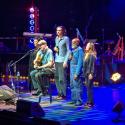
For last night’s show, the music was acoustic and portable, notably in the case of the opening artist Ramy Essam, who was a key figure in Tahrir Square and came on wielding his guitar like a combination of Billy Bragg and Manu Chao (with his guitar case casually placed on stage) and just a percussionist as accompaniment. Essam’s song “Erhal” ("Leave!") (see video below) was an unofficial anthem of the Square. Its singer was arrested and beaten up by the police, and his satirical songs immediately got the entire audience clapping along, and laughing, for those who got the jokes. His most rousing number, “Where is the Army?”, was a satirical song dissing the military in assorted Arabic countries.
Watch a video of Ramy Essam performing "Erhal" in Tahrir Square
The fetching figure of Azza Balbaa was next, accompanied by more traditional instruments, like the shiveringly bright runs of the dulcimer-like qanoon and expressive Egyptian flute. Her songs were “patriotic”, as in a rousing declaration of love for Egypt despite the poverty, dirt and corruption. Another was a mournful tune about those who died in protests not just recently, but in previous aborted uprisings. "They are flowers," she sang, "who will bloom in the garden of the country".
After the interval, Mustafa Said, a virtuoso oud player, played some self-described “parodies” of classical styles in a peculiarly avant-garde style. From a musical point of view, this was the most innovative section of the evening and, no doubt undermining the strict classical scales, made its own subversive point. He quoted a poet - “When the sky is dark, you pray for rain” - and said that a musical instrument is as much a weapon as a gun (recalling Woody Guthrie’s slogan on his guitar: “This Machine Kills”).
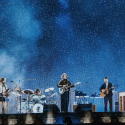
The headliners were El Tanbura, the only band previously known here on the world music circuit and whose richly atmospheric albums are well worth investigating. Now over 20 years in existence, they are based in Port Said (and - I am open to being corrected here - were not in Tahrir Square at the height of the protests). This 11-piece band was led by Zakaria Ibrahim. As with other bands, they were able to sing about fighting oppression under Mubarak but only if it was about events in history like the Suez war over 50 years ago. Their audience would read between the lines in applying the words to contemporary politics. Now they could sing songs about Mubarak and get away with it, but they finished, amusingly enough, with the audience clapping madly to a song of Suez vintage about the English imperialists.The band did a slightly ill-advised Arab dad-at-the-disco dance to accompany it.
Not all the musicians on the night were as technically accomplished as some I’ve heard from the region – but that wasn’t the point. Here were eminently capable musicians celebrating freedom and, for the first time in living memory, being able to sing what they wanted. One of the protesters photographed in a book for sale in the foyer had a banner: “I used to be afraid, I became an Egyptian". Many of the musicians have been going back to Tahrir Square in recent weeks to keep up the pressure on the post-Mubarak authorities.
An inspirational evening and well worth it, but if there is a next time the organisers should consider making greater effort to communicate the meaning and the poetry of what we were listening to – whether through backdrops, in the programme or in the introductions.
 Find El Tanbura on Amazon
- Other contemporary music events at the Barbican