“One pure sonofabitch 45. The record to put them high in the national charts. Top five at least.” In October 1976, the weekly music paper Sounds was unequivocal about Eddie and the Hot Rods’ “Teenage Depression” single.
Over at Melody Maker, the tone was similarly frothing: “Everything about the single [released 29 October] works – the explosive power, the convincing presence and the intense sound. They are the first of the new-wave punk bands to trail blaze into the national chart.”
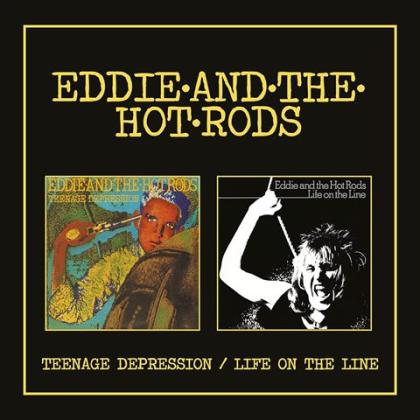
Depending on how their music was defined, this was so. A month earlier, the Hot Rods’ Live At The Marquee EP had indeed charted – hitting number 43. “Teenage Depression” did not go Top Five as predicted by Sounds, but stalled at 35. Still, not bad for a band which had issued its first single in February that year and hadn’t yet released an album.
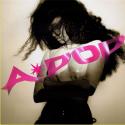
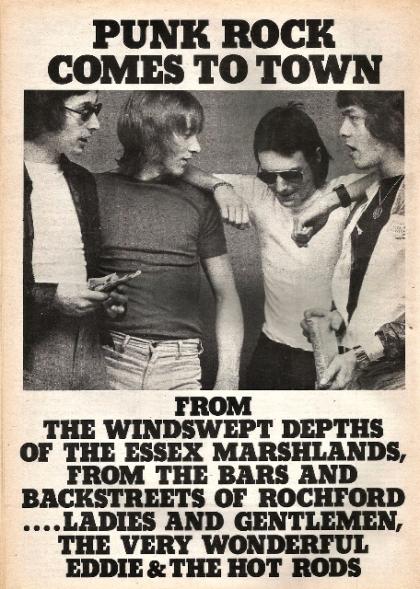
As to the punk label, in May 1976 the music monthly ZigZag had headlined an article on the Hot Rods “Punk Rock Comes To Town.” (pictured below left)
Weekly paper NME was also on board with the acclaim, accompanying the front-cover picture of the band’s guitarist Dave Higgs on its 18 September 1976 issue with the words “With one resounding B flat chord, Eddie And The Hot Rods save Rock and Roll."
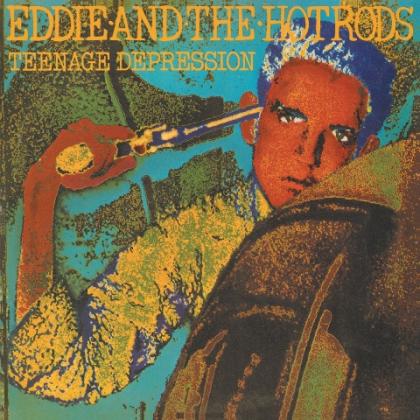
However, a problem was emerging. The Overton Window of what constituted punk was swiftly shifting. The Hot Rods had been supported in February 1976 at The Marquee by Sex Pistols and had to be well aware something else classification-wise was in the offing. And then there was muttering about the Teenage Depression, their debut album – released 19 November 1976, a week before Sex Pistols first single “Anarchy In The U.K.”
The UK’s first – and then only – punk fanzine Sniffin’ Glue had since its inception been an avowed supporter of Eddie and the Hot Rods. But, in its November 1976 fifth issue – which also carried a rave review of them live – said of the album that the band have a “flat sound in the studio, no distinctive sound to build on. A poor imitation of the real-live thing. I’m gonna stick to seeing the band live. It’s the only way to stay liking ‘em.”
In the world of what was unambiguously punk, there were grumblings. In October 1976’s Sniffin’ Glue, The Clash’s Mick Jones – who was in the band with Joe Strummer, formerly of The 101ers, who the Hot Rods regularly played live with in 1975 – said of the Hot Rods “they’re a load of bozos and they’re not telling the audience to do anything other than stay as they are, they’re playing old stuff and I don’t think much of their originals. The situation is the Hot Rods’ audience are bozos, and its easy to identify with a bozo.”
In 1977, there was further griping. When June 1977’s live EP At The Speed Of Sound was covered in Sounds, the verdict was “another live EP, not as good as the Marquee one. The Rods were good when there was nothing else to listen to. Now they seem a bit lame.”
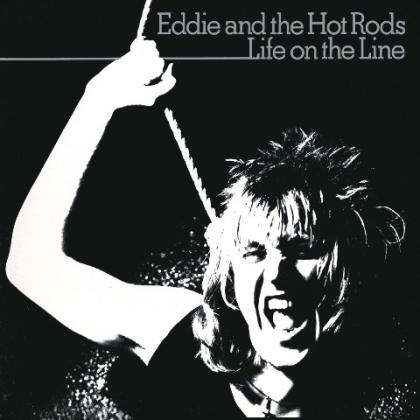
Despite this, their next single “Do Anything You Wanna Do” – credited to “The Rods” and issued 29 July 1977– was a smash, went Top Ten and was and is one of the UK’s greatest rock-pop singles. The parent album Life On The Line, in shops 4 November 1977, was similarly strong: surprisingly, it only spent three weeks on the album charts, peaking at 27 (Teenage Depression had hit 43 in its one week on the album charts). But after this, declining chart fortunes and Eddie and the Hot Rods gradually became less-and-less a vital force. They were, though, the thread linking pub rock (which is what they really were) and punk rock.
The band had formed in Rochford, Essex in 1973, and were initially called Buckshee. Guitarist Dave Higgs was previously in a band named The Fix, which also included future Dr Feelgood members Lee Brilleaux, John Sparks and – at another point – Wilko Johnson. There were line-up changes and, in either 1974 or 1975, Buckshee became Eddie and the Hot Rods. They made their London debut at The Kensington pub on 17 May 1975 – Dr Feelgood got them the booking. More London dates were played, including a residency at the Nashville Room with The 101ers (just as Sex Pistols would do there in 1976).
After seeing a 7 October 1975 Nashville show, Island Records signed them in late November – each member of the band was put on a wage of £20 a week. Essex music-scene figure Ed Hollis came on board as their manager. After December 1975 and January 1976 recording sessions at Trident Studios, which yielded enough tracks for an album, they began recording afresh at Jackson’s in Rickmansworth – the debut single, February 1976’s “Writing On The Wall” was from these later sessions. Harmonica player Lew Lewis was then fired, and their also non-charting second single, a not-great version of “Wooly Bully,” was produced by Roxy Music's Andy McKay, who also played on it. It was the Live At The Marquee EP which made a mark though.
The next milestone after the Teenage Depression album was the February 1977 arrival of former Kursaal Flyers guitarist Graham Douglas. He instantly contributed to the songwriting and, in the “Do Anything You Wanna Do”/ Life On The Line period, the band was on fire.
The soundtrack to all this is gathered on the literally titled double-CD set Teenage Depression / Life On The Line. Alongside the two albums are the non-album tracks from singles and EPs, plus the odd promo-only version. It is a no-frills set, but everything is here. The breezy liner notes do not get to grips with the content, and do not adequately dig into the important story and the contemporaneous context. There is a leaning towards manager Ed Hollis being the band’s puppeteer. It is not difficult to have this suspicion: his name appears in production and songwriting credits. There are some wrong assertions: The Dammed were not booed off at the August 1976 First European Punk Rock Festival in Mont de Marsan (the Hot Rods also played this) – the full show has been issued, and the audience loved them (the Damned did try to take the stage a second time later in the day and were prevented from doing so); it says initial copies of the Teenage Depression LP bear a photo of The Dammed – no, it was The Damned’s debut album which had a pic of the Hot Rods. This text should have been proofed.
Just as Eddie and the Hot Rods were integral to the changes in British music over 1976 and 1977, this one-stop set – for anyone who hasn’t dug into the band – needs to be heard. At their best, the Hot Rods were one of the period’s best. And even not at their best, they were a breath of fresh – actually, beer-infused, cigarette fume-laced, sweat-saturated – air.
- Next week: Little Bangers From Richard Hawley's Jukebox Volume Two
- More reissue reviews on theartsdesk
- Kieron Tyler’s website