May this be a New Year sign and a symbol of a revitalized concert scene to come: an eclectic programme of dazzling range to draw in the new pick-and-mix generation, full of segues that worked and executed with the right balance of poetry and in-your-face exuberance by a crack team of young players. The Aurora Orchestra’s American “Road Trip” nearly drove into a ditch with Kentucky singer-songwriter Dawn Landes on board, but even one or two of her numbers were fascinating and in any case the purely instrumental sequences were rich enough to make up a concert in themselves.
So let’s get the dips out of the way first. Don't get me wrong: I know this kind of collaboration can succeed (it certainly did when June Tabor met the Northern Sinfonia and Shara Worden worked with the BBC Concert Orchestra). It may have been that Landes just isn’t used to standing in front of such an audience – she seemed nervous at first and if she’d turned up on American Idol she’d have been dismissed by Randy Jackson as “pitchy” (“cracky”, too, when she forced the sound in her last song, Paul Simon’s “Hearts and Bones”). The miking may not have been ideal for her own “Dig Me a Hole” – she did, in a wonky start – and Nico Muhly’s arrangement of the folk hymn tune “Idumea (Am I Born to Die?)” clogged up its simplicity.
The second-half song strand worked much better. Landes struck an ideal note of plain poignancy in another of her own brood, “Home”, all the better for Iain Farrington’s simple piano transcription. And though I couldn’t hear all the words of the umpteen-versed ballad “The Brown Girl”, Muhly's arrangement was more successful in illustrating a grim story through to its supernatural denouement. The Aurora idea of placing between them in one haunting sequence Ives’s “The Housatonic at Stockbridge” from Three Places in New England worked literally like a dream, the simple tune this time surrounded by zinging string atmosphere.
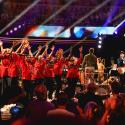
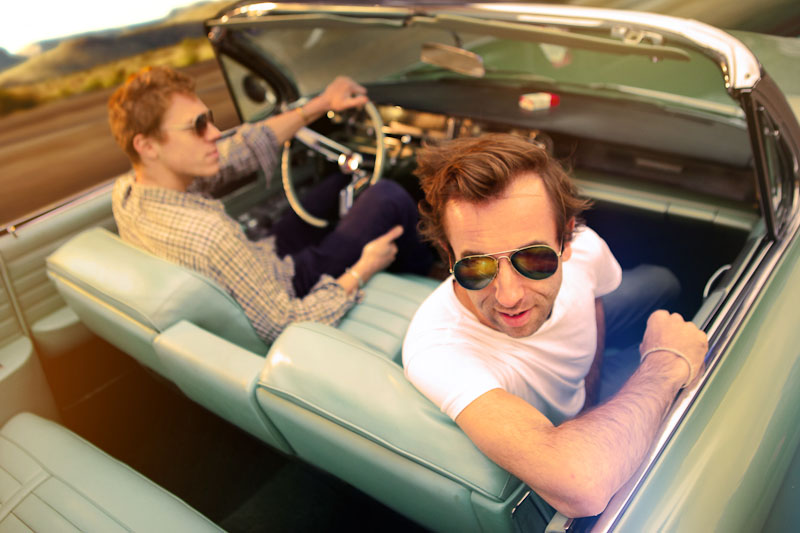 Opening segues In the concert were inspired. Who’d have thought Elliott Carter had so much song in him as the centenarian’s extraction of the trombone solo from his Double Trio as Retracing V so loveably proved? Aurora trombonist Matthew Gee gilded it with just the right degree of cool vibrato as an opening fanfare for the road journey (pictured above: Aurora's Max Baillie and Ben Griffiths by Stanton Media). Leader Thomas Gould and subtle pianist John Reid turned on the engine and steered the first movement of John Adams’s Road Movies with smooth exuberance. Then there was a beautifully modulated happening, a notated string jam session with the brilliant Iain Farrington serving up a transcription of an arrangement, based on a performance of the “folk fiddle melody” Dusky Meadow – whether UK Scots or Nova Scotian doesn’t really matter – by Hanneke Cassel. The wow factor went up a notch when Max Baillie swapped his viola for a banjo. This was one number throughout which we needed to be on our feet bouncing.
Likewise the ants-in-pants discombobulation of Adams’s Chamber Symphony. The Auroras are no stranger to this demented polyphonic riot – they played it in another New World-themed concert back in 2011 – but practice makes perfect, and though it was difficult to know what to fix on, every strand made sense. The great American based what was, in 1992, his most complex piece on Schoenberg’s splurge of the same name – as Adams describes it so well in his indispensible journey through 20th century music Hallelujah Junction, “an entire Strauss tone poem or a Mahler symphony compressed into a trash compactor, squeezed down and spring-loaded into a tightly wound mass of volatile energy.”
Textures shift with bewildering sleight of hand
That applied here too in a work which is to Adams's giant freighter Harmonielehre what Schoenberg’s piece is to Strauss’s Ein Heldenleben. But Adams’s work has gone through the classic-jazz and cartoon-music processor too: this time I heard not only the cited Milhaud and Hindemith models but also Stravinsky’s Ebony Concerto and Bernstein’s Prelude, Fugue and Riffs.
None of the references hangs around long enough to feel derivative, and the textures shift with bewildering sleight of hand. For the first five minutes I couldn’t take my eyes off the razor-sharp artistry of percussionist Henry Baldwin, phenomenal on his drum set. Then interest moved on to the rising phrases of the brass, the trombone and piccolo songs of the central “Aria with Walking Bass” and much later the gobsmacking, hold-on-a-bit violin cadenza of the crazy finale. Throughout all this the acoustics of Kings Place's Hall One were tried and found perfect in every frequency.
Every player deserves a credit, and so of course does conductor Nicholas Collon, who balanced the Adams to perfection with an ideally lyrical-vibrant take on Copland’s Appalachian Spring (many of the same ingredients, polar-opposite effect). Even given the sheer beauty of Timothy Orpen's cornerstone clarinet solos, its “gift to be simple” never touches me as it does others - my loss - but with the nine strings working wonders on what are usually more sensuous textures, the ballet music sent us all out clear-headed in the hope of warmth and ease now not so far away.