It’s nine days into the 10-day London Jazz Festival, and highlights so far include the double bill of saxophonists Steve Williamson and Steve Coleman, and the UK’s own Empirical supporting veterans Archie Shepp and Joachim Kuhn (the former a mellowed African-American firebrand, the latter a German pianist with all the wild intensity of Klaus Kinski in a Beethoven biopic). Contemporary crooner Gregory Porter, who played the "Jazz on 3" launch at Ronnie Scott’s, didn't do much for me, but it seems already to have been written that he is THE FUTURE OF JAZZ and it might just come to pass.
The room wasn’t full for Henry Threadgill – maybe everyone was next door at the Portico Quartet – but for fans of more leftfield music, the multi-instrumentalist’s rare London appearance had been much anticipated. The jazz avant-garde is a world dominated by improvisers; Threadgill, who was associated with Chicago’s pioneering AACM in the 1960s and went on to lead groups including Air, has established himself as one of its few truly gifted composers.
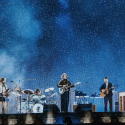
Only when he switched to alto sax did the music acquire quite the grit it neededSad to report, however, the show was a mild anti-climax. Clad in green and brown and sporting a loose waistcoat, all from Barbour’s lesser-known Robin of Loxley range, Threadgill seemed largely content to act as ringmaster. He didn’t play at all during the opening minutes, and when he did join in he favoured feathery flute over the more familiar alto saxophone. This left the focus on his fellow musicians - a typically imaginative line-up of acoustic guitar, acoustic bass guitar, tuba/trombone, cello and drums - and on the material itself. Much could often have passed for free improvisation, although a compositional hand was evident in the intricately tessellated rhythms and sudden, emphatic endings.
It was clever stuff, certainly, but - for all the bottom-end wallop when tuba joined the thunder and thump of the acoustic bass guitar - also rather cold. This is an accusation that has been levelled at fellow Chicagoan Anthony Braxton, but Threadgill’s peculiar talent has been to combine contemporary classical and free-jazz influences with rambunctious ragtime and marches: "If you can’t move to Threadgill," young Oxford pianist Alexander Hawkins told me earlier this year, "you may be clinically dead." Such a counterweight was lacking for much of the show last night (don't worry, I've checked my pulse). Only when he switched to alto sax did the music acquire quite the grit it needed, but then suddenly it was all over without an encore.
Still, there's one more night of the LJF still to go: a tough call between free-jazz innovator Ornette Coleman and Hermeto Pascoal, a Brazilian musician described by Miles Davis, no less, as one of the most important musicians on the planet.
- The London Jazz Festival continues until 20 November