First Person: trumpet player Ibrahim Maalouf on his family's vital connection to the quarter-tone trumpet

The Lebanese-French musician's father was behind a unique musical innovation

share this article

Maalouf with his four-valve trumpet

There is a story hidden inside my trumpet.

Not the kind of story people usually associate with innovation today. No laboratory. No startup. No investors. No software. No algorithm.

Just a poor Lebanese peasant’s son, born in 1941 in the mountains above Beirut, listening to village brass bands trying – and failing – to play Arabic music.

My father, Nassim Maalouf, grew up surrounded by European-style fanfares that had settled permanently across Lebanon during the colonial partition of the Middle East. Brass instruments arrived with soldiers, ceremonies, churches, and military traditions, before becoming part of daily Lebanese life. Villagers embraced them. Weddings embraced them. Entire generations grew up hearing trumpets echo through mountain valleys.

But something was wrong.

The maqams – the very soul of Arabic music – could not fully exist inside a traditional Western trumpet. The instrument itself was incapable of producing the quarter-tones essential to Arabic musical expression. Yet nobody around my father understood this technically. My grandfather, himself a village musician, believed the players simply lacked discipline or education.

He did not realize the instrument itself was incomplete.
Image
dad

My father understood it almost immediately.

As soon as he seriously began practising trumpet, he realized the problem was mechanical, not cultural. The solution seemed simple to him: modify the instrument so it could finally access the missing notes.

But history moves strangely. Sometimes inventions are born not from institutions, but from heartbreak.

In the early 1960s, my father fell deeply in love with a German woman living in Beirut. She encouraged him constantly to leave Lebanon, to pursue music seriously, to believe his future could exist somewhere beyond poverty and circumstance.
Then one day, she told him she had to leave. She was getting married. My father was devastated.

And almost impulsively, he boarded a boat to Europe with no clear destination, very little money, and only the vague certainty that his life had to begin somewhere else.
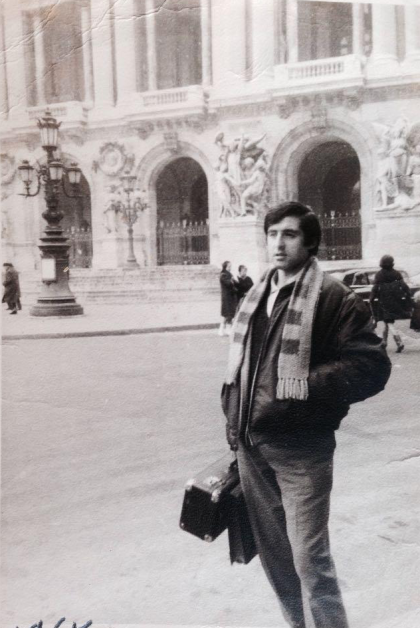
When he arrived in France in 1964 to study classical trumpet, the first thing he spoke about was his idea: adding a fourth valve to the trumpet in order to access quarter-tones (Nassim Maalouf pictured above, outside the Paris Opera in 1967). France at the time was still a country of craftsmen, workers, repair shops, and metal workshops. Very quickly, he found people willing to help him build the first prototype.

And in 1968, something extraordinary happened. One of the last truly organic musical inventions of the modern era was born.

Not digital. Not virtual. Organic.

A transformation of breath, metal, mechanics, and human intuition.

Today, I carry that instrument around the world almost like a flag. Because what my father invented was never simply “an Arabic trumpet”. That definition is far too narrow.

Quarter-tones do not belong exclusively to Arabic music. They exist almost everywhere humans have expressed emotion through sound: in Celtic music, African traditions, Indian ragas, Japanese music, Eastern European folklore, flamenco, blues, and countless oral traditions across the world. Even the famous blue note in jazz – inherited from African musical traditions – exists precisely in those spaces between the fixed notes of Western academic systems.

Human emotion has never been perfectly tempered.

What fascinates me is that my father’s invention arrived decades before our current obsession with globalization and cultural hybridity. Without theory, without slogans, without political discourse, he simply built an instrument capable of moving more freely between cultures.

And yet almost nobody talks about it. We live in an age fascinated by technological innovation, artificial intelligence, and digital revolutions. We celebrate what is fast, disruptive, virtual, scalable. But we rarely celebrate slow inventions anymore. We rarely celebrate mechanical poetry.

Because my father’s invention does not belong to the mythology of modern innovation. It was not created by a corporation, a university, or a billionaire engineer. It was imagined by a poor immigrant who simply could not accept hearing his culture played incorrectly.

That is what moves me most today. Not only the musical achievement, but the symbolism behind it.

A peasant’s son from Lebanon inherits a European brass tradition introduced through colonial history, transforms it through Arabic musical language, then collaborates with French craftsmen to create an instrument capable of crossing cultural borders more freely than before.

Without ever trying to make a political statement, my father created one.

His trumpet quietly suggests something our era still struggles to understand: cultures do not become weaker when they adapt to one another. They become deeper.

In the early 1960s, my father fell deeply in love with a German woman living in Beirut. She encouraged him constantly to leave Lebanon, to pursue music seriously, to believe his future could exist somewhere beyond poverty and circumstance.
Then one day, she told him she had to leave. She was getting married. My father was devastated.

And almost impulsively, he boarded a boat to Europe with no clear destination, very little money, and only the vague certainty that his life had to begin somewhere else.
When he arrived in France in 1964 to study classical trumpet, the first thing he spoke about was his idea: adding a fourth valve to the trumpet in order to access quarter-tones (Nassim Maalouf pictured above, outside the Paris Opera in 1967). France at the time was still a country of craftsmen, workers, repair shops, and metal workshops. Very quickly, he found people willing to help him build the first prototype.

And in 1968, something extraordinary happened. One of the last truly organic musical inventions of the modern era was born.

Not digital. Not virtual. Organic.

A transformation of breath, metal, mechanics, and human intuition.

Today, I carry that instrument around the world almost like a flag. Because what my father invented was never simply “an Arabic trumpet.” That definition is far too narrow.

Quarter-tones do not belong exclusively to Arabic music. They exist almost everywhere humans have expressed emotion through sound: in Celtic music, African traditions, Indian ragas, Japanese music, Eastern European folklore, flamenco, blues, and countless oral traditions across the world. Even the famous blue note in jazz – inherited from African musical traditions – exists precisely in those spaces between the fixed notes of Western academic systems.

Human emotion has never been perfectly tempered.

What fascinates me is that my father’s invention arrived decades before our current obsession with globalization and cultural hybridity. Without theory, without slogans, without political discourse, he simply built an instrument capable of moving more freely between cultures.

And yet almost nobody talks about it. We live in an age fascinated by technological innovation, artificial intelligence, and digital revolutions. We celebrate what is fast, disruptive, virtual, scalable. But we rarely celebrate slow inventions anymore. We rarely celebrate mechanical poetry.

Because my father’s invention does not belong to the mythology of modern innovation. It was not created by a corporation, a university, or a billionaire engineer. It was imagined by a poor immigrant who simply could not accept hearing his culture played incorrectly.

That is what moves me most today. Not only the musical achievement, but the symbolism behind it.

A peasant’s son from Lebanon inherits a European brass tradition introduced through colonial history, transforms it through Arabic musical language, then collaborates with French craftsmen to create an instrument capable of crossing cultural borders more freely than before.

Without ever trying to make a political statement, my father created one.

His trumpet quietly suggests something our era still struggles to understand: cultures do not become weaker when they adapt to one another. They become deeper.

And perhaps that is why this instrument still matters today. Because in a world increasingly divided into identities, territories, and ideological camps, it reminds us that the role of art is not to erase differences, but to create tools capable of speaking across them.

And perhaps that is why this instrument still matters today. Because in a world increasingly divided into identities, territories, and ideological camps, it reminds us that the role of art is not to erase differences, but to create tools capable of speaking across them.

Below: listen to "Zaatar & Zeit" by Ibrahim Maalouf
Add comment

The content of this field is kept private and will not be shown publicly.
Name that you would like to appear as the author of the comment
One of the last truly organic musical inventions of the modern era was born

rating

0

share this article

the future of arts journalism

You can stop theartsdesk.com closing! 

We urgently need financing to survive. Our fundraising drive has thus far raised £33,000 but we need to reach £100,000 or we will be forced to close. Please contribute here: https://gofund.me/c3f6033d

And if you can forward this information to anyone who might assist, we’d be grateful.

Subscribe to theartsdesk.com

Thank you for continuing to read our work on theartsdesk.com. For unlimited access to every article in its entirety, including our archive of more than 15,000 pieces, we're asking for £5 per month or £40 per year. We feel it's a great deal, and hope you do too.

To take a monthly subscription now simply click here.

Or
Why not take an annual subscription and save a third off our monthly price simply click here.

more new music

The Lebanese-French musician's father was behind a unique musical innovation
The Philadelphia punk rockers continue to impress
A partial account of how Brit-punk absorbed an aspect of reggae
The Fez Festival Of World Sacred Music and the Fes Gathering bring the world together
Bristol band aren't happy but offer up the occasional sing-along
A new album is unveiled and old tunes are played for the last time
Decades of psychedelia and wonder packed into a puzzling construction
Neo-folk songs that are woozy and atmospheric but thoroughly engaging
An eardrum damaging evening spent with Birmingham’s Sunn O))) worshippers