

Skeletal horses; piles of newborn babies smothered in a bloody sheet; a whole garden centre of prickly pears. There’s no denying that Italian director Emma Dante’s new production of Verdi’s Macbeth, which Turin’s Teatro Regio brings to the Edinburgh International Festival, is visually dazzling, even at times hallucinatory.
opera reviews
David Nice

The road to hell is paved with brilliant ideas in Berlioz's idiosyncratic take on the Faust legend.
David Nice

"Ura!" as soldiers cry in Russian epic opera's last fling, Prokofiev's War and Peace: supertitles have arrived at the Proms, after much special pleading here and elsewhere.
David Nice

So much light in the Glyndebourne production of Brett Dean's Hamlet; so much darkness in Mozart's La clemenza di Tito according to director Claus Guth. Something is irredeemably rotten in the state of ancient Rome, at odds with the fundamental enlightenment and radiance of Mozart's last complete opera.
Robert Beale

Clonter Opera is a finishing school for young opera performers, with its own well appointed theatre and professional administration and artistic direction, based on a farm in Cheshire near Jodrell Bank. It’s seen a succession of promising young post-conservatoire singers come to perform in fully staged productions for many years, and is also (from an audience point of view) the only countryside summer opera venue of any substance in the north of England.
David Nice

What a pity Beethoven never composed an appendage to Fidelio called The Sorrows of Young Marzelline. One crucial moment apart, the music he gives to his second soprano in his only opera isn't his best, but Louise Alder so lived the role of the gaoler's daughter in love with a woman disguised as a man that everything else felt rather less intense. It's only fair to say that there were other singers facing bigger challenges very stylishly, for the most part, but neither they nor the BBC Philharmonic under its chief conductor Juanjo Menja made us feel as though their lives depended on the outcome. And that ultimate lack of blazing commitment, in what should be the most incandescent of prison dramas, sold it all a bit short.
True, this was an unashamed concert-performance Prom with no directorial supervision, principals delivering score-free – with one exception, James Creswell, a more than adequate late replacement for Brindley Sherratt as gaoler Rocco – in front of the orchestra, with co-ordination not always the tightest. This, Beethoven's much more celebrated revision of the original Leonore swapping drama for a pageant-finale, worked best in that oratorio-like final scene – though like much else it was bright and pleasant rather than shattering or deeply moving. It was hard to come from the Chamber Orchestra of Europe under Haitink, projecting every phrase of Mozart and Schumann into the Albert Hall space, and be brought back down to earth with the more usual situation of fuzzy strings lacking ideal bite. No doubt the answer would be to stand in the Arena, an occasional option, but no way was this playing on the same level. And the horns were having a bad night.
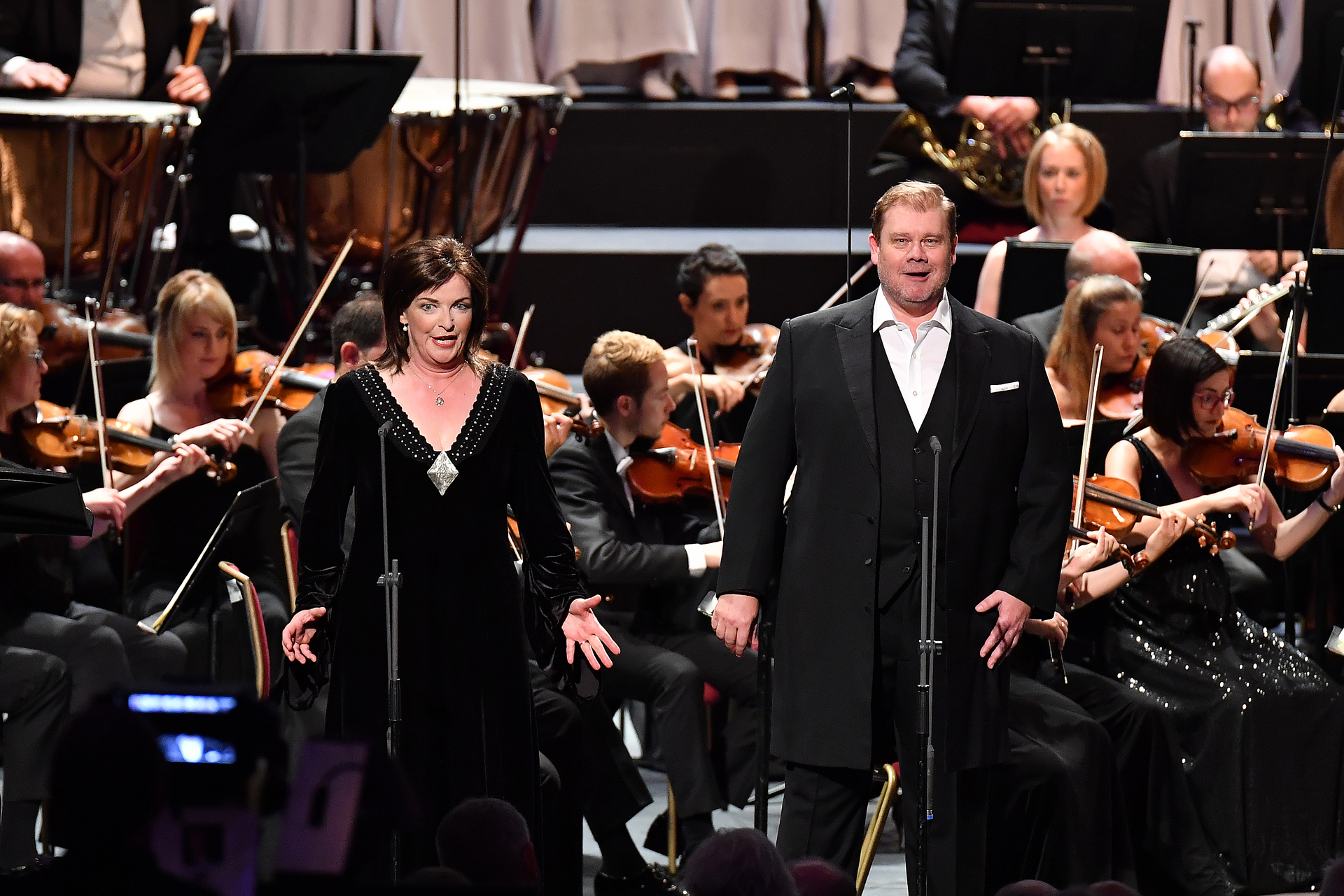 Nor was focus always there in Ricarda Merbeth's Leonore (pictured above with Stuart Skelton – nice dress, but a trouser suit would have been more appropriate for the heroine's male disguise). Her lower middle-range tended to disappear in these acoustics, though it was obvious why she's a fit for the part: no soprano I've heard live has essayed the testing top so fully or flawlessly. None, either, has made clearer work of what can be a treacherous bark of a duet when the wife who's risked her life for her political-prisoner husband is finally reunited with him. Stuart Skelton could manage it, too, though even he was tested by the ludicrous high vision of "an angel, Leonore" at the end of his aria: perhaps it can only work as part of a stage performance delivered in extremis. Skelton was otherwise palpably in control, phrasing stylishly and weighting the big entry on the word "Gott", swelling it as only a heroic tenor can.
Villainous prison governor Pizarro can only work at a level of testosterone-driven edginess; Detlef Roth conveyed nothing more than a petulant bank-manager, despite a couple of energetic footstamps. Creswell's subordinate could have eaten him for breakfast; as they sang alongside each other, one got the feeling of the same mésalliance as when King Philip in Verdi's Don Carlos has more vocal power than the only one supposedly lording it over him, the Grand Inquisitor. We could have done with more colours and force from the Orfeón Donostiarra, Spain's finest choral society, playing their compatriots albeit singing in German, but emphatically not the essential professional opera chorus. Better, perhaps, to have assembled voices from the London music colleges.
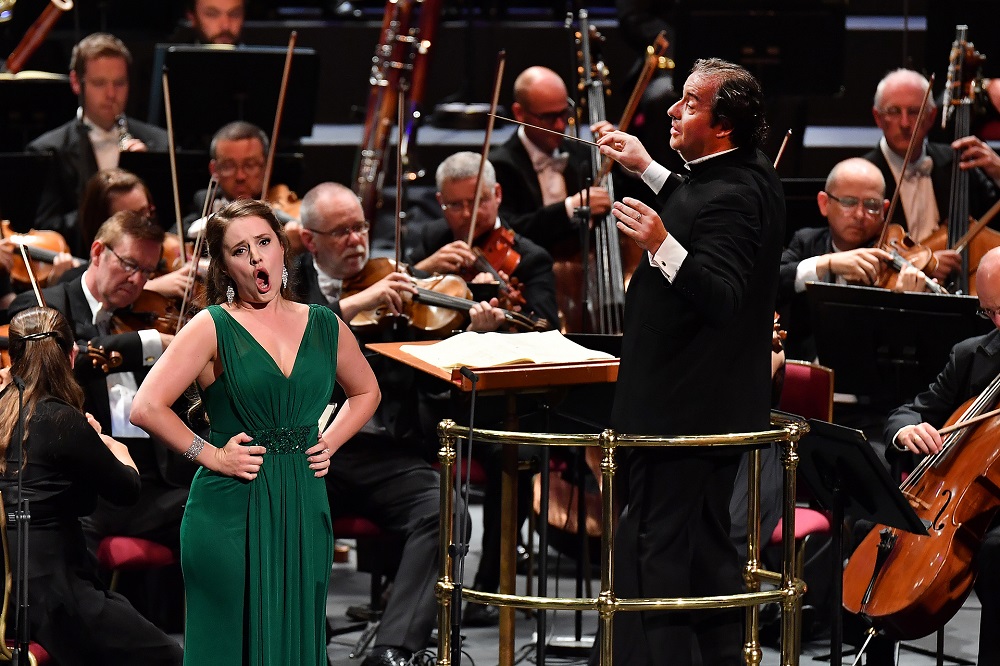 Only the three not-so-long graduated young Brits in the cast offered perfection. Alder (pictured above with Mena), having made her surprise Proms debut three years ago stepping in as the Glyndebourne cover Sophie in Der Rosenkavalier, has deservedly shot to fame since then, winning the Dame Joan Sutherland Audience Prize at the BBC 2017 Cardiff Singer of the World Competition, and she owns the stage. Her launch of the great canon-quartet "Mir ist so wunderbar" provided the one truly moving moment of the evening. Tenor Benjamin Hulett was a fine match as the lad her Marzelline treats so badly, and David Soar declaimed to perfection as deus ex machina Don Fernando. But inevitably their subordinate roles were limited.
Amplifying the (minimal) spoken dialogue meant a plunge in levels for the music. Cultivated, mostly lively orchestral playing just needed more heft, despite excellent work from timpanist Paul Turner. It didn't tell the story by itself, and given that the Proms organisers still won't provide supertitle screens around the hall – it can be done – more of the performers needed to work harder to carry the narrative and compel focus from those in the audience with their heads in the programme.
- Listen to this Prom for the next month on the BBC iPlayer
- Stop press: Louise Alder replaces an indisposed Andrei Bondarenko for a Wigmore Hall recital with Gary Matthewman tonight (22 July)
- Read more opera reviews on theartsdesk
Next page: watch Louise Alder sing 'No word from Tom' from Stravinsky's The Rake's Progress at the BBC Cardiff Singer of the World Competition
David Nice

They get to work with the best music and language coaches in the business. They make their mark in small parts throughout the Royal Opera season and showcase their art more prominently at the end of it, proving to the world that there are major talents among them (four outstanding ones, I reckon, on this showing).
Gavin Dixon

Katya Kabanova is an ideal fit for Opera Holland Park’s verismo-focussed programming. It’s Czech, of course, but the dramatic style is very close to the Italian opera of the day, the story all gritty realism, the music punctuated with intense emotive episodes. This staging, a revival of Olivia Fuchs’s 2009 production, does the work full justice, a straightforward account that doesn’t overcomplicate the clear-cut narrative and morality.
David Nice

Unless you're an undiscriminating fan of bel canto, the lesser Italian and French operas of the 1830s and '40s - that's to say, not Verdi's Nabucco and Macbeth or Berlioz's Benvenuto Cellini - need to be approached with caution. Once you've lowered expectations to a simpler level of compositional style, you then have to hope for stylists of the first order to make it work. That doesn't happen too often these days, but the inspirational company Opera Rara, responsible for this often spectacular programme of operatic excerpts, knows where to find them. In soprano Joyce El-Khoury, tenor Michael Spyres and, an equal partner in the pleasures of the evening, conductor Carlo Rizzi conducting an amazingly idiomatic Hallé, it found the magic recipe for showcase success.
It was as well to have it announced that the Lebanese-Canadian soprano was recovering from a cold; catarrh stops the flow in lyric lines, and that was occasionally apparent. But what a spectacular voice this is, allied - as with Spyres - to supreme musicianship. The top makes the ears ring, but can also be reduced to a sliver of sound in true bel canto style; the stage presence is perfect, dramatic evocation economical but crystal-clear. El-Khoury, Spyres and Rizzi (pictured below by Neil Bennett) between them managed to rebirth the excerpts from the one opera I thought I knew well, Donizetti's Lucia di Lammermoor, culminating in a shared ability to sing the eight-bar melodic phrases of the Act 1 duet in a single breath. Sheer artistry.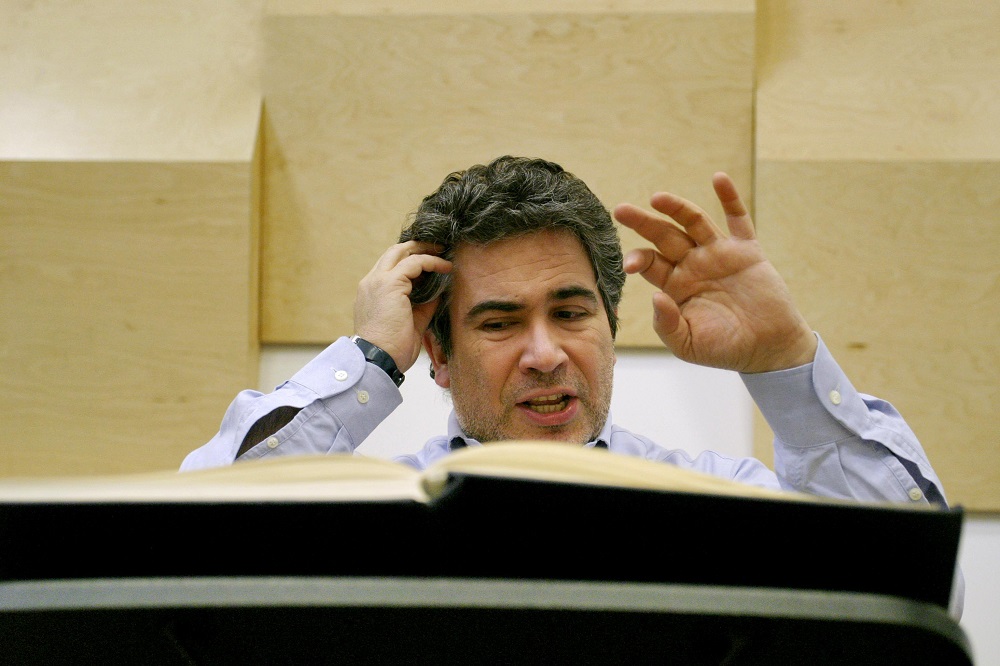 But what of the unfamiliar, its presence linked by repertoire for two apparently great singers of the 19th century, Julie Doras-Grace and Gilbert Duprez? The best cases were made for an aria and duet from Halévy's Guido et Ginevra - interestingly orchestrated in what, we were told, are reminiscences of the hero's early Romance, and with a high quotient of melodic originality - and the Act 1 air from Auber's Le lac des fées. Spyres always makes a good case for an unorthodox turn of phrase. His beaten-bronze sound in the French repertoire is ideal; even if the high notes are never actually thrilling - he got there without the bottling which troubled me in the Royal Opera's Mitridate - the middle range is perfectly valorous, and he always projects the meaning of the text.
More stock-in-trade were the numbers from Meyerbeer's Robert le Diable - lovely phrasing of the crucial word "grâce" from El-Khoury, though - Rossini's Otello (the hero's entrance cavatina) and Hérold's Le Pré aux clercs, bland material despite the violin solo beautifully taken by Hallé leader Simon Blendis. The Hallé's first trumpet, Gareth Small, also gilded his bel canto spotlight with handsomely applied vibrato to the Halévy aria and the Pas de Six from Donizetti's La Favorite, much more original as ballet music than Verdi's Paris divertissement for the recast I Lombardi, Jerusalem. Verdi's glory days as a dance master were yet to come, while Donizetti surprises us with orchestral sophistication, especially in a delicious duet for the two oboes.
It was hard not to feel a sudden affection for this pisseur of 70-odd operas at his best; time to go and listen to the Opera Rara recording of Les Martyrs featuring the evening's two stars - appropriately they served up a powerhouse duet from that rediscovered grand opera as their encore - plus their two discs, soon to be released but available last night, including the concert's plums. Not, perhaps, since Nelly Miricioiu revived the bel canto art towards the end of her career have its possibilities seemed so exciting.
Next page: watch a short excerpt of El-Khoury, Spyres and Rizzi recording the Act 1 Duet from Lucia di Lammermoor
stephen.walsh

About The Magic Flute there’s a certain amount of domestic theatre and a great deal of pantomime. It calls for fun, sentiment, movement, a measure of spectacle, and plenty of direct communication with the audience. But like the mechanicals’ play in A Midsummer Night’s Dream it needs no excuse, no big ideas.