

Jean-Pierre Jeunet, of Amélie fame, makes so few films that whenever he pulls one out of that magic hat of his it feels like an event. At least it used to. The Young and Prodigious T.S. Spivet, which has just had its world premiere at the San Sebastian Film Festival in Spain, is a lovingly made and sweet film; but the novelty of the director’s style – that minutely observed production design and full-blown whimsy – has now completely worn off, leaving one wishing for a new dimension.
The 10-year-old protagonist, who might also be described as gifted, precocious and brimming with initiative, lives on a Montana ranch with his taciturn cowboy dad (Callum Keith Rennie, looking every bit the Marlboro Man), chatty naturalist mother (Helena Bonham Carter) and older sister. His much-loved twin brother has recently died, leaving T.S. feeling cut off from his grieving parents. So when the lad’s perpetual motion machine wins a prize from the Smithsonian Museum, he jumps on a freight train for Washington to collect it.
Jim Broadbent won the best actor prize for a typically fabulous performance in Le Week-end
What follows is a pleasing, amusing road trip, through an American West evocatively shot in 3D, offering a poignant account of a child’s guilt and the quirks of familial affection. Whatever its qualities, however, M. Jeunet needs to reset his bar.
Quai d’Orsay is a more cynical affair, though its subject is handled with a gleefulness that is positively effervescent. Bertrand Tavernier’s film dips its toe into the territory of The Thick of It and Veep, namely political satire, offering a similar take on French government as those shows present of the British and American – that it’s overrun by buffoonery and self-interest. It’s adapted from the comic book of the same name, written by Antonin Baudry and based on his experiences as a speech writer for the former French foreign minister (later prime minister) Dominique de Villepin.
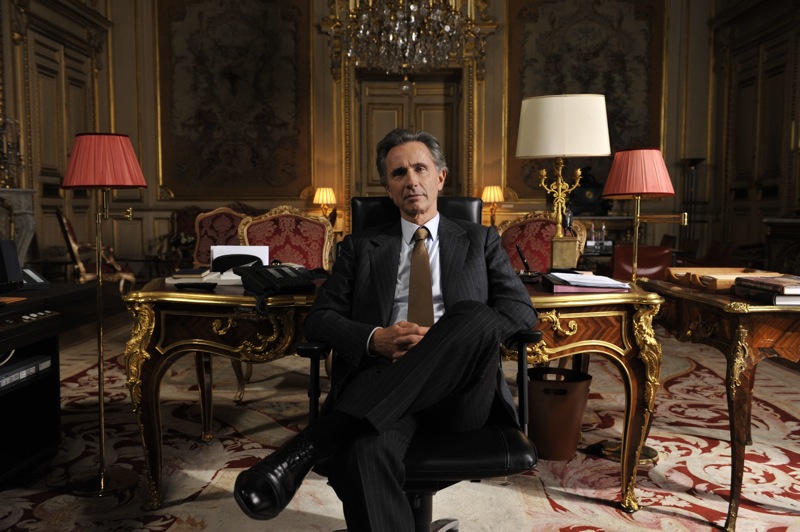 Here the minister is named Alexandre Taillard de Vorms and brought gloriously to life by Thierry Lhermitte (pictured right) as a patrician, silver-haired flurry of movement and pretension – one moment incongruously quoting the Greek philosopher Heraclites, the next waxing about the virtues of “intuitive highlighting”, whose minions can’t decide whether he’s a leftist visionary or barking mad. He’s certainly a charismatic clown, albeit with one or two surprises up his sleeve.
Our guide through the chaos is new boy Arthur Vlamick (Raphaël Personnaz), hired to take charge of the ministry’s “language” but who can’t get a word in edgeways. Actually, no one can speak or indeed function when de Vorms is in the room, least of all the one aide who knows what he’s doing, Claude Maupas (Niels Arestrup), whose quiet industry and political nous is a joy to behold.
Arthur’s remit as speech writer, a colleague tells him, is to “find things for them to say, so they needn’t do them”. His painful route through the maze of folly and misinformation – leading towards his boss’s speech to NATO against American warmongering – lends itself to almost constant hilarity, both verbal and physical. Behind the camera, Tavernier, one of France’s most intelligent and wily directors, handles proceedings with panache. For writing the adaptation, alongside Baudry and Christophe Blain, he justly won San Sebastian's best screenplay prize.
The competion jury, led by Todd Haynes, awarded the festival's Golden Shell for best film to Pelo Malo (Bad Hair), an intense, thought-provoking Venezuelan drama, about the tensions between an unemployed single mother in Caracas and her nine-year-old son, prompted by her homophobic fears about his sexuality. Jim Broadbent won the best actor prize for a typically fabulous performance in Le Week-end, the third film by writer Hanif Kureishi and director Roger Michell, which is to be released in October.












Add comment