

Mark Cousins, the multi-award winning director of this strange film, is lying in bed watching Ray Charles speaking on the Dick Cavett Show in 1972. The singer went blind in childhood; how would he respond if offered the chance to see again? “I might turn it down,” says Charles. “I’m not all that hung up about seeing things … and with some of the news I hear about today, I mean there are some things I absolutely don’t wanna see, man !”
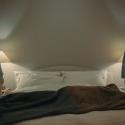
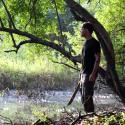
“For somebody like me who has always loved looking,” remarks Cousins, “what he says is unbelievable… Looking has been my joy, my world.” He is trying to decide whether or not to get up; tomorrow he has an appointment that is making him anxious. ”Someone is going to cut into my left eye, suck out the lens that I was born with and add in a plastic one,” he explains. What if things go wrong? This horrible thought prompts him to reflect on the importance for him of seeing. “I’d like to tell a story about our looking lives,” he says, and this quirkily intimate film is the result. His friend Michael Ewins sends a tweet: “To make a film you have to get up!” it says, but Cousins has already opted for a bedside chat. His darkened bedroom is a good place to imagine what he might see if he went outside and to remember things encountered in a lifetime of looking. He glances out of the window, though, to see a tree that provides a comforting sense of continuity, but also a man standing on a chimney stack, as if contemplating suicide (pictured above).
He returns to bed and what follows is an apparently off-the-cuff ramble around the subject starting with the blur of infancy. Cue beautiful footage of misty landscapes, Venice in the fog, a Japanese painting of ghostly pine trees, a Turner seascape and the final frames of Billy Wilder’s Sunset Boulevard in which focus is pulled to dramatic effect. Cousins links the images together with observations delivered in a soft Irish brogue that are brief but insightful.
Topics such as motion, making or avoiding eye contact, light and self-regarding adolescence are given similar treatment while colour sees the painter Yves Klein “signing” the Mediterranean sky with blue fingers (pictured below). The experience is fascinating – like rifling through pictures stored in the director’s brain – and I could watch for hours.
Voyeurism comes next. We see Giuseppe Cesari’s painting of Diana and Actaeon (1603). The hunter has stumbled into a grove where Diana, goddess of the hunt, is bathing with her nymphs. To punish his trespass she turns him into a stag so that his hounds will tear him to pieces. “Is that what we are when we look,” asks Cousins. “Stags?” And I’m dismayed; his question suggests total misunderstanding of Ovid’s story. The stag is not a symbol of voyeurism, as he seems to think, but of the reversal of normal power relations – the predator reduced to prey, the hunter hunted down.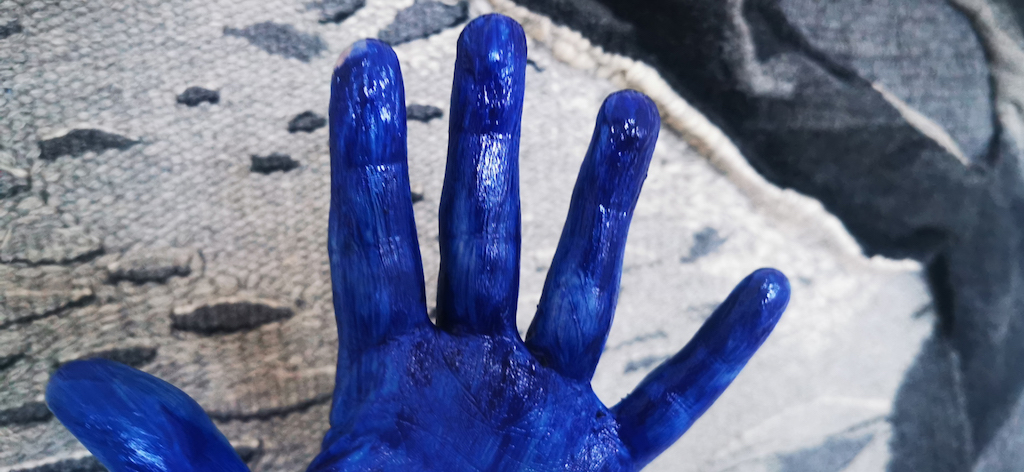 Now we see Cousins floating in shallow water. “I’m the opposite of the goddess Diana; I don’t mind being seen naked,” he says. “Does that make me an exhibitionist, or an object in your eyes? Does it make you a voyeur, a stag?” I’m astonished at his naivety in comparing his peaceful solitude with the invasion of Diana’s privacy. Is he really unaware of the gender politics of voyeurism and its routine deployment as a weapon – a way of objectifying and repressing women? In fact, lust, sexual obsession and sexual violence don’t seem to figure in his universe, despite the fact that films are his main point of cultural reference and they are rife with all three, with the male gaze being a crucial factor in all of them.
Nor does he discuss the use of looking as a mechanism for social control. There’s no mention, for instance, of the ubiquity of surveillance and facial recognition cameras in public places. To be fair, though, he has run out of time and he acknowledges the gap. “I wanted to talk about politics and adulthood today,” he says, “but instead I’m starting to feel afraid. I don’t want someone to stick a knife into my left eyeball tomorrow.”
The next day’s filming sees a dramatic change in emphasis. We witness the operation in detail, see clips of movies playing in Cousins’ head and encounter various theories about human vision. Some time later, when he tears off the eyepatch and realises that his eyesight is intact, he is visibly moved. As if the emotion is too intense to explore, though, we switch to a future where the director is an old man living in Sweden. This inexplicable shift feels fortuitous and, after the pillow talk of the first section, shockingly removed. Over a seemingly interminable shot of seaweed drifting in the current, Cousins concludes “I realise Ray Charles was wrong. We don’t put up with what we see. It isn’t a burden; it’s the opposite.” And so the film simply fizzles out, leaving you feeling frustrated and in danger of forgetting all the riches you’ve encountered along the way.




Add comment