

Italian journalist Roberto Saviano still lives in fear of his life 11 years after writing Gomorrah, which explores how criminal gangs use tax havens to launder money. “You make 100 million euros from trafficking cocaine or migrants,” he explains, “and you buy restaurants, hotels and houses legally, sell them to your offshore company then buy them back at a much higher price.”
No-one else, it seems, has been willing to risk delving into the underlying causes of the housing crisis – until now, that is. Swedish director, Fredrik Gertten has achieved the almost impossible, making an informative and upbeat documentary that lifts the lid on the problem.
The most troubling image is a map of London covered in thousands of red dots representing properties owned by those offshore companies. The highest density is in Mayfair, where the dots almost merge; no wonder London is dubbed the money laundering capital of the world. The scale of the problem is astronomical and many of the houses stand empty, year on year. “This is not about housing, but making money,” says Saskia Sassen, Professor of Sociology at Columbia University. “The value of all real estate that functions as an asset is $217 trillion, more than the global GDP of all the countries in the world.”
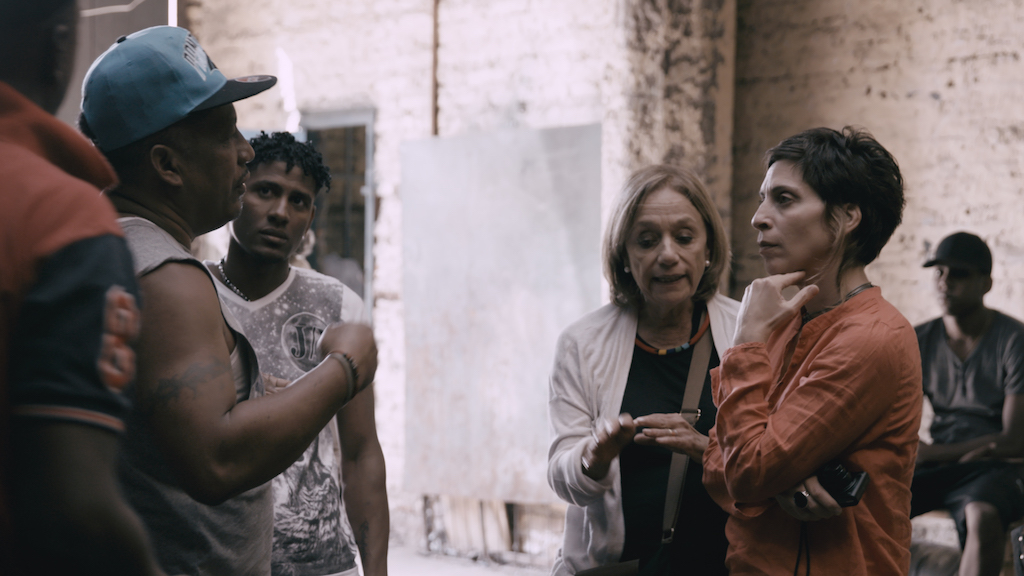
Enter the intrepid Leilani Farha, UN Special Rapporteur on Adequate Housing, who travels the world uncovering the global spread of the problem. Adequate housing is a human right, it seems, and her goal is to persuade governments to honour their obligations to citizens. We follow her to Barcelona, New York, Paris, Seoul, Stockholm, Toronto and Valparaiso; wherever she goes, the story is the same. And this amazing woman is grappling with the enormity of the task. “Am I being ridiculous?” she asks herself. “I’m 5’2” and I’m trying to make a huge difference globally. I’m thinking I can change the system.”
The other villains are private equity firms like Blackstone, whose clients are investors wanting good returns on their money. Following the 2008 financial crash, they made hay buying houses from mortgage lenders at big discounts, then doing them up and renting them out. They’ve since moved into low income housing, buying cheap apartment blocks in cities across the globe, tarting them up and increasing the rents, thereby pushing out long standing residents and destroying whole communties.
 “Its a totally dysfunctional system,” says economist Joseph Stiglitz. “They’re not creating wealth, just taking it. You can make money by destroying the world and there’s something wrong with that. They (Blackstone) are not intrinsically evil, but they are amoral, so amoral that I would say they are evil.”
The situation is so bad that Farha describes the disastrous fire at Grenfell Tower as “a physical representation of the displacement of a community. For me that’s the narrative of the world right now.”
Had the film been ten minutes shorter I’d have been suicidal, but there’s hope. Thanks to Farha’s unflagging energy, a meeting is convened in New York of mayors from cities the world over intent on formulating initiatives to combat the speculators – buying up properties and preventing public land from being sold off. Sadiq Kahn was nowhere to be seen. I wonder why ?
Although the topic is of major importance, making a feature length documentary that holds one’s attention is a real challenge; but fast pace, good interviews, nimble camerawork, snappy editing and the inspiring example of Leilani Farha all make this a must.












Add comment