Pretty Red Dress opens with a classic Motown-esque girl group belting out a show tune before cutting to Travis (Natey Jones) as he leaves prison. Waiting for him outside is Candice (Alexandra Burke); she’s sitting in her Audi, singing along to the radio.
At home is their teenage daughter, Kenisha (Temilola Olatunbosun), happy enough to have her dad back in their Lambeth flat on a council estate, but facing her own problems at school with both authority and friends.
Candice works as a cashier at a local supermarket but dreams of being a performer; she spots a sequin-studded, bright red mini-dress in a shop window. She knows it would be perfect for her upcoming audition for the lead in a Tina Turner musical.
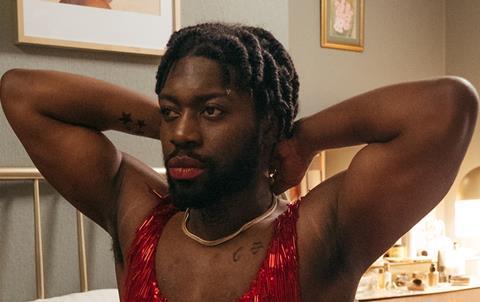
Travis takes a menial job with his smug older brother in order to pay for the dress. It turns out that he doesn’t just want to see Candice rocking that frock. He also likes the look of it and there’s fireworks when Candice catches him wearing it, along with her lingerie and lipstick (Natey Jones below). The couple have always enjoyed role-playing in their sex lives, but cross-dressing may be a step too far for Candice.
 Pretty Red Dress is haunted by the memory of Kinky Boots and Alexandra Burke’s own image as an X Factor star. Coming out so soon after the death of Tina Turner herself, it’ll doubtless attract audiences who will enjoy its homage to the late, great Anna Mae Bullock. Singer-songwriter Eliot Sumner (one of Sting’s children) has a cameo as a Mick Jagger-like actor-performer in one of the audition scenes.
While it’s great to see a British film with a majority black cast that doesn’t get trapped in familiar narratives about racism or criminality but focuses on sexuality and family relationships, it’s a shame that the dialogue and performances are so patchy.
Writer-director Dionne Edwards’s debut film is admirably ambitious, but not always wholly convincing. There are scenes of conflict – with local men, within the family – that feel underdeveloped. The ending seems rushed. Still, Burke can certainly sing and Temilola Olatunbosun, in her first screen role, shows potential.