

When Joker won the Golden Lion in Venice in September, it was an unprecedented achievement, the first time a comic book-related film had won such a prestigious prize. But then, isn’t your typical comic book film. Starring a phenomenal Joaquin Phoenix, it’s seriously themed, brilliantly executed and quite extraordinary.
We’ve seen many Jokers, including memorable turns by Jack Nicholson and Heath Ledger, so it’s not unreasonable to wonder why we’d need another. One reason is that this is a Joker without his Batman, or any superhero trappings; another, that the ‘origin story’ is not of The Joker as a villain, but a victim.
With his open nod the New Hollywood films of the 1970s, particularly the Scorsese classics Taxi Driver and King of Comedy (but also One Flew over the Cuckoo’s Nest and Dog Day Afternoon) writer/director Todd Phillips has offered a powerful depiction of one man’s mental breakdown in the context of a society tearing itself apart.
At first, this Joker actually wants to make people laugh. Joaquin Phoenix is Arthur Fleck, a professional clown in Gotham City (more clearly New York than ever). He means well, but is odd, creepy, with a condition that makes him break into uncontrollably laughter that sounds more like crying, or gagging. The first time we see this terribly sad man, he’s beaten senseless by kids. Later he stares at himself in a mirror, pulling at his emaciated face to create a cracked smile, while his running makeup gives him inky blue tears. 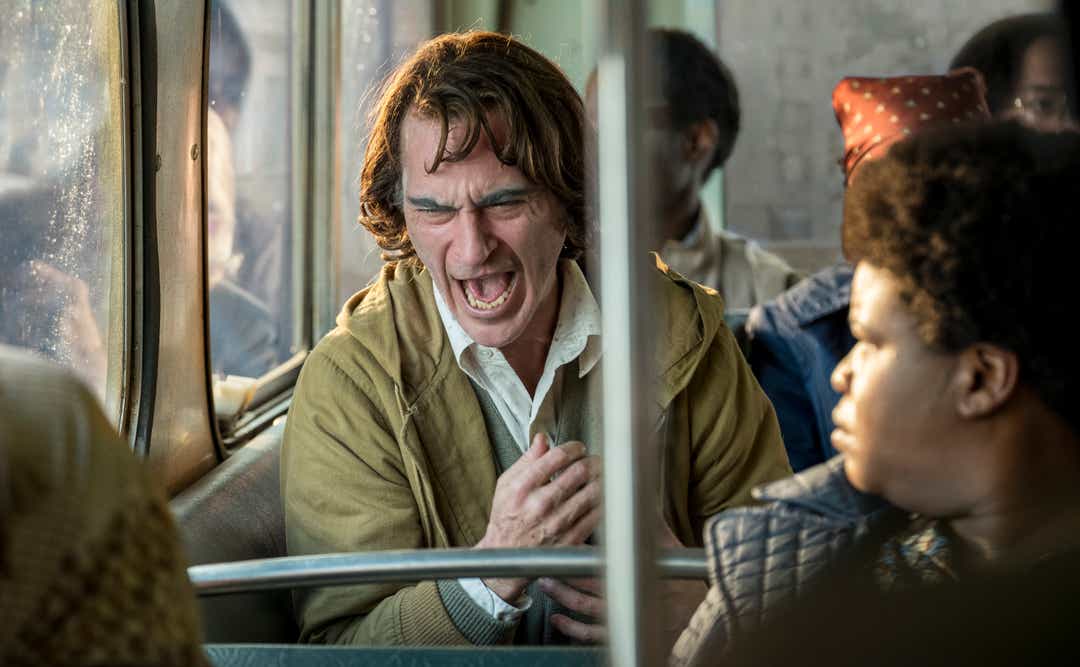 Arthur’s broke, living with his mother (Frances Conroy) in a decrepit apartment building, fantasising about the neighbour down the hall (Zazie Beetz). Outside, Gotham is in a state of emergency, with rubbish piling up on the streets. “Is it me, or is it getting crazier out there?” he asks his social worker. The answer is a bit of both. He’s spent time in a mental institution, is reliant on medication; City cuts mean that the therapy and the pills are about to stop.
All the while, Arthur keeps trying. His dream is to be a stand-up comedian, like his hero Murray Franklin (Robert De Niro). Though it doesn’t help if you can’t stop laughing at your own jokes. And even his mother asks,“Don’t you have to be funny to be comedian?”
Phillips spends most of the film turning the screw on poor Arthur, to the extend that there’s a wide choice of tipping points, including Franklin’s humiliation of him on his TV show. Arthur’s delusions trick our own understanding of his experiences, his constant bursts of crazed laughter making it difficult to know exactly what he’s feeling. But when he finally fights back, violently, he can’t stop. And Phillip’s most electric conceit is that the abused loner will bring the discontented city with him – an entire mob of angry clowns. 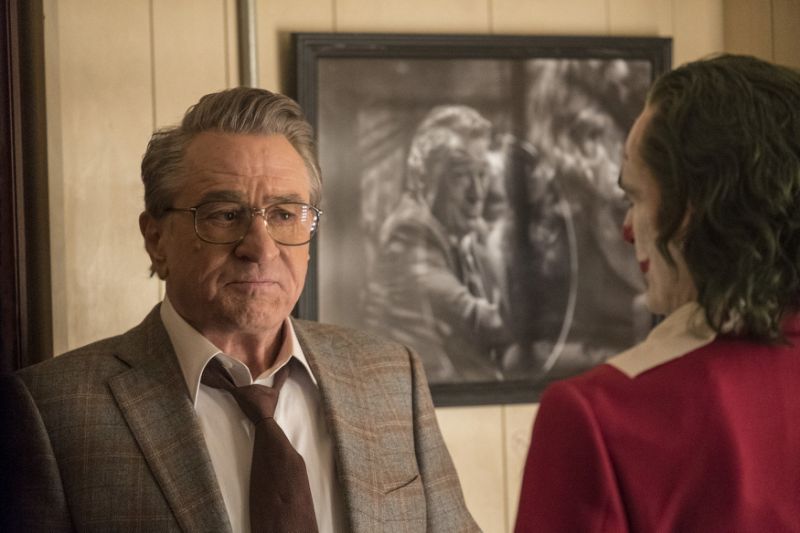 There are numerous parallels with those Scorsese films, visually and thematically, both of which he made with De Niro and both of whose protagonists suffered from mental illness – Taxi Driver’sTravis Bickle, obsessed with the depravity he sees on the New York streets, King of Comedy’s would-be stand-up Rupert Pupkin, who turns on his hero; it’s inspired casting to have De Niro flip the roles, becoming the smug establishment figure who earns Arthur’s scorn.
The Hangover films were fun, but there’s nothing really in Phillip’s CV to lead us to expect such power and purpose. This has some terrific, look-at-me set pieces, including a chase through a subway train full of clowns, and a magical scene in which Arthur enters a cinema disguised as a bell hop, while Chaplin’s Modern Times is playing on the screen. But more notable is the intense, sombre, dystopian feel of the film, created by a plangent, cello-driven soundtrack, and cinematography and production design that capture both the grimy misery of Arthur’s real life and the romantic canvas for his delusions.
And at the heart of is Phoenix. The actor has not only taken his face and body down to the bone, but paws and contorts himself constantly, in such a way that leaves no doubt about Arthur's agony, despair and growing rage. Yet now and again he'll burst into a silent, choreographed, self-involved dance, a moment of peace, perhaps, or a warning of the narcissistic control that he's about to achieve. It's a performance that has it all – danger, disturbance, pathos, black humour and twisted grace.








Add comment