

Action-movie season ain't over quite yet, folks. Sure. OK. Over Your Cities Grass Will Grow isn't exactly your conventional salute to Armageddon. No guns, no baddies, no hot babes, no long-haired hunks. The pace is slow. The dialogue's pretty non-existent - and mostly European. The setting is pastoral. The soundtrack is Ligeti. It is, in fact, mostly pure, unadulterated arthouse. But still Sophie Fiennes's documentary portrait of artist Anselm Kiefer, I would contend, could also be seen as one of the finest action movies ever made. Certainly, it's got to be the only one to feature a leading man who cycles around his Ardèche studio in roomy linen slacks and sandals.
For those struggling to understand the link, let me explain further. If for a moment we think of the action movie in terms of the dependable essentials - death-defying explosion, destruction and extremity - and not the more iffy variables - Angelina Jolie, for example - Over Your Cities fits very beautifully into the category.
Kiefer's creative process - like the narrative of any decent shoot 'em up - is violently metamorphic. Results are achieved only through a quite extraordinary, noisy and explosive effort. We see him swing huge giant concrete huts around by crane, flinging them on top of one another as if they were toys (these form the sculpture that the film takes its title from). We see him hurling masonry. We see him cutting up the earth with a digger. Books are burnt. Rocks are cooked. Glass is smashed. Dirt is lobbed. Like a modern Prometheus, we see him creating a volcano, hovering sweatily over a rocky mound covered in molten metal, fire-blasting the solid metallic rivulets until they start to weep again.
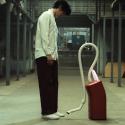
 Through a thorough and slow investigation of artistic process we start to engage and discover character. We begin to see where the line is drawn between what Kiefer (pictured right) will do and what Kiefer will instruct assistants to do. We intermittently see the child within explode in a sudden smash here, a sudden hurl there, a kick, a run, a splash. Or is it a child? There is actually something of the spoilt monarch's caprice to Kiefer's bouts of aesthetic whimsy - though the activity is too benign to be tyrannical.
Most fascinatingly we see the formal decisions being worked out. This artist before us is no post-modern trickster. Romantic impulse and formal rightness are Kiefer's concern. He is even clearer about this in his interview with a visiting German journalist - the only extending discussions that we get - in which he runs rings around the interviewer and extols the virtue of beauty. Kiefer's mischief-making also comes to the fore here. Blood has the same chemical composition as the sea, he tells the journalist; boredom is the basis of existence. Despite the artistic evidence to the contrary, gloom lurks but little in Kiefer's mind. Play seems far more present.
The film isn't all equally engaging. When Fiennes allows the camera to linger over Kiefer's work, engaging in that slightly pretentious arthouse game of luxuriating in image, energy evaporates. Indeed, the first 20 minutes, in which we see not a single human but merely wander through deserted tunnels, was almost excruciating.
But most of the film - particularly when flat-capped Kiefer shows up - is gripping. Perhaps too gripping. It might be the one problem with the film. That it is almost too good, the processes of creation too beguiling, the images that are a by-product of the artistic act too beautiful that they almost outperform the final artistic product. Which sort of lets the cat out of the bag, confirming a sneaking suspicion that I have always harboured: that modern art is in fact often much more fun to do than to see.
- Over Your Cities Grass Will Grow is showing in selected cinemas
Watch a clip from Over Your Cities Grass Will Grow:








Add comment