

One of the most mystifying of working relationships is that between an artist and model. For any sitter the experience must be tiring, if not tiresome, but for the artist their compliance is as integral as paint or clay; one may become famous, while the other remains anonymous, the silent partner in a work of art; there’s also the fact that, in the most common permutation, the arrangement involves a man staring for hours at a naked woman, without reproach – and where else can you find that? Well, filmmaking.
The Artist and the Model is not the first film to explore the relationship, nor the most memorable: it doesn’t have the same vigour and tension as Rivette’s La belle noiseuse, nor the biographical fascination of this year’s Renoir, both superior films. But there is a pleasurable, ravishingly expressed simplicity in its focus on a sculptor’s belief in the female form as a wonder of nature, and on the process from drawing to maquette to sculpture that attempts to capture it.
Most of the film’s pleasures involve Rochefort, an actor who gets ever riper with age
It’s 1943. Ageing artist Marc Cros (Jean Rochefort) is living in a village in the French Pyrenees, close to the Spanish border. Cros hasn’t worked in years, disillusioned with the world and with art. But one day his wife Léa (Claudia Cardinale) observes a young Spanish woman living on the streets and recognises the sort of beauty that might reignite her husband’s imagination.
After the briefest of interviews with Mercé (Aida Folch), a refugee from the Spanish Civil War, Cros is indeed spurred to action. He offers her a temporary home in his studio, on the edge of the mountains, and dusts off his tools. As his work progresses, we observe the growing familiarity between a rarefied, introverted man, who really needs to take his head out of the sand, and an earthy, inexperienced yet world-hardened youth, puzzled by the fuss he’s making over her.
The film is directed by the Spaniard Fernando Treuba, best-known for his Oscar-winning comedy Belle Epoque, and whose last was the spirited, lustily grown-up animation Chico & Rita. Compared to much of his work, this is remarkably restrained. It seems as though Treuba wants his cameraman Daniel Vilar’s beautiful black and white compositions to carry the film, while the chief aim of the script – written by himself and Jean-Claude Carrière – is simply to keep out of the way.
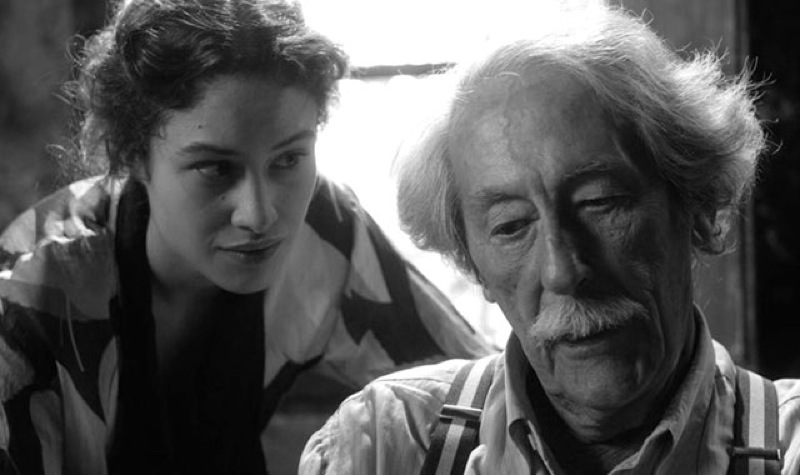 It’s a novel path, admirable even, but it does result in a film that is thematically wafer-thin. The artist’s dilemma, his need of a new muse to spark him back to life, is well-worn and given no fresh insight. And unlike Emmanuelle Béart’s spiky fictional model in La belle noiseuse, and Christa Theret’s Andrée Heuschling – model for one Renoir and leading lady for another – Mercé has little substance, her motivations and emotions ill-expressed by the script and by Folch's muted performance. With the muse no more than a sketch, there can be little depth to the drama.
Moreover, while Treuba and Carrière set up the materials for an interesting dialectic about art and life, their handling of the war-time context – notably Mercé’s surprising assistance to resistance fighters and Cros’s bizarre friendship with a Nazi art-lover – are perfunctory.
Most of the film’s pleasures involve Rochefort, an actor who gets ever riper with age, and an excellent fit for the taciturn artist – dispensing lines like “They don’t make bodies like yours anymore” without making us squirm, and lighting up the screen with just a glimmer of a smile behind his exorbitant moustache.
The film’s most exhilarating scene doesn’t involve a gorgeous tableau, but an intimate exchange between artist and model over a postcard of someone else’s art: Rembrandt’s famous drawing A Child Being Taught to Walk. The tender passion and admiration of his analysis, in a voice that sounds like a rake over gravel, finds a down-to-earth complement in her curiosity about the people depicted – the scene thus reflecting the film’s strongest suit, its appreciation of the alchemy that turns the commonplace into art.
Overleaf: watch the trailer for The Artist and the Model





Add comment