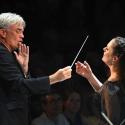
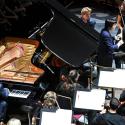
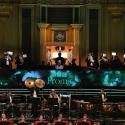
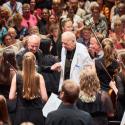
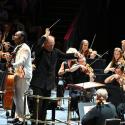
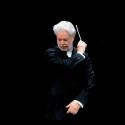
Featuring two Russian composers, the two halves of the Royal Scottish National Orchestra’s programme could hardly have been more different. In the first, pianist Xiayin Wang (pictured below) joined the RSNO for Scriabin’s florid, rarely-heard Piano Concerto. The orchestral sound under Peter Oundjian – in what is his final season as Music Director – was lean yet strong, as the vast number of violins played as a single, powerful muscle.
While this made for a captivating orchestral presence, Wang’s solo playing was for most of the first movement either overshadowed or downright drowned out. Which was a shame, since when audible, it was rather lovely. She gave an illustrated level of detail to the score showing a mastery of the technicalities of the piece. During the unaccompanied passages of the second movement, she exuded a dream-like quality from the piano’s upper registers that gave gentle, celestial qualities to the music, but still had a sharp, zesty piquancy.
Wang’s playing in the third and final movement was, at long last, rousing and strong, but she still struggled to hold her own over the orchestra’s vast forces. While she rose to the fore for much of it, at times in the final sections the piano was yet again lost to an overly bulky blanket of strings. There’s no doubt that Wang is an exceptionally talented musician with an intensive mastery of her instrument, and her playing on Friday was detailed, animated and intelligent. It was sadly just a little too polite to fully carry the depth of Scriabin’s score, especially against such a large orchestra.  Oundjian once again took to the podium for a far more lengthy second half. Shostakovich’s meaty Seventh Symphony, the "Leningrad", was given a thorough and visceral exposition. This is where such a huge string section makes sense. The uniformity of such a vast number of musicians boldly marked the angular lines of the symphony’s opening bars, and the orchestra was sensitive to the solo playing of those from among their own ranks – perhaps more so than to the first half’s soloist. A soft, single snare drum was beautifully complemented by steady pizzicatos, and as the tune was passed around the woodwind, the instrumental balance was always spot on, with a precise dynamic variance unfortunately missing in the concert’s first half. Even when the music turned to its most tumultuous and cacophonous, Oundjian seamlessly maintained the music’s stability.
Shifting to the dignified second movement, principal oboist Adrian Wilson’s solo was gorgeously light and lyrical. There are dark undertones to this movement, but these were understated, and even the piercing E flat clarinet solo had an elegance to match its edge
Oundjian steered the orchestra powerfully through the stark differences in musical mindsets, from the serene to spiky rhythms of the third movement to the myriad moods of the tempestuous finale. By its second part, the music’s hard edge had softened a little bit, but there was still a steeliness to it: a resolve, a determination, a primary-coloured vibrancy. This is a symphony jam packed with ideas, and the RSNO on Friday night gave voice to each and every one with strings both silky yet strong, clear and precise woodwind and rich brass. It was the percussion’s night, though; the bite of the snare drum and build of the timpani exuded a gripping potential energy that seeped into the pores of the piece, further igniting Shostakovich's triumphant score.