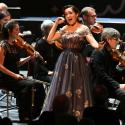
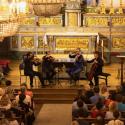
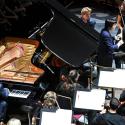
A metallic shower rained down upon us as five percussionists of the BBC Scottish Symphony Orchestra's percussion sextet unleashed the meteoric potential of five huge metal thundersheets on our unsuspecting ears, and percussionist number six, a pianist, encouraged her muzzled instrument (a metal brace lying across its stringed body) to gnash away rhythmically and to dance amid the downpour. 1939 was when John Cage came up with this breathtakingly original, endlessly exhilarating work, First Construction (in Metal), that opened this late-night Prom. It was the most invigorating 10 minutes I've had at the Proms so far.
The night had been dedicated to the great experimental Anglo-American outsiders: John Cage, Morton Feldman, Cornelius Cardew and Howard Skempton. Mavericks who had made a point of sticking two fingers up to the establishment whenever they could and had found the favour returned. Together, the four pieces programmed have notched up a total of one previous Proms performance. Two of the works (both over 35 years old) were receiving their London premiere. Yet, between them, they had more to say - musically, intellectually, sensorily - than all of the new works I have heard at the Proms so far - save James Dillon's brilliant La Navette, which was given its long overdue UK premiere the other night, more on which anon.
A beautifully varied selection of pieces were on offer, from the Varèse-like directness of the Cage to the elegaic minimalism of Howard Skempton's Lento. Amid all this variegated non-conformity it was odd to find Cardew - arguably the most radical figure of the lot - serving up a sweaty, expressionistic slice of high modernism in Bun No 1. Stockhausen's moment form, an Alzheimer's-like compositional principle that relies not on narrative but on the now, is the guiding principle. Melodic instruments - there are no percussion - struggle around, staccato, trying to find a voice. Trumpets sleepwalk into melody. Exertion dissipates into a beautiful passage marked con fermate lunghe ("with long pauses"), a period of laziness and leering and fascinating cohabitation (tuba and flute; bass clarinet and trumpet).
It wasn't the most original work on the programme but it was surprisingly effective. The most original work on the programme, Feldman's meditative anti-piano concerto, Piano and Orchestra, from 1975, was on the other hand arguably the least effective. Like the Cardew, we enter through a haze and then step delicately from one detached island of sound to another. But whereas in Cardew notes often understayed their welcome, here they very much overstayed. The piano, in the expert hands of veteran experimentalist champion John Tilbury, drops its stony pebbles into the orchestral waters and rests, regarding the sonic penumbra - often a very beautiful array of muted thuds and sustained, lightly dissonant harmonies. It was like walking through a giant empty turbine. What we were doing in it and why was anyone's guess.
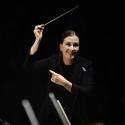
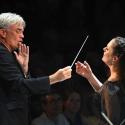
The aim of Skempton's Lento was much more direct and clear. Sentiment without sentimentality. Volkov did a brilliant job of shifting Skempton's blocks of sounds and preventing them from lingering. The result was a stream of music not a vale of tears. It may have seemed strange to bundle this slice of elegiac minimalism in with the Cardew, Cage and Feldman but the work's unashamed beauty and tonality is just as much on the fringes of acceptability as the others - as its 20-year wait for a Proms slot shows.
Turnout was impressive - much more impressive than an equivalent late-night Prom of establishment works would garner. The Feldman drew the most enthusiastic response, strangely. My mind was always drawn back to the unforgettable metallic clatter of Cage, which after the initial roar seemed to smelt itself into something more discernible - the relatively tuneful but still complex sounds of the gong and the bell - and took on the shape of a fanfare. It's the sort of thing that should become a fixture of the Last Night.