

Left, alone, Hans Abrahamsen’s new piano concerto for the left hand, swirls out of the darkness to a jagged motor rhythm. Piano and orchestra clash and interlock; you’re reminded of Prokofiev and Ravel. Then something happens. A piano plays, but the soloist is motionless. It’s been there all the time, of course – an orchestral piano, up on the percussion risers. But now it’s turned threatening: upstaging the soloist with its full two-handed range and stealing his musical voice, his very identity. And although it doesn’t really intervene again until the last movement, you’re continually aware of its sinister gloss black presence crouching there in the background – a quiet doppelganger, waiting to make its move. The concerto becomes a dark fairy tale.
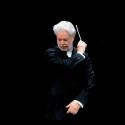
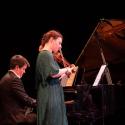
Am I going too far? To be fair, Abrahamsen (pictured below right) actually describes the last of the concerto’s six short movements as ‘in flying time, Fairy Tale Time’, and, himself unable to play the piano with his right hand, clearly identifies with his soloist. For this UK premiere that was the work’s dedicatee, Alexandre Tharaud, bringing a miraculous range of tone and expression to a score which at times has him playing no more than a single note suspended in silence, or picking his way between a pair of claves. It’s rare to hear a new work in which every note has been so carefully chosen and so perfectly placed. 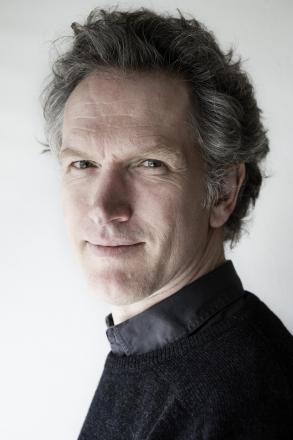 But Abrahamsen is emphatically not a minimalist, and Left, alone is the opposite of sterile. Abrahamsen’s fantasy creates miniature worlds of subtle, multilayered orchestral colours: chattering clouds of violins, lit up with harp and bells, and tissues of bass texture so soft and fine that you have to wonder if they’d even be audible in an acoustic less perfect than Symphony Hall. Ilan Volkov conducted with pinpoint precision, and the CBSO supported Tharaud with playing of breathtaking transparency and refinement. Transfixingly beautiful and charged with unspoken emotion, Left, alone doesn’t so much end as cease to be audible. It deserves the same success as Abrahamsen’s Grawemeyer Award-winning song cycle let me tell you (due to be performed by the CBSO and Mirga Gražinytė-Tyla at this summer’s Proms). For now, congratulations are due to the CBSO for co-commissioning a work that should by rights become a modern classic.
After the interval, Volkov deployed all his alertness and ear for texture in Mahler’s Fourth Symphony. More than that: beginning with sleighbells in strict time, he made the cod-Mozart opening theme as graceful and springy as a ballet. From there on in, this was Mahler in inverted commas - all knowing irony and brisk, bold gestures. That gave the scherzo a hallucinatory quality, with long string slides offset by honking clarinets and tangy, low vibrato solos from leader Ioana Petcu-Colan. In the third movement Volkov held the cellos’ opening theme poised above its pizzicato bass like the slow movement of Schubert’s string quintet; later he unleashed huge sweeps of horn and violin sound with the same crisp beat. And then on came Sarah Tynan in full storytelling mode, gazing around the hall, glancing conspiratorially up at the audience and all the while colouring Mahler’s "child’s vision of heaven" with luminous warmth darkened by just a hint of boyishness.
Volkov and the CBSO supported Tynan with the same delicacy and care they’d brought to the concerto; and at the start of the concert, Abrahamsen’s orchestration of Debussy’s Children’s Corner. These arrangements were lovely, poignant things. Doctor Gradus Ad Parnassum became a lush prelude, the tuba commented on Jimbo’s Lullaby and a lone castanet clicked comically and just a little sadly in the Serenade of the Doll. On paper, it looked like a throwaway opener. But by the time Left, alone had told its tale and Tynan’s wide eyed child was marvelling at her heavenly fruitbowl, it made perfect sense. Few conductors have more eclectic tastes than Volkov, and few plan their programmes with more intelligence and care. Under his direction, every part of this concert clicked perfectly into focus.



Add comment