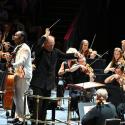
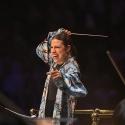
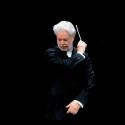
To be interestingly disappointed isn’t bad - it’s being uninterestingly disappointed that is. This was an intriguing Prom with a full house, possibly because of Hélène Grimaud’s presence in the Ravel piano concerto, as well as Vladimir Ashkenazy on the podium. Surely it wasn’t for Scriabin’s Third Symphony, unheard here for almost 80 years? Or perhaps Richard Strauss’s Der Rosenkavalier is so well beloved that even a dubious orchestral suite made from it lures the thousands?
Whatever the reason, the point in such intriguing programmes is not to come out cursing at being served minor-league fare, but to have been taken into curious musical personalities and to have been made to ask questions.
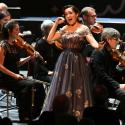
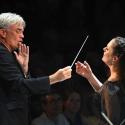
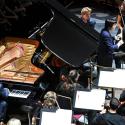
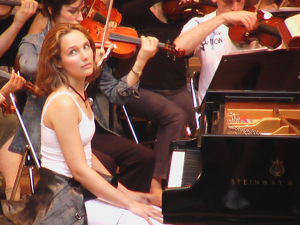
To get the duller disappointment out of the way first: Grimaud is a mystery attraction I’ve yet to succumb to. She has some of the most efficient fingers in the business, and for this listener too little of the magician’s charisma about her to invest so familiar a piece as the Ravel with her own distinct sonic spells, especially in the Albert Hall's cavernous acoustic. Studiedly languid in her opening, breezy no-nonsense in the third movement, Grimaud (pictured below) showed herself better at bustling about the keyboard than whispering melancholy blues in the dark.
 A harpist showed the way, suddenly stopping time with the faerie enchantment of her playing in the second movement. It was at that hallowed point where there are three marvellous exchanges: the harp dreaming in mysterious rills and muted harmonics, the piano rebuking this mood with a storming rush of arpeggios up the keyboard, and a French horn, high and cloudy, turning back to the harp’s mythological reveries.
Grimaud isn't without wit: her trills in the third movement summoned up the eeriness of the theremin, and Ashkenazy's body language showed him relishing the swift cut and thrust of syncopation and skirling changes of direction. I’m prepared to believe that the radio relay may convey something more compelling about the performance - these are not the acoustics for Ravelian detail.
The Strauss is a curious thing, a reductio ad absurdum by hand unknown, losing the voices of his smash hit Der Rosenkavalier and turning bleeding chunks of it into what’s practically a gala medley. Strauss wasn’t keen on an earlier suite arrangement of the opera’s waltzes and had his own underway when this one appeared just before his death, possibly done in the US by the New York Phil's conductor Artur Rodzinski. It’s a sort of tabloid rewrite of the opera, correcting what was evidently too downbeat an ending for the purpose. It starts with the whooping sex music between Octavian and the Marschallin, cuts swiftly to the love music of Octavian and Sophie, brusquely turns to Ochs’ pissed waltz, jumpcuts to the great concluding trio, then reprises Ochs’ hiccoughing oompah-pah for a rousing singalong finish.
If this sounds brutal, well, it sounds brutal. Strip out the voices and the music shrinks to something far less significant than it should be. Like ballet music, opera music is different in texture and needs to symphonic music, and melodies that are sublime when breathed through voices, with the physical colouring of expression and breath control, become banal when translated to violins that never need to breathe, or when the subtlety of Octavian being a mezzo-soprano is translated blatantly into the male instrument of the baritonal horn.
Ashkenazy evidently adores it, given his gleeful exuberance at the end, but the Australian flagship orchestra (which has numbered Sir Charles Mackerras among its mentors) was given too much to swallow. While it has several excellent soloists, the violins were seriously eclipsed by the brass, lacking penetration or richness of colour, while there were too many uncomfortably cracked notes from horns and trumpets. If we must lose the complexity of emotion provided by singers in this music’s true context, at least let us have downright technical brilliance instead.
This is a splendid student of prodigious capabilities, but how grandiose Scriabin is here
Players and conductor pulled out all their stops in the 45-minute marathon of Alexander Scriabin’s Third Symphony, written in 1902-4 when he was simultaneously falling in love with Nietzschean philosophy and with an 18-year-old mistress. Like Strauss’s Octavian, Scriabin (then 30) wants us to know in every detail both how marvellously special and soulful he is and how ready to give his all, but where Strauss had the wit to turn off Octavian’s spout judiciously, Scriabin keeps the tap running for a very long time.
I love the man’s later, highly fragrant individuality where he abandoned conventional tonality and adopted his own unmistakable melodic scale. Those works have an exploratory sensuousness that’s genuinely suspenseful. But I can only partly admire earlier works like this.
The symphony shows what masterly skills he had in fluency, fearless orchestration and bold borrowings from other masters - there’s Wagner’s spaciousness, Richard Strauss’s succulence and Debussy’s (contemporaneous) La Mer in there, hints of Sibelius, Ravel, Tchaikovsky. This is a splendid student of prodigious capabilities, but how grandiose he is here. He allows his fans to wrap the symphony in orotund labels: the title The Divine Poem, the section titles “Luttes”, “Voluptés”, “Jeu divin”. He writes the words “I am” on the first motif, a self-conscious and not-quite-memorable brass question and answer phrase to which he frequently resorts through the immense work - often when he’s doing something more individual with strings. I found myself irreverently thinking of the spaceship theme in Close Encounters of the Third Kind.
Episodes roll, swell after swell - not quite oceanic, since there is frequently a drop in tension between each swell. Birdsong, military combat, rapt string mists, apocalyptic tutti, flash-forwards to Scriabin’s later harmonic world when violin solos assert an intriguing chromatic voice against insistently tonal brass chords. So many colours, so much tumescent ecstasy, so much gnawing doubt, yet increasingly more exhausting than exalting.
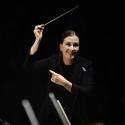
Ashkenazy gave tirelessly to the piece, a small bushy-haired figure dragging ever greater volume out of the vast, 18-strong brass section, or digging for victory with the cellos. The absence of this piece from the Proms since 1921 seems inevitable - Mahler, Bruckner, Sibelius all attained greater heights with less fuss about it, and Scriabin went on to become a glittering individual. But it’s fascinating indeed to listen to a piece that fulfils almost all the requirements to be magnificent, and yet so falls short because the composer has still to find the truth about himself that’s inside the bubble of self-admiration.
Very happily, Ashkenazy had the perspicacity to give the audience an encore: Elgar’s Chanson du matin played by the Sydney strings with a lush, gorgeous, plump-lipped sound that left a final charming impression of them, to add to one’s admiration for their sheer stamina.
- Listen to this Prom on BBC Listen Again for a week
- Read theartsdesk's recommendations for the 2010 BBC Proms
- Full listings for the 2010 BBC Proms