The screen lights up, the Zoom link connects and there, blinking back at you (30% awkward, 70% enthusiastic) is a familiar face. Is it definitely working? Can you hear me? What do we say now? God, I'm getting old. Even after 12 months of conversation through webcams it still feels forced to me; something to one side of real life, simultaneously weird and routine, intimate and alienating, even as memories of the Old Normal grow increasingly remote. Is that a piano? Well, why not, these days? And then the face on the screen – I knew I recognised him; it’s the tenor Joseph Doody, who I last saw saving the day in a touring Ravel opera in the Welsh marches, two years and a pandemic ago – opens his mouth and starts singing.
Or rather, hissing. “Psst, psst” – he’s the lovestruck Fenton from Verdi’s Falstaff, grabbing a brief, digitally-enabled moment with Nannetta (or for today’s purposes, Sylvia – there’s some Schubert coming up). She’s stuck at the other end of quarantine and a wireless connection, but happy to be in touch at all, and bobbing back and forth on her sofa, eyes wide with delight. Claire Wild’s sunlit, warm toned soprano is a life affirming sound; like you’ve treated yourself to a really nice bottle of Sonoma Zinfandel. Well, we all need a little boost to get us through weeks like these, and the dramatic set up rings perfectly true, as you’d expect from Opera Up Close, who’ve been getting imaginative with limited resources for well over a decade now. This is the ninth of their Coffee Break Concerts (the 10th goes live on 31 March) and while it’s distinctly low res, this is a company that knows precisely what’s possible, and necessary. Everything just works.
So anyway, Doody logs off, and we’re left with Wild, cross-legged on the fuzzy throw that covers her sofa and pealing out "Je veux vivre" from Gounod’s Roméo et Juliette as if she was centre stage at the Wales Millennium Centre. The theme of this Coffee Break Concert is "Shakespeare Re-shaped", and apart from a brief spoken introduction, the words, the music and the dramatic situations are largely left to make their own case. They’re accompanied remotely at the piano by Kelvin Lim who, rather brilliantly, has a portrait of Wagner on the wall behind him (Doody, in a possible reference to The Tempest, had a box of Ariel capsules). Two non-sung contributions to the anthology prompt timely, open ended reflections about the relationship of music to text, and the assumptions that underlie it. Kat Rose-Martin reads from Measure for Measure, and Lara Steward performs Juliet’s "Gallop apace" monologue in British Sign Language. Music suddenly seems superfluous.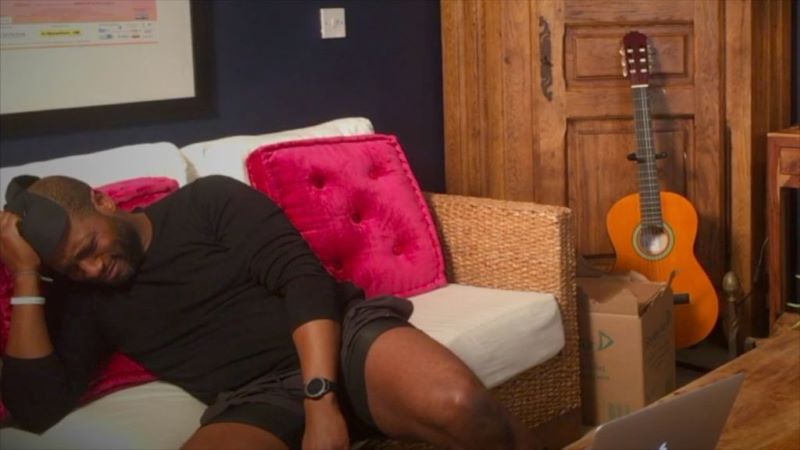
That’s always been the problem with Shakespeare settings, of course – what can music add to such language? – and shrewd opera makers tend to step lightly around the problem by avoiding those magic words altogether. Falstaff – with Boito’s text spiritedly re-Englished – provided another terrific little minidrama, as Rodney Earl Clarke (pictured above) sang Ford’s jealous monologue hunched over his MacBook, fulminating, gesticulating, pouring out great airy billows of baritone sound which curdled into something closer to a snarl as he squinted at the screen and saw…well, what, exactly? And are they aware that he can see them? Clarke found just the right amount of possessive, voyeuristic menace, even if his final, perfectly timed tug of his baseball cap managed to end this little drama – or as much of it as we saw, anyway – with a smile.
Again, it was stylishly done – taking the music as a starting point to create a modest but genuinely dramatic response to what Grayson Perry calls "this strange time we’re living through". It makes its points without overstatement and leaves you wanting more – oh, and delivers some very engaging singing and acting along the way. What more could you ask from a coffee break? The final split screen quartet on Finzi’s "It was a lover and his lass" felt like a thoroughly well-deserved curtain call. So go on, treat yourself. Then click through to the donation page and bung Opera Up Close some cash – because they’ve earned it, and because we’re going to need them more than ever once this is all over.