

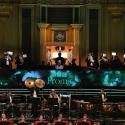
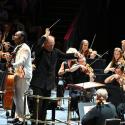
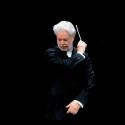
A great deal of scepticism greeted the release of a new Beethoven symphony cycle from Osmo Vänskä and the Minnesota Orchestra in the mid-2000s. Would this lot really be able say anything that hadn't already been said by the hundred or so other cycles? Could anyone really find anything very new or fresh to say about these warhorses? The answer then was yes. And the answer last night in their Prom's performance of Beethoven's Ninth was also a resounding yes. Hardly surprising if you'd heard Vänskä's Bruckner the night before or his Sibelius cycle earlier this year. In Vänskä-land even stale buns come fresh.
Let's start with Vänskä's pianissimos. Most conductors are content with beginning Beethoven's Ninth with a pianissimo that is audible. A registering of "very softness" will do, they think. But "very softness" should be on the cusp of being registered. It should verge on the ppp, or pianissimo possible ("the softest possible"), a marking that encourages us to strain our ears to hear the notes - as we did on Friday night with the opening ppp tremolos of Bruckner's Fourth. Vänskä's opening pianissimo in the Ninth flirted with that extremity, walked the tightrope of audibility, and fizzed with a desire to become audible. However many more instruments came in on the opening hush, the pianissimos continued sempre, as Beethoven desired, filling with a dormant energy that Vänskä then deployed to full spontaneous effect in the following tumults.
One could go through every marking and moment in this way, explaining why Vänskä is a cut above the rest: the length and depth of those long bows on open strings that saw into the dotted fortissimos, the sponteneity of those storm explosions, the bounce of the parabolic passages, the harrying of the counterpoint, the drawing out of the inner voices - say, the dissonant tripleted semi-quavers in the second violins in the development - the maintenance of tension through the stilled repetitive sempre piano passages. It all made for an unforgettably demonic first movement.
The scherzo second movement was like that of the Bruckner Fourth, a little neglected, though driven almost to the point at which it was popping out of the shrink-wrapped fabric that Vänskä's beat was bundling it in. The Adagio molto cantabile was done as so many do it post-Harnoncourt as an Andante con moto. It never convinces me at first, this tempo, but as we begin to rock and dance to the beat the sense comes. Again like Friday, there was a simple, tender sweetness to this Adagio that made the brass calls of responsibility - and perhaps adulthood - that usher in the final movement all the more poignant.
The Finale was great when the orchestra was solely in control, less interesting - and in fact, at times, frankly weak - when the eccentric singers (a Brünnhilde-like soprano in Helena Juntunen and a Captain Mainwaring bass in Neal Davies) or the BBC Symphony Chorus (who were seriously lacking heft, gravitas or finesse) got in on the act. Another extraordinary pianissimo before the percussion-capped barn-stormer of an end rescued the interest.
Gil Shaham was the saviour in the Berg Violin Concerto, filling in for an indisposed Lisa Batiashvili two days after his impressive Proms performance of the Barber Violin Concerto. He proved the perfect live-wire companion to the impulsive Vänskä, particularly in the first movement, where he showed why he is such a great artist to see live, charging down those trombone calls, stealthily, like a fox on the scent of a rabbit. If the supremely tricky second movement was played, understandably, a little safe, there was at least an attempt to evoke the road to Calvary-like faltering steps in the double-stopping. The one small disappointment of the evening were the woodwinds, a surprisingly characterless bunch, even in the Bach chorales. But then came a simple and effective rendition of the Sarabande and Double from Bach's Partita No 1, in B minor, from Shaham that seemed to make amends.


Add comment