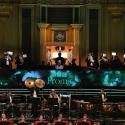
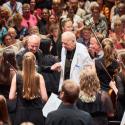
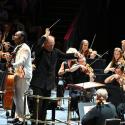
The Vienna Philharmonic makes a beautiful sound, no question about that: the question is what to do with it. Michael Tilson Thomas has some ideas, but they are mostly low-key. He is currently touring with the orchestra, and seems to have been chosen as a safe pair of hands, offering elegant and lyrical interpretations, but without any extravagance. The result was a concert that was all about the orchestra, and although the players had a few rough patches, it fully justified their world-class standing.
Even so, it was often hard to shake the feeling that Tilson Thomas was playing it safe. His tempos were mostly slow, and, while he often pushed for greater weight of tone, it was rarely in the service of heightened drama or of any broader dramatic thinking. The Brahms Variations on the St Anthony Chorale (the theme’s misattribution to Haydn now ancient history, it seems) was given a steady reading, with little sense of overarching structure between the sections, and a surprisingly scrappy coda. Even so, it served well to introduce the special sound of this orchestra, from the broad but distinctive woodwind sonorities of the opening to the wide variety of string textures later on. The bassy penultimate variation was particularly satisfying, with the bottom-heavy Vienna strings filling the hall, even at a modest dynamic.
Ax has an approach to Mozart that fits well with the Vienna aesthetic
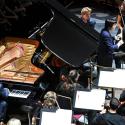
I don’t know for sure, but I’m guessing that Emanuel Ax (pictured below) and Michael Tilson Thomas are long-time collaborators. An intuitive sense of communication between the two was evident throughout the Mozart 14th Piano Concerto, allowing the pianist to make some dramatic tempo and dynamic changes, at a moment’s notice, knowing that the orchestra would always keep step. Similarly, Ax has an approach to Mozart that fits well with the Vienna aesthetic. He plays with a warm tone and a liberal, but well thought out approach to phrasing and rubato. His melodies are elegant and cleanly articulated, his accompaniments warmly sonorous, but no less precise. And Tilson Thomas made real music out of all the accompaniments, tenderly shaping all the string figures, even when the orchestral music was secondary to the piano. Yet Mozart’s direct and melody-focused music never lost its charm, even when presented in these many layers of textural detail.
The Beethoven Seventh Symphony received a solid performance, though this too was often ponderous, and rarely danced. The main theme of the first movement lumbered, the result of overly bass heavy textures and a surprisingly steady tempo. The development was more successful, with Tilson Thomas relying on the ever-focused string tone to carry the lines, even at the quietest dynamics. The second movement was a gem, with each string section added one at a time, from the bottom up, each adding another layer of opulence to the sound. Steady tempos again, but the movement was carefully shaped through tempi and texture.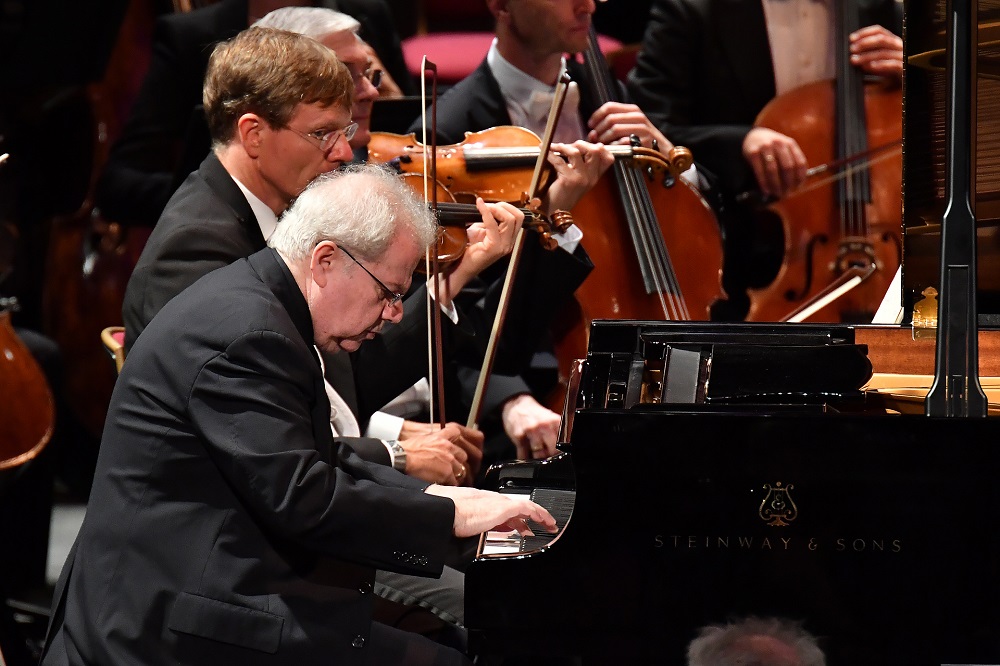 The more upbeat music of the third and fourth movements benefited from the unity of ensemble in the strings and that perfect, uniform attack they apply to the repeated down-bow chords. As in the Brahms, Tilson Thomas showed little interest in building towards a climax in the finale, which ticked over nicely, but without any feeling of focus or direction. That changed in the coda, where he applied a sudden burst of intensity to accelerate the music towards a spectacular conclusion. Too little, too late? Perhaps, but the final bars were delivered with impressive impact.
A satisfying performance, then, if more for the series of magical moments it offered than for any major interpretive insights. Two of the most magical were the encores, both well chosen and beautifully performed. Emanuel Ax followed the concerto with the Schubert D 935/2 Impromptu, one of those perfect Proms moments of such intimacy you feel that only the pianist and yourself are present. Tilson Thomas made a more daring choice, On Hearing the First Cuckoo of Spring. It turns out the Vienna sound is ideal for Delius (who’d have thought?), with the tonal sophistication of the strings enriching the harmonies and the clarity of texture, especially in the mid-registers, beautifully delineating the chord patterns and delicate counterpoint. Delicious!