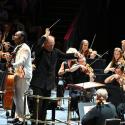
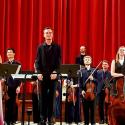
After full orchestral performances of Brahms’s Violin Concerto and First Symphony, the Scottish Chamber Orchestra shone a more intimate light on the composer’s oeuvre with a recital of chamber works in Edinburgh’s Queen’s Hall on Sunday.
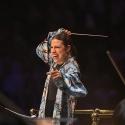
Having made his SCO debut as the soloist in the Violin Concerto on Thursday and Friday, Russian violinist Aylen Pritchin joined a few members of the orchestra, as well as Principal Conductor Maxim Emelyanychev (pictured below by Christine Kernohan) at the keyboard, for some smaller scale works. Pritchin gave a calm sensitivity to Brahms’s Violin Sonata No. 2, with a tender, singing tone and remarkably sophisticated double stopping.
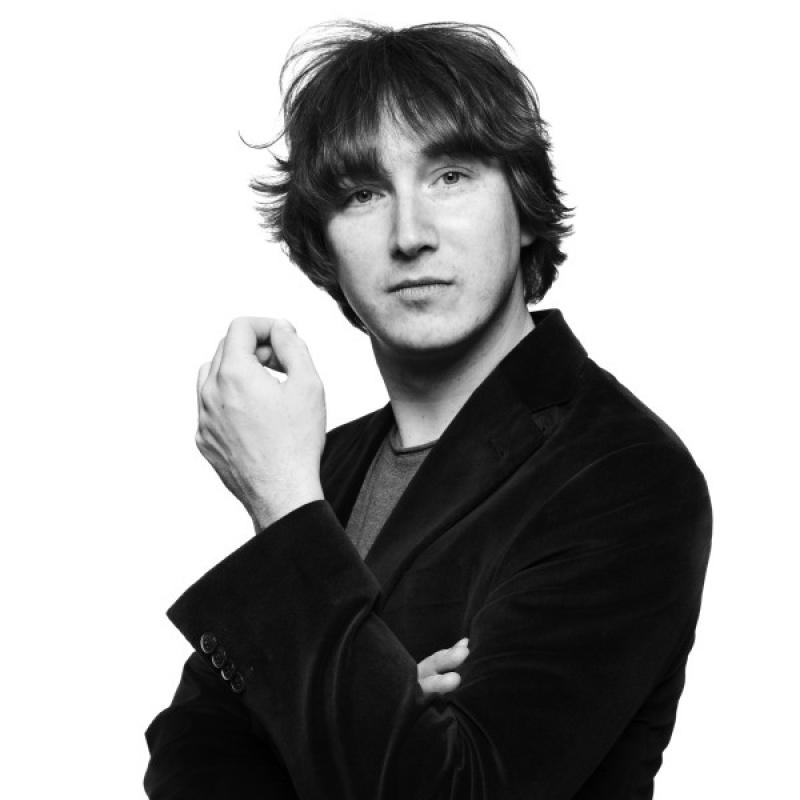 The SCO’s principal cello, Philip Higham, then joined Pritchin and Emelyanychev for a gripping rendition of the composer’s First Piano Trio. Throughout both these works it was Emelyanychev who was ultimately in the driving seat, steering the music through unexpected twists and turns, and uniquely illuminating each voice in the harmony, before the trio rounded off the work with a sumptuous flourish.
These three instrumentalists were joined in the second half by violinist Marcus Barcham Stevens and violist Max Mandel for a lively and rousing performance of Brahms’s Piano Quintet in F Minor. Playing very much as a team, they made the opening unison passages sound as one voice, and the perfectly synchronised bowing which drew the scherzo to a close was particularly impressive.
This was very exciting chamber music indeed. Dogged rhythms drove the music forward, while the subtle and ingenious pushing and pulling of tempo kept the listener on their toes. Emelyanychev’s spiky touch in the scherzo delightfully echoed the earlier cello pizzicato, and the shifts the quintet took as a whole between dark tumult and calm relief rendered this a thrilling performance.
The stand-out star was by far Emelyanychev, whose skills off the podium are at least equal to what they are with baton in hand. He is, quite simply, a superb pianist. The range of voices he teased from the mysteriously sourced Broadwood (see comment below) was as surprising as it was rich, with insight and interest apparent in every phrase. Audiences in Scotland – and beyond – should take any chance they can get to hear him at the keyboard.