Like a hokey-cokey, we’re back to live music in London – but for how long? I overheard another audience member explaining it was her third time at Kings Place this week, as people cram in as many concerts as possible before a feared return to cultural lockdown. Kings Place has been in the London vanguard (with Wigmore Hall) of venues opening as much as possible, and Aurora Orchestra have responded with imagination, transforming their Mozart concerto cycle to a festival of chamber music.
The format was the same as the Imogen Cooper concert I reviewed in October: starry soloist, Mozart concerto in chamber arrangement, new commission from a young composer and a warhorse from the chamber repertoire, in this case Shostakovich’s Piano Quintet. And it was very enjoyable, if perhaps without quite the same level of sparkle and joy that Cooper prompted.
Mozart’s Piano Concerto No. 23 is genial and conversational, with a haunting slow movement and a rollicking finale. The chamber arrangement by Ignaz Lachner dates from the 19th century and keeps the piano part unchanged while reducing the orchestra to a string quartet plus double bass. It works very well, in particular freeing up the cello from its role in the original simply doubling the bass to a wider brief, playing a variety of inner lines in the texture, cellist Sébastien van Kuijk revelling in each identity.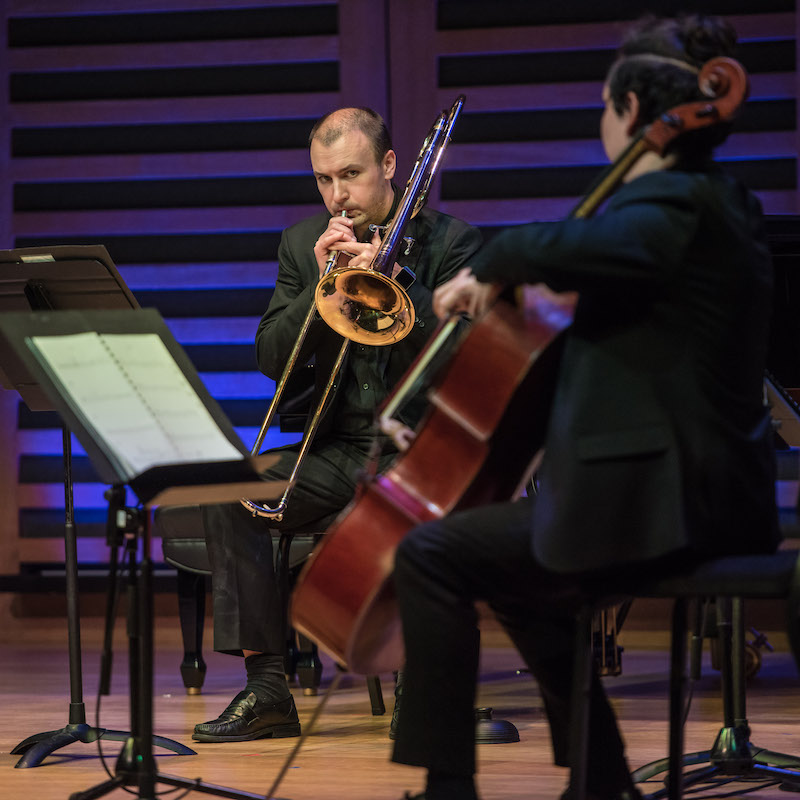 Steven Osborne’s playing was intimate and warm, especially in the hymn-like first movement second subject. The tender opening of the second movement – so, so hard to capture – was delicious, as was the bleak ending. In the finale his scales flowed like water and the ensemble was rock solid as the cello and bass scurried and danced. The minutes flew by.
Sylvia Lim’s Points of Intersection, premiered here, is scored for the unusual (unique?) combination of trombone and string quartet. She explained the piece is “about lines that move and shift and sometimes overlap” and that she wanted the trombone to integrate into the ensemble rather than be a soloist. Of course, a trombone does not naturally integrate into a string quartet (or else there might be more pieces for this combination), especially when the strings are playing quietly throughout. The trombonist (a committed Matthew Gee, pictured above) instead blew air through the instrument, found a kind of mezzo-voce sound and at one stage produced a slightly undignified kind of muffled fart.
The parts given to the strings were much more convincing, exploring microtones, a variety of misty sounds where the bow pressure on the string was varied, conjuring a vaguely throbbing, sliding timbre that was elusive but attractive. But for all these intriguing sounds the composer’s self-denial of so many basic musical elements – melody, rhythm, harmony – gave the piece something of a hair-shirt aspect.
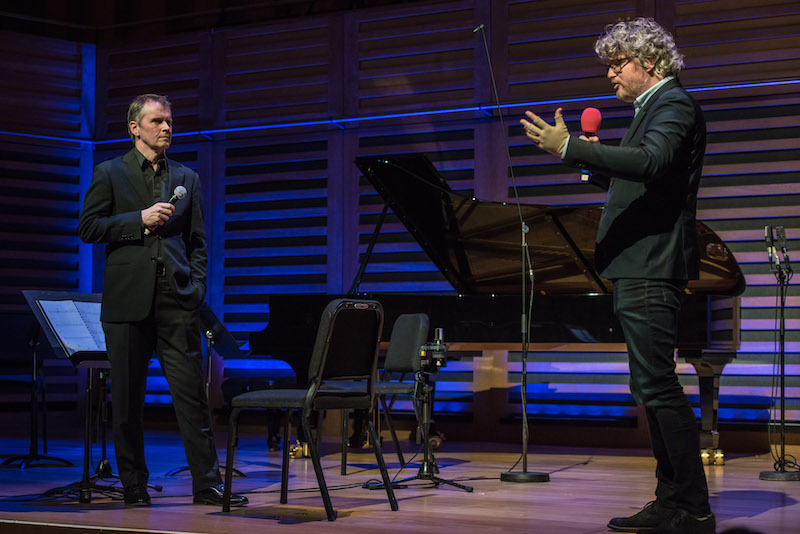 The concert was hosted by Radio 3’s Tom Service (pictured above), including interviews with Sylvia Lim and Steven Osborne. He is a very fluent speaker and maintains an indefatigably Tiggerish enthusiasm for the music, but there was slightly too high a chat-to-music ratio for my liking, and the constant exhortions to supply yet another round of applause became a bit wearying.
The Shostakovich piano quintet provided fare that was sterner than the Mozart, weightier than the Lim and more concise than Tom Service. Here, Osborne’s previous restraint was cast aside as he threw himself into the declaratory opening solo. The tumultuous first movement gave way to a fragile fugue, led off by first violin Alexandra Wood, playing with the minimum of vibrato, which built to a passionate climax with affecting solos by cello and viola (Ruth Gibson).
The motoric scherzo showed Shostakovich’s command of pacing within the piece, the ensemble driving to the ending with complete conviction. The finale offers glimpses of the good-humoured Shostakovich of his sixth quartet, interspersed with fiery interludes, Osborne alternating between discursive melodies and pounding rhythms. Then the most extraordinary final few bars, suddenly like salon music, delivered here with exquisite élan, presenting a new idea right at the end which is, like Keyser Söze, gone before you know it.