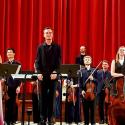
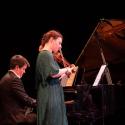
It takes a lot to humanise the hideous late-Victorian glitter of Drapers' Hall, but the City of London Festival's latest cornucopia knew how. Ornithologist-composer David Lumsdaine's soundscape greeted us with Australian birds fluttering invisibly around Corinthian gilt. Then it was down to business with the Nash Ensemble's small band of personable generals. They gave us high-toned Grieg and Dvořák, cheerful homespun songs with sophisticated twists by Grainger, Vaughan Williams and Delius to make the austere central portrait of Victoria inwardly smile, and a jungly new Sextet by Brett Dean, core composer of the festival's Antipodean theme.
Dean's labyrinth, following on the heels of his full-scale opera Bliss, makes intriguing play of his six chosen instruments (his own, the viola, is curiously absent). In the mood-musics of the outer movements it's the violin - Nash principal Marianne Thorsen - which sets the ambient tone. Pianist and percussionist are relegated to supporting artists; the real conflict in the rhythmically chameleonic central battle of trios comes between the pairs of strings and woodwind. Shape and structure rather than thematic ideas are what impress, as usual with this composer, but it's a work I'd like to hear several times, and presumably beyond the extended life of the Radio 3 broadcast, the Nash will be playing it again.
Around all this, the audience strolled through the overdone suite of rooms, gaping like poor relatives, wondering no doubt about Thomas Cromwell's original palace on the site Density and substance were just what we needed at that point in the concert. Grieg's trio movement is surprisingly monumental for the Norwegian miniaturist, a slightly stiff lament relieved by native inflections; the dream team of Thorsen, effortlessly projecting cellist Paul Watkins and that most eloquent if underrated of pianists, Ian Brown, made sure to treat the assumed postures of grief robustly. Watkins and Brown focused the simplicity of Vaughan Williams's folksong studies to make the lofty surroundings invisible (the acoustic is surprisingly warm and immediate, though); another great string player, violist Lawrence Power, self-effacingly joined the line for a foursome treatment of Grainger's Handel in the Strand, though it was the uniquely personal dying fall of My Robin is to the Greenwood Gone which lingered in the memory.
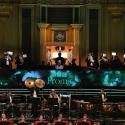
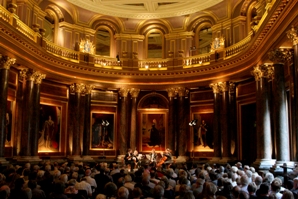 And for the grand finale, modestly prefaced by more simple candour from flautist Philippa Davies springily partnered by Brown in two familiar Delius miniatures, strings and piano tore into Dvořák's vast Op 87 Piano Quartet. They made sure the extended middle movements didn't outstay their welcome by means of charm and intimacy - and for Power and Watkins, the best was definitely last in the wayward, high-lying song that makes the finale so personal. Around all this, the audience strolled through the overdone suite of rooms (main hall pictured above right at last year's CLF), gaping like poor relatives, wondering no doubt what Thomas Cromwell's original palace and extended garden on the site must have looked like, and surely grateful for the chance this festival gives us of looking into the City's swankier enclaves. But it was thanks to the Nash that the music remained very much centre stage.
- What's on at the City of London Festival
- Listen to this concert on the BBC Radio 3 iPlayer for the next seven days