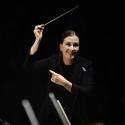
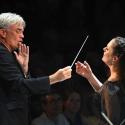
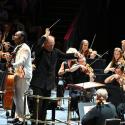
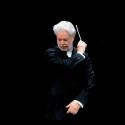
Sir Simon Rattle's intriguing return to the London Symphony Orchestra podium after years away threw up a curious thought: what happens after Berlin? The fate of six of his eight predecessors at the Berlin Phil has been death on the job. Was last night a first step to finding another way out? Were we witnessing an early bit of courtship and re-familiarisation with a possible post-Berlin playmate? It certainly had all the hallmarks of an early date between old friends, with its bouts of overenthusiastic passion and moments of awkward fumbling.
But what an intense programme to kickstart a neglected relationship: monumental works from two of music's greatest believers, Messiaen and Bruckner. Had Webern been charged with editing Bruckner's symphonies and mislaid the scores among an inquisitive indigenous South Asian tribe, I have no doubt Messiaen's Et exspecto resurrectionem mortuorum (I await the resurrection of the dead) (1964) would have been the glorious result. Solemnity, economy, toe-tapping, gong and bell-filled ritualistic joy and Messiaen's terrorising concept of religious awe (administered by three enormous tam-tams) are the main feature of this vivid but wordless holy rite.
Rattle and the LSO did exactly what was necessary to pull off this weighty testament to the Christian story of death and resurrection.
The London Symphony Orchestra played like true believers. For, except for the heady outburst of counterpoint on brass, percussion and woodwind in the fourth section, this is a world of simple symbolic musical blocks, through which we are guided. What boded well for the second half Bruckner Nine was Rattle's way with line. I've always thought Rattle was a man of the vertical, not the horizontal. But here, at his most impressively shamanistic, Rattle unfolded the ritual - a mysteriously noisy, violent and awesome brass-capped chorale - with great contiguity.
Unusually for Bruckner's Ninth, it couldn't really compete in the violent, awesome or loud stakes in this match-up. But there were other things to enjoy. Who could resist the roaring open fire of those horn-capped string passages? Rattle appeared to bring some of that lush Mitteleuropean magic to the LSO strings and horns. That's not to say either section was always tidy, or able to summon up that barely audible hum that's so often required, but they were sure as hell Feierlich. Rattle being Rattle, he couldn't help fiddling, bringing out forgotten filigree passages, jabbing away at dissonances, always recalibrating colour and dynamic.
His obsessive way with texture almost offered its own forward-flowing electricity, the rich contrasting tapestry of the third movement being pushed along like an alternating current. But, as ever, this messing around with verticals came at the expense of Bruckner's vast horizontals. The work wasn't allowed to breathe as organically as it should have. Rattle rushed through natural caesuras, ritardandos and Langsamers and whenever he got to those ecstatic climaxes, he peaked too soon. Then, who hasn't on a big date?