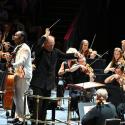
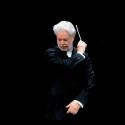
Dennis Russell Davies and his musicians from the Czech Republic’s second city began a UK tour last night with an enterprising programme and a large and appreciative audience in Manchester.
Freddy Kempf as piano soloist was an undoubted part of the attraction, but he was not there to play a conventional concerto but to join the bouncing Czechs in their love of jazz idioms.
The Brno Philharmonic could hardly omit Janáček from their concert, as theirs is the city in which he spent most of his career, but it was a brief acknowledgment in the form of four out of six of his Lachian Dances – an early work, written when Dvořák was still in his prime and very much in the tradition of 19th century approaches to folk music. That’s not to say that Janáček over-civilised or faked his material: they’re the real McCoy and traditionally short and undeveloped.
The sound of the orchestra in its touring form was clear and open – 40 strings working hard to produce the warmth and varnished richness we tend to associate with music from their homeland, discipline and clean articulation their characteristic, with wind and brass players who like to be expressive and fill a performing space with sound. The two Starodávný dances had a swaying lilt that probably comes with mother’s milk to these musicians (the brass chorus briefly showing its resplendence in the final chord of the first one), and the livelier dances were done in flowing style with thrilling conclusions. (Incidentally, I admired the esprit de corps which saw the principal flute, at one point, become page turner for his neighbour the principal oboe when any alternative would have been awkward.)
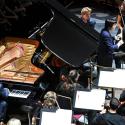
Freddy Kempf joined the Brno Philharmonic for a spot of Gershwin and Brubeck. The Gershwin was the 1934 Variations on I Got Rhythm (in its re-worked version for large orchestra), and is a virtuoso piece for its piano soloist, but he is, as ever, a self-effacing star, rarely dominating his orchestral colleagues but co-operating with them and letting the limelight fall on their solo spots – a gorgeous trombone solo in the slow and sleazy waltz variation, for instance – as well as his own. Mind you, he enjoys the fun endemic in much of Gershwin’s writing, especially the third variation where everyone gets to fool around with the tune, and the crazy foxtrot version of it was enjoyed by all concerned. The finale was a glorious romp, and he added icing on the cake at just the right moment (pictured below). There might have been an opportunity for something more classically attuned to Freddy Kempf’s wide-ranging sympathies, but it was the improvisatory skill required for a Brubeck score that followed: Brandenburg Gate, in which he was joined by Brno musicians Marek Švestka on saxophone, Pavel Zlámal on amplified double bass, and Radek Tomášek on drums. Those hoping for a replay of the famous 1963 recording by the Dave Brubeck Quartet, Brandenburg Gate Revisited, may have been a trifle disappointed, as the orchestral arrangement (by Howard Brubeck) provides a luxurious backdrop of sound for French horn and strings but leaves it to the jazz combo’s members to do their own thing in their own solo or duetting sections. Freddy Kempf is obviously at home in this idiom but entirely his own man, keeping his rhythms straightforward rather than bulldozing against the beat, and letting the clever near-pastiche of JS Bach’s counterpoint (a reference to the other “Brandenburg”, i.e. the Concertos) in the orchestra have prominence much of the time. Marek Švestka’s alto sax was gloriously mellow, and Radek Tomášek’s solo spot firm and forceful, while Pavel Zlámal proved the real rhythmic driver thanks to his level of power volume.
Dvořák’s Seventh Symphony, often seen as his greatest despite the popularity of the “New World” Ninth, is a matter of D minor grimness contrasted with lightness of F major melody and dance tunes – the graceful and beautiful Furiant of the third movement being the part that sticks in the mind when all the rest has gone. It’s second nature for Czech musicians, of course, and was played with eloquence from the wind soloists of the Brno Philharmonic and as much warmth as the strings could muster. Dvořák doesn’t say much in his score about tempo variation, and Dennis Russell Davies doesn’t ask for more than what’s there (though the slow accelerando at the close of the first movement took some time to be felt at all), but there is a lot there regarding dynamics to pay attention to. I felt that in the super-reflective acoustic of the Bridgewater Hall there could have been more attention to getting a real pianissimo at several points – rather than the almost bland sameness of dynamic (except for the big climaxes) that came across. But the blend of the woodwind, the incisiveness of the brass and the clarity of the strings were all good to hear, the flutes bell-like in their upper register, and the cellos sweet-toned in their melodic moments. The desire to make an impact in a big hall is understandable, and the Furiant verged on being thumpy while the finale was never lacking in drama and vigour – but the instinct to play its second subject in idiomatic and ingratiating style made it a pleasure nonetheless.
- Further performances at Symphony Hall Birmingham tonight, Sheffield City Hall on 18 October and Usher Hall Edinburgh on 19 October; also with Maki Namekawa piano and programme changes at The Anvil, Basingstoke on 16 October and Cadogan Hall, London, on 17 October
- More classical reviews on theartsdesk