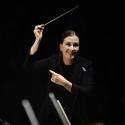
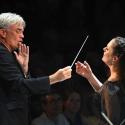
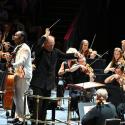
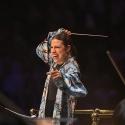
Boy, did I want to enjoy this Prom. On paper it should have been the highlight of the season. Young Canadian conductor Yannick Nézet-Séguin has been making his mark in London as principal guest conductor of the London Philharmonic Orchestra with several sensational performances of Bruckner over the past few years. Here he was for his Proms debut at the helm of his smart new orchestra, the Rotterdam Philharmonic (Gergiev's old outfit). And joining him was one of the most intelligent of singers, Simon Keenlyside, in Mahler's Rückert-Lieder. What could go wrong?
Effort was certainly not lacking. Nézet-Séguin showed a manic, unquenchable energy in his pursuit of a freshly laundered sound. The opener, the Tannhäuser overture, was flung into the wash from the off, the opening brass chorale emerging newly minted, its woodwind underskirt clearer than ever. The Mendelssohnian scurrying was brought into such sharp focus. And the many beautiful inner voices were lovingly tended to, as was bowing and phrasing and slurring to a degree I have rarely seen a conductor display to a mere overture.
A spring-cleaning of this kind is nearly always a good thing. But one can over-scrub, over-tend, and, in attempting to be loving and clever, crush the object of one's affections. Things went that way in the rest of the programme.
Nézet-Séguin tried a little too hard in the Rückert-Lieder to summon up a pungent air. The oboes were intrusively tangy in "Ich atmet' einen linden Duft" ("I breathed a gentle fragrance"), the woodwind in general too loud and brash in "Um Mitternacht" ("At midnight"). I understood what he was trying to do in this bold rebalancing, summoning up all the things that go bump in the night, but for me it went too far.
And not even Keenlyside could bail things out. His voice was uncomfortable in the range that this cycle demands - even more than most. He was stretched at the top and the bottom. Admittedly, this fragility of sound had its own pathos, especially in the world-weary "Ich bin der Welt abhanden gekommen" ("I am lost to the world"). But it was a little hairy for him and us at times. Hairy too for Nézet-Séguin and the orchestra was Keenlyside's tendency to rush off ahead without warning.
There were moments of awkwardness in the final work, too, a performance of the Eroica that was marked by a deluge of new details, some of which worked brilliantly, some of which didn't. The fast, light and intermittently violent account of the opening Allegro was successful. So brutishly did Nézet-Séguin drive home those down-beat sforzandos that I suddenly began to understand the contemporary anxiety that many had had with this beast of a symphony, where melody becomes a side-show to a rhythmic muscular display.
The Marcia funèbre was where the effectiveness of Nézet-Séguin's new tricks began to seriously wane. There was too much of an attempt to conjure up darkness through special effects - vibrato-free long bows, glissandos, strange accelerandos and ritardandos - rather than through honesty. And while I usually love his child-like inability to let any phrase just sit quietly unmanipulated, he became a little too interventionist in the Eroica, pumping a shape into passages that seemed to want to be left alone.
With an underperforming woodwind section, who sold short the finale at key moments, and Nézet-Séguin losing the propulsive thread of the variations - and completely, and very unusually, seeming to miss the whole swaggering point of the Hungarian dance variation, running it fast and flat in the ground, like a French galop - the unassuming little Trio became the unexpected highlight. He shaped those hunting calls like a bona fide German Junker and then scampishly sped into the Scherzo. No one is better at getting the dancing started than Nézet-Séguin. But sometimes he just needs to ease off on those E-numbers.