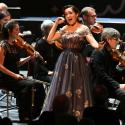
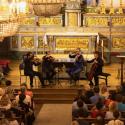
Even for a singer as driven, communicative and self-reliant as Joyce DiDonato, the song recital with string quartet is a bold step. Whereas an endless repertoire of songs with piano exists, there is virtually nothing off-the-peg for singer and string quartet; it is a case of commissioning the arrangements, and to some extent building your own art form.
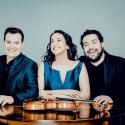
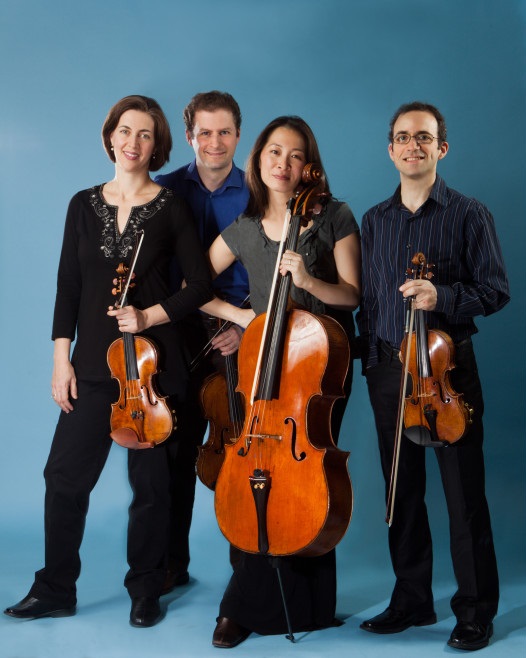
Monday night’s programme at Wigmore Hall by DiDonato and the Brentano String Quartet (pictured below by Christian Steiner) naturally received the kind of adulation that will always greet opera stars when they step away from the big stage to perform something more like a house concert – the two nights had duly sold out quickly to the venue's patrons.
 I enjoyed it, but was left with a feeling that more variety of style and period, and perhaps casting the net wider for arrangements, will eventually lead to a more fulfilling experience. For DiDonato and the Brentanos, the greatest success came at the end: “and tomorrow the sun will shine again...” Strauss’s "Morgen!", that glorious song from 1894, was the encore, introduced by DiDonato as carrying a badly needed message of hope in dark times. And it does. Originally written for singer and piano, it was adapted by Strauss himself for full orchestra, and for piano with violin. It can even be made to work well with harp. DiDonato is blessed with a very clever arrangement (uncredited in the programme) which avoided the obvious and monotonous solution of earlier arrangments, to give the rising arpeggio figure to the cello, but using the cello to mark the time pizzicato, and to make the song redolent of the slow movement of the Schubert C major string quintet. The performance was compelling and beautifully poised, a tour de force of effortlessly limpid legato from DiDonato.
Earlier there were deft arrangements by Jake Heggie of Debussy’s three Chansons de Bilitis. The strings were muted throughout, there was a filigree lightness to the writing, and DiDonato had the freedom to weave Debussy’s sinuous lines to Pierre Louÿs’ sensual and allusive words.
DiDonato performed a work clearly written in the shadow of Debussy, Heggie's cycle Camille Claudel: Into the Fire, commissioned in 2012 by San Francisco Performances, and previously performed in London in 2015. Camille Claudel’s story is a tragic one. A genius sculptor, she spent the last 30 years of her life in a mental institution to which she was contentiously consigned by her family, and where she died of malnutrition in 1943. The strongest of the seven movements musically was "Shakuntula", ending in a melismatic virtuosic cadenza. The string writing is tonal and it is a vehicle for DiDonato to play the tragic heroine. Claudel's imprecation to Rodin “Was there ever a time you wanted me to find you?” was clearly impassioned but uncomfortably loud.
The arrangements of songs by Richard Strauss from his youthful song-writing period (again uncredited) allowed DiDonato to stretch the line, to lose the sense of the strophic form, and to turn each song into an operatic scena. It was as if these songs from the 1880s and 1890s were being seen through the prism of Capriccio, the Four Last Songs and Metamorphosen from half a century later. “Ach Lieb ich muss nun scheiden” is about youthful lovers parting rather than the full-on Weltangst we were treated to, and the portentous swelling to which the Brentanos subjected the postlude of "Die Nacht" was self-indulgent over-statement.