Jordi Savall has spent half a century combining instrumental performance on the viola da gamba with being the leader of ensembles of pioneering scholarship. Now in his early 70s, he has certainly had the recognition he deserves: a Grammy (he has made over a hundred albums), an honorary professorship (he has taught since 1974), and the Légion d'Honneur. These days he is also a prominent public figure supporting the “Catalunya should have the right to vote” campaign. His solo recital at the Sam Wanamaker Playhouse last night showed what a lifetime of patient endeavour can achieve.
In Savall's programme note he remembers poring over the Tobias Hume Musicall Humours from 1605 in the Reading Room of the British Museum in 1964, getting microfiches of the collection developed, and then "trying to crack the code of those old notation systems and tablatures."
But the results are anything but dry. The recital showed above all that by digging deep into collections such as the Musicall Humours, or the Manchester Gamba Book (sic) of around 1660, Savall the performer can take the listener on a satisfying journey. We may have started in solitary contemplation with pavanes and laments, in which Savall showed mastery of both strict tempo and freer playing, but he led us right through - and without ever departing the works to be found in these collections - to strathspeys, hornpipes and jigs. He recorded the Musicall Humours in 1982 (a CD still available on Astrée) and his understanding has deepened further.
When he plays the quieter tunes pizzicato, Savall's shoulders turn in slightly, the instrument is cradled more delicatelyPatience is everything. Savall turns the tuning and the re-tuning of the instrument into an art-form in itself, always ending with a cadence and a flourish. And when he talked about his craft, he showed the respect with which he treats his instrument, a seven-string English bass viol from 1697: "When I talk, I give my instrument a chance to be stable."
It is indeed a close relationship between man and viol. When he plays the quieter tunes pizzicato (Tobias Hume's "Loves Farewell" for example, quite exquisite), Savall's shoulders turn in slightly, the instrument is cradled more delicately. As Savall also pointed out, the underhand bow grip for the viol puts the ring and fourth fingers in direct contact with the bow hair, and the performer can use this to affect bow tension, volume and articulation, a craft which was lost when technological advance introduced the metal screw to regulate the tension of the bow.
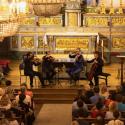
The candlelit Sam Wanamaker theatre was the right, intimate venue for this recital, but it was very hot, and the audience was packed very tightly. One audience member fainted and needed to be carried out - it was, ominously, not long after Savall had said that the piece listed in the programme as "Pavin - a Life" is in fact called Death - but he did recover.
Savall dealt with that incident serenely, completely aware of what was happening, but keeping concentration, and focus, and bringing us straight back to the music.This was a masterful recital by a unique figure in music.