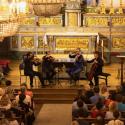
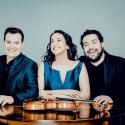
What a splendid little ensemble the Purcell Quartet is. The sort of group that you rather hope might reduce in size as the years go on, so that in the end you can put them in your pocket and carry them around with you all the time. If ever an ensemble could provide a soundtrack to the ups and downs of life then this is it.
Which is just as well really, because this little celebration of Purcell’s music covered the whole gamut of emotions, from heart-wrenching song to boisterous sonata to the frankly ludicrous When the Cock Begins to Crow, replete with busy bees, singing crickets and lazy sluts. It was a birthday treat of delicate delights, where the mood changed capriciously from one moment to the next.
The birthday boy, who may or may not have been born on 10 September 1659, was shown in his best light. If it feels like we’ve had too much Handel this year – and on the odd occasion it has – then Purcell could possibly still stand a few more concerts to himself. We heard three sonatas in the first half, each displaying infinite variety between and within each movement. Curlingly chromatic opening sonnatas gave way to gently insistent largos, which in turn were brushed aside by witty allegros, one of which came to a razor-sharp conclusion with a homage to the English cadence that Purcell must have written with his tongue in his cheek.
In between we got what Purcell does best: a selection box of songs and scenes from Emma Kirkby, Michael Chance, Charles Daniels and Peter Harvey. If Kirkby was perhaps a little off-song in the dramatic Blessed Virgin’s Expostulation – I would have preferred the Blessed Virgin to be a little more beefy than Kirkby’s was – she was sublime in "The Plaint" from The Fairy Queen, its violin obbligato played to perfection by Catherine Mackintosh. Harvey was the pick of the bunch: the lugubrious and strangely affecting Hosanna in the Highest was the highlight of the first half and he played the lover with a certain amount of understated panache in final number: "How Happy the Lover", from King Arthur.
Daniels was a suitably angsty Saul in In Guilty Night, a paraphrase of the Book of Samuel, while Chance was velvet personified in Incassum Lesbia, an elegy written on the death of Queen Mary, and O Solitude, a beautiful, rambling monologue set against one of Purcell’s inventive ground basses. Behind it all, Robert Woolley was a continual and reassuring presence on harpsichord and organ.
He may never have written the large-scale operas of Handel, the symphonies of Haydn, or the oratorios of Mendelssohn, but there was plenty of emotion to share round here this evening. The best piece was also the smallest; the magnificent three-part B flat Pavan played by the Purcell Quartet as though the composer was in the room. Which it almost felt like he might have been.
More early music from Ton Koopman and the Amsterdam Baroque Orchestra at the Wigmore Hall on September 21.