You only have to look down the list of recent winners of the Handel Singing Competition – Andrew Kennedy, Elizabeth Atherton, Ruby Hughes, Sophie Junker – to see its pedigree, its knack for spotting serious talent. Yet you also only have to look down the list to realise that Handel gives sopranos an unfair advantage in a competition which gives them so much more repertoire to choose from than certain other voice types. Pity especially the tenors and baritones whose operatic choices all too rarely extend beyond walk-on roles. All of which makes this year’s winner – Spanish baritone Josep-Ramon Olivé – both more surprising, and more impressive.
This year’s final, held at St George’s Hanover Square, was striking for the variety of programming approaches on display from the five competitors. Choices ranged from the absolutely artistic (soprano Sarah Hayashi, opting to perform a complete cantata La Lucrezia), to the showcase-collage (Olivé chose four contrasting arias, soprano Ingrida Gápová three), and the more standard two contrasting works (soprano Alice Privett, mezzo Maria Ostroukhova).
The baritone walked away not only with the jury's endorsement but also the Audience Prize
The cynic in me says that Olivé’s approach – pack as much in to your 20 minutes as possible, and ensure that each piece, however short, shows off a different facet of technique – is designed with winning rather than musical satisfaction in mind, but perhaps I’m alone in that, as the baritone walked away not only with the jury's endorsement but also the Audience Prize. “Nel mondo e nell’ abisso” from Tamerlano is always a crowd-pleaser, and it was nice to hear the recitative to go with it too. If Olivé still tends to grip his sound in his nose, dulling his enunciation, his projection rings clear, coming off best in the impressive agility of “Tu sei il cor” from Giulio Cesare. Olivé is definitely a true baritone, and despite his best efforts Handel’s bass-inclined writing still strained him at times. But it seems unfair to hold this quirk of the repertoire against him, and I look forward to hearing him outside a competitive context.
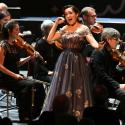
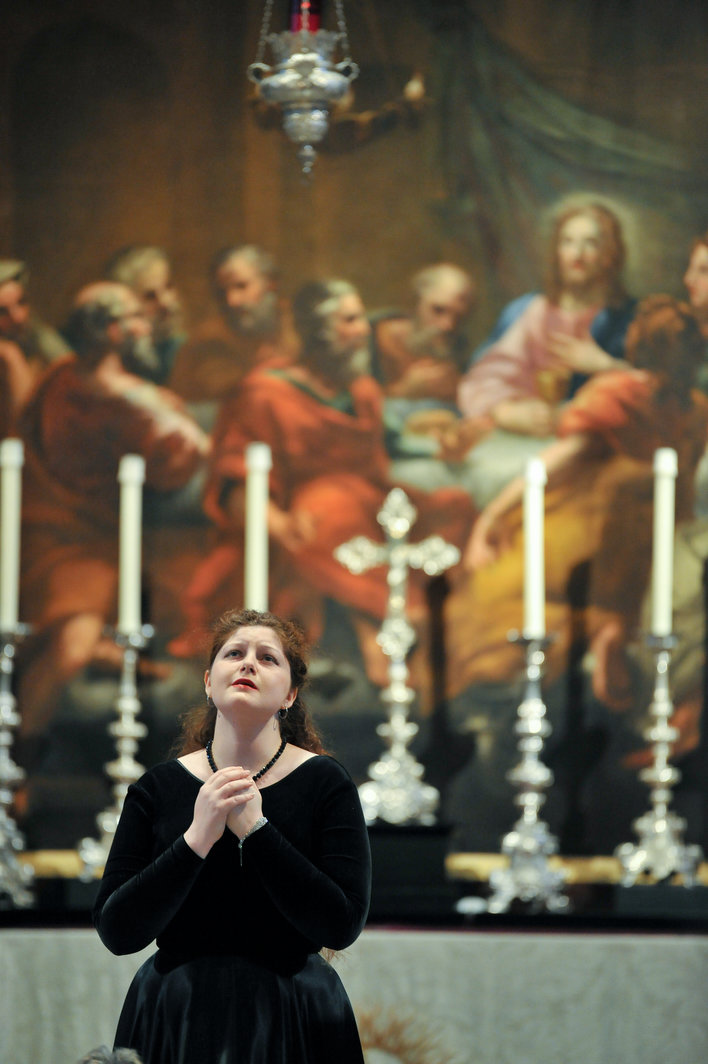 For sheer vocal quality it was Second Prize winner, Russian mezzo Maria Ostroukhova (pictured right), who shone. Hers is a damask-heavy voice – rich, low, but also impressively manoeuvrable when required, as she demonstrated in “Se in fiorito” from Giulio Cesare – duetting coyly with the obbligato violin in anything-you-can-do rival cadenzas. But this is an instrument made for tragic legato – a Cornelia in the making – and it was in Giove in Argo’s “Nel passer” that it really came into its own.
The most “finished” voice of the day belonged to British soprano Alice Privett – a surprise absence from the top awards. Perhaps this was down to a programme that failed to offer the variety of some of the others, showcasing the singer’s poised stagecraft and impressive coloratura, but leaving question marks as to the quality of the voice itself when exposed in simpler, more lyrical material. Privett’s is not the prettiest of sopranos, a muscular rather than radiant instrument, but her command of its colours and movement is striking, and she’s a natural performer.
The Handel Singing Competition is a wonderful annual opportunity to revisit some of the dustier corners of this prolific composer’s output, to hear star arias from operas you might not necessarily want to see in their entirety, and to marvel once again at the sheer breadth and variety of a composer with such an unerring instinct for musical emotion. The real winners here, as always, are Laurence Cummings and the London Handel Orchestra whose joy and energy is infectious and unstinting, and music-making so generous. The evening was dedicated to the memory of Handel Festival founder and unceasing champion of young musicians, Denys Darlow. I think that, had he been there, along with everyone else at St George’s, he would have had a pretty wonderful night.