It was, without doubt, a moment unlike any witnessed in Fabric’s history of just over quarter of a century. Hundreds of us crammed into the superclub seen worldwide as an icon of underground electronic music culture and listened in silence as Jack Bazalgette, co-founder of Through The Noise, read a description of the conditions in which Messiaen composed Quartet for the End of Time.
For many in this unconventional classical music crowd, it would have been the first time they had heard about how Messiaen – who was captured by the Germans in World War II after serving as a medic in the French army – wrote the piece in the Stalag VIII-A prisoner camp. Stripped naked when he arrived, he refused to let go of the small bag of scores he had brought with him, and was eventually allowed by his music-loving captors to carry on composing. The legendary premier of the quartet was performed to an audience of hundreds – or thousands according to more fanciful accounts – of prisoners and German officers, on a clarinet, violin, a cello with (allegedly) three strings, and a piano with keys that stuck at random. “Never had I been listened to with so much attention and understanding,” Messiaen declared.
For this 231st noisenight – which marks the end of Through the Noise’s triumphant fifth year – we had crowded into the club to listen to Ensemble Mi, previously hailed for their “vision and intensity” in their interpretation of the piece. Later in the evening, legendary pianist and producer Jon Hopkins, “avantpop” cellist Maddie Ashman and guitarist and producer Leo Abrahams (whose collaborators include Brian Eno) would perform their own improvised response to the work.
There was a sense of new cultural territory being broken as the audience, standing silently on the dance floor, listened to the opening notes of the "Liturgie de Cristal" movement, famously inspired by the pre-dawn birdwatching sessions Messiaen would go on with cellist Etienne Pasquier. Anthony Friend’s clarinet chirped and twittered as dissonant chords on the piano and an etiolated accompaniment on the strings evoked the eery half-light and distorted sense of reality as darkness retreats. Here Messiaen was already deploying his complex prime number-based mathematical systems to create a simultaneous sense of timelessness and unease. Pitch and rhythm were painstakingly separated to leave the audience jolted and discombobulated.
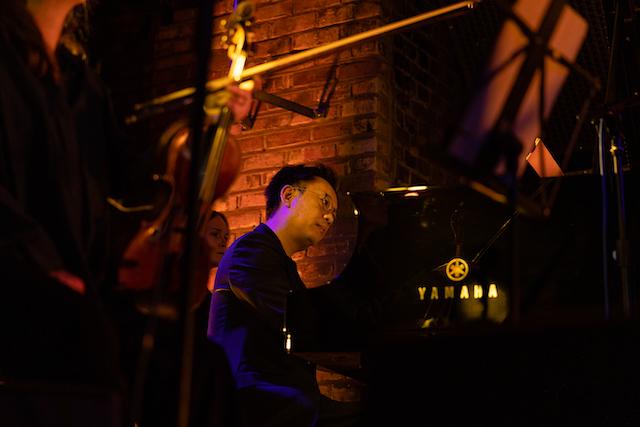
The mood became more apocalyptic as the impact of angrily smashed chords on the piano was heightened by the manic tearaway energy of Agata Daraškaitė on the violin and Peteris Solokovskis on the cello. This, for the profoundly religious Messiaen, was the moment in the quartet that evoked "The Angel Who Proclaims the End of Time" with “a rainbow upon his head and clothed with a cloud, who sets one foot on the sea and one on the earth”. After the furious, elemental introduction, the strings and piano embarked on a more haunting, elegiac sequence, creating a simultaneous sense of fear and hope with their taut, anguished lyricism.
Then came the famous clarinet solo for "L’Abîme des Oiseaux" ("The Abyss of Birds", in which Friend hypnotically explored the range of what his instrument could achieve in a piece that’s demandingly written at 44 eighth notes per minute. Technically it’s extremely difficult to pull off, not least in the long slow crescendos on one note that mark the piece throughout, and Friend managed to give these their full dramatic power without betraying the physical effort that it took. As he demonstrated the “chalumeau” range of the clarinet with its rich, darker notes, the whole auditorium was transfixed by the music’s pungent mournfulness. By contrast, when he ascended to the higher ranges, it was like a sudden explosion of light.
The "Intermède" for violin, cello and clarinet introduced a more jaunty mood, at points almost sounding like the music from black and white comedy movies. Then we had what for many is the highlight of this work, the "Louange à L’Éternité de Jesus". Strangely this was originally written for six ondes Martinot, but it’s difficult to imagine it having the same impact it does now as a piece for cello and piano. Sokolovskis eked out the full sense of the piece’s meditativeness and mystery, while James Cheung added depth and nuance in the hypnotic progression of chords on the piano.
The biting fortissimo of the Danse de la Fureur pour Les Sept Trompettes broke the mood as the quartet hurtled with dizzying technical accomplishment through the disruptive rhythms played in unison octaves. Then the "Fouillis D’Arc En Ciel Pour L’Ange qui Annonce La Fin Du Temps" ("The cluster of rainbows for the angel who proclaims the end of time") put the weeping eloquence of the cello centre stage once more as it strove to capture what Messiaen described as “these swords of fire, this blue-orange lava, these sudden stars.”
In the final movement, "Louange à L’Immortalité de Jésus", Daraškaitė played this last meditative sequence with a magnificent haunting resonance on her violin, while Cheung’s piano accompaniment was like rich golden light on rippling water. According to the unconventional structure of the work, the cello and clarinet sat in silence.
The explosive applause at the end was testimony to the fact that many of us felt we had witnessed a real cultural event. As is characteristic for these evenings, it was paired – to striking effect – with more contemporary music, on this occasion, live improvisations responding to the Messiaen from Hopkins, Abrahams and Ashman.
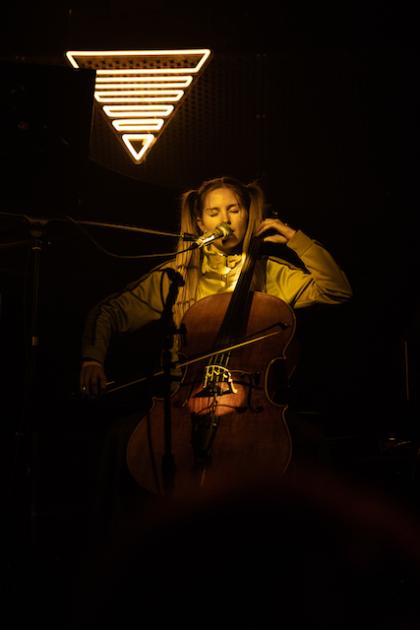
Ashman, particularly, impressed with her delicate quartertone riffs and vocal experiments that went from feather-soft singing to wailing like a child. From the piano, Hopkins created an absorbing canvas of sound with his stealthy chordal progressions while Abrahams added a sense of unworldliness with subtle reverberations.
It was a fitting end to an evening that marks another landmark for Bazalgette and his co-founder Jack Crozier, two of our most dynamic and exciting classical music organisers. If he had had the chance to witness the packed, hyper-attentive crowd – in such a radically different setting from the piece’s stark origins – I suspect Messiaen would have approved.