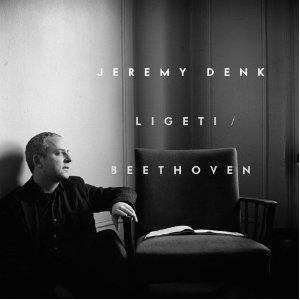
 Beethoven: Sonata no 32, Ligeti Études Books 1 and 2 Jeremy Denk (Nonesuch)
The word Études conjures negative associations for musicians. They’re studies. Which suggests endless practice. As New York-based Jeremy Denk says in his notes, they’re pieces which can crush a child’s enthusiasm for music. “You can imagine zoning out, lulled by the drudgery, modulating up and down until you fell off the keyboard.” Eccentric Hungarian modernist György Ligeti composed 18 Études for piano in three volumes, and they’re all great. Your ears are twisted, challenged but always entertained. And the poor pianist’s technique is stretched in superhuman ways. Denk finds the right sense of “joyful, delirious madness” in these pieces as well as illuminating their musical qualities. These Études are demanding in the extreme, their occasional violence abruptly melting into black humour, cool jazz and calm lyricism.
Cordes à vide begins as a spare study in open fifths, gently thickening in texture. Arc-en-ciel ‘s Bill Evans tribute is elegant and understated: Ligeti always trusts the listener and never makes his points crudely. These two Études are among the gentlest, but it’s the nuttier, crazier pieces which have gripped me most: Der Zauberlehrling, the thunderous left hand of Entrelacs and the haunting, shimmering Automne à Varsovie with its brutal close. Denk gives us Beethoven’s final piano sonata as a coupling, its compressed two movement structure still radical and surprising. His performance is imposing in the extreme, emphasising the craggy, unwieldy elements. The sleeve notes are erudite and witty. A stunning recital.
Watch Jeremy Denk discuss Ligeti:
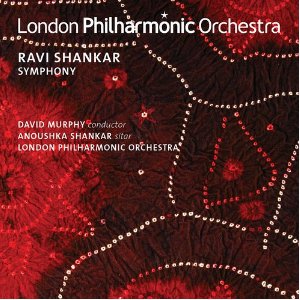 Ravi Shankar: Symphony Anoushka Shankar (sitar), London Philharmonic Orchestra/David Murphy (LPO)
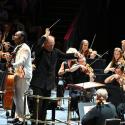
Sitar player and composer Ravi Shankar was born as far back as 1920. The list of people who he’s encountered and collaborated with during his career is daunting. Casals, Toscanini and Menuhin are among the names that feature. Shankar became a global star in the 1960s when he met the Beatles and became a profound influence on George Harrison’s subsequent career. He’s probably the one Indian musician to achieve global stardom. And Philip Glass cites Shankar as the greatest influence on minimalism, opening his eyes to “music in which the rhythmic structure became the controlling function”, rather than conventional Western harmony. For Glass, Shankar “almost single-handedly altered the course of contemporary music in its broadest sense.” Heady, well-deserved praise.
Sadly, this four-movement symphony with sitar obbligato doesn’t live up to expectations. As an extended suite of colourful orchestral pieces it’s everything you’d hope – well-scored, ripely harmonised in places. It’s hard, though, not to see the marriage of two totally different styles as a doomed one – I can’t convince myself that Western classical instruments and players can inhabit an Indian classical style. What we get are some intriguing, though unsubtle, attempts to mimic different ragas and rhythmic patterns. The LPO players gamely keep up, even chanting and clapping near the last movement’s brilliant close. But the only glimpses of authenticity come during the extended passages for sitar, wonderfully played here by Shankar’s daughter Anoushka. These are well-integrated into the symphony’s structure, but they don’t happen often enough. David Murphy, who helped Shankar with the work’s scoring and notation, conducts with energy. The recorded sound is clear and detailed. But the end result can’t help falling between too many stools.
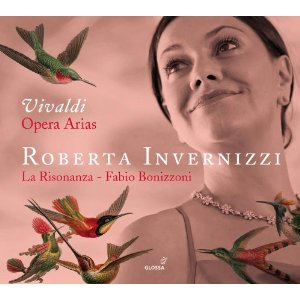 Vivaldi: Opera Arias Roberta Invernizzi (soprano), La Risonanza/Fabio Bonizzoni (Glossa)
Those thinking that Vivaldi’s music is all a bit, er, samey will have their preconceptions dashed by this recital disc. The surprises aren’t harmonic ones; what dazzles is the infectious bounce and the lightning changes of mood. Plus, the singing is spectacular. Roberta Invernizza’s voice can be so many things – subtle, soft, veiled when she chooses, and powerful enough to make the hairs on the back of your neck stand up when she’s at full-throttle. There’s never any hint of iciness, of bravura for its own sake. Nothing grates. The slight, unobtrusive vibrato is enough to give Invernizzi’s voice a touch of fallible humanity. Plus, you can tell that she’s approaching each of the 14 arias individually – as an Italian, the texts mean something to her.
There’s plenty of panache and humour in the delivery– Invernizza goes over the top several times, but you smile as she does so. As with the aria from Ottone which closes the disc, with its somersaulting vocal line delivered with an agility which defies belief. The flamboyant arias are all showstoppers; one from Dorilla in Tempe is typically enjoyable, Invernizzi’s lightning delivery matched by Fabio Bonizzoni’s sizzling accompaniments, with baroque guitar adding plenty of rhythmic kick. Marvel at the natural trumpet solo which opens Combatta un gentil cor, and at the crisp string semiquavers which propel several of the faster arias. Totally compelling. The packaging and documentation are stylish too.