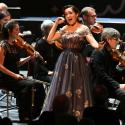
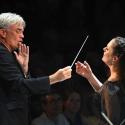
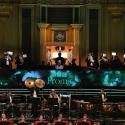
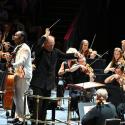
The Barbican Hall’s house lights faded to black, with just the soft glow of music stand lamps on stage as the Britten Sinfonia filed on and eased into the Adagietto from Mahler’s Fifth Symphony. Directed from leader’s desk by Jacqueline Shave, the orchestra gave an exquisite account of the piece, the chamber aesthetic and necessary communication between players somehow helping to draw the audience in. It was certainly a rewarding alternative to the lusher – and slushier – version one would hear from a full symphony orchestra’s worth of strings.
It was a nice theatrical touch to begin the concert in the half-light and bit of a shame, then, that the spell of the Mahler was broken by lights-up and much pottering about on stage in setting up for the next item. It really ought to have been possible to preserve the mood with a more orderly transition into Henze's L'heure bleue – an impressionistic and lyrical evocation of Mediterranean dusk which could well have benefitted from growing straight out of the dying strains of the Adagietto.
Bostridge's voice is a subtle instrument and ideally suited to the ethereal dreamworld of Britten's Nocturne
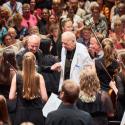
Next were three Schubert Lieder arranged for the Britten Sinfonia by Detlev Glanert, best known as an operatic composer. Ian Bostridge is, of course, a seasoned and much admired performer of the song repertoire, yet here he did not seem entirely comfortable. Partly I suspect this was a question of balance, as he would occasionally find his lower notes disappearing into the orchestral texture. He was also consulting the score more often than was ideal which somewhat cramped his attempts to inject some characterisation into his performance.
These are minor niggles, though, judged against the extremely high standards he sets. Waldesnacht ("night in the forest") was particularly effective, the "rushing of the wind, God's own wings" brought vividly alive by Glanert’s orchestration and the orchestra’s nimble playing.
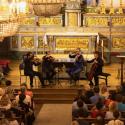
The second half opened with a Schubert’s Notturno for piano trio, played by the orchestra's section leaders Jacqueline Shave (violin) and Caroline Dearnley (cello) with Huw Watkins on the piano. But the standout performance of the concert came next, with Bostridge back on for Britten’s song cycle Nocturne. Scored for seven soloists plus strings, the work gave ample exposure to the individual talents of the Britten Sinfonia's musicians, the clarinet and flute combination in 'Sleep and Poetry' being particularly memorable.
What had been missing for Bostridge in the Schubert was immediately in evidence here. The sparse orchestration supported rather than swamped him (making Glanert's efforts seem, in retrospect, a bit over-dense); and he was entirely at ease and confident with the piece, taking enormous pleasure in the richness of the language – from Shelley to Shakespeare – which underpins the work. His is a subtle instrument and ideally suited to the ethereal dreamworld of this work. The result was perfection.