The Father, the Son and the Holy Ghost materialised yesterday. And I'm not talking about the transcendental appearance of the Holy Trinity of News International. I'm talking Proms. Last night's two saw a geriatric performance of the Brahms double, a brand spanking new way through an old Rite and a transfiguringly spectral invocation of Schubert's Quintet.
In the earlier prom, Myung-Whun Chung's Orchestre Philharmonique de Radio France demonstrated what a capricious beast the French orchestra can be: one moment on top of their game, luminous, surprising, virtuosic; the next, heels dug in, grumpily (Gallically?) being dragged along by the conductor's baton. Last night we got the teenager and the adult.
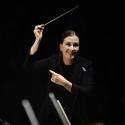
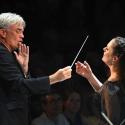
Having said that, Chung's tempi deserve some of the blame for the torpor of the Brahms Concerto for Violin and Cello. Both the Capuçon brothers set off at a faster pace than Chung wanted. Almost literally conducting them into the ground, he slowed them down to a speed that meant for much of the first movement it felt like we might actually be moving backwards.
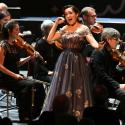
Certainly in no one's hands were we heading purposefully forward. The contact between bow and string that younger cellist Gautier Capuçon was achieving wasn't clean enough to imply direction. Only violinist Renaud - knees bending, shiny feet incrementally leaping forward with each effortful harmonic discovery - achieved a degree of fluency of movement and expression.
There were hints of what was to come. Solo contributions in both the Brahms and Weber's Oberon overture reminded us of the musicianship in this ensemble. They got their chance in the Stravinsky. Chung's Rite wasn't the most visceral or intense this hall has ever seen. But it was one of the most brilliantly transparent. Every member of every one of the comprehensively extended sectional families of the orchestra (Stravinsky invites every mad uncle and maiden aunt to this jamboree) was given a chance to be heard in this rendition.
This time Chung's slow tempi petri-dished the piece. Every part of the orchestra was now exposed. And they stepped up a gear under scrutiny. The woodwind sounded like they'd ingested a vat of tea, buzzing about gloriously as if on a caffeine high. The brass like they ingested a vat of gin, collectively leering at us like a stinky young Muscovite drunk with a nasty mission. Scary but fun.
Colour wasn't the only aspect benefiting from Chung's floodlights. Structural development became clearer. A proper climax on the first part's hyperactive polyrhythmic dances (which sounded more extraordinarily multivalent than ever) was delivered. And the gluey, featureless beginning of the second part, which audiences and orchestras alike mostly use as a way of getting a breather before the controlled mayhem returns, was integrated into the drama in a way I've rarely heard before.
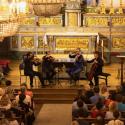
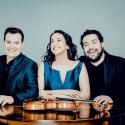
For an exposition of an interior world, however, we had to wait for the Belcea Quartet and Valentin Erben of the Alban Berg Quartet in a very special late-nighter. It is one of the great ironies of the Royal Albert Hall that the smaller the forces, the better the sound - and the better the audience. So it was in last night's performance of the great Schubert String Quintet in C, D956. Hush was demanded; there was a lot of beauty to attend to.
There was Corina Belcea-Fisher's soulful first violin, impeccable in technique and delivery, and Axel Schacher's sweetly phrased second. There was Krzysztof Chorzelski's coal-burning viola, an indefatigable and dramatic catalyst for the changes of mood that sweep through this piece. The cellos (Erben and Antoine Lederlin), supposedly the bedrock, give way to tremors and, in the development of the Adagio, a psychological earthquake that last night rattled every fibre of the body.
However, when this dreamy piece finds a horse (in the fiery Scherzo: Presto) or a lady to dance with (in the Allegretto), the quintet were enthusiastically up to the hale and hearty challenge. But with Erben perhaps able to be freer with his emotions away from his own musical family, it was the alien landscape of the cello-stalked trio that haunted the mind. What on earth was this thing? Only Rebekah Brooks's halo of amber rivulets has had the capacity to induce unease and wonder in me like this. In Erben's hands it felt like we'd seen a ghost. Only Prom 7 and hairs already on end.